You may use all of your notes/practice problems on this test. You should have access to rewatch the edpuzzle videos. Please know that I will not work the test problems with you, but I will work the Study Guide problems with you. Please show as much work as you can. Write me a sentence how you got your answers. ****DUE: Sunday, October 15, 2023 @ 11:59pm***
After taking the Unit 2 Test for Geometry, please give me some feedback on how you are learning Geometry virtually. What works best for you virtually? What would you like to see more of virtually? Please explain thoroughly to help me understand what changes can be made.

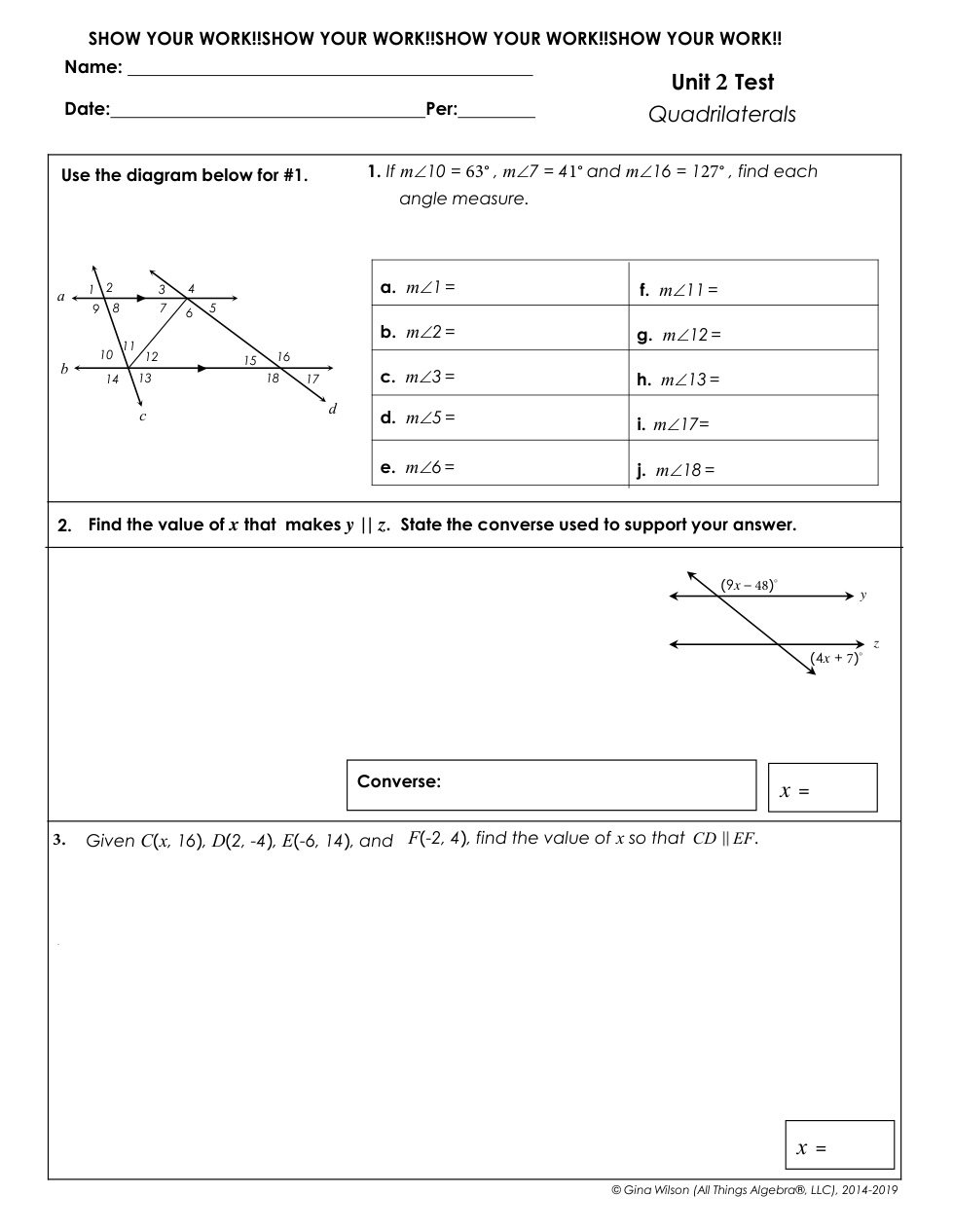
1. If m∠10 = 63° , m∠7 = 41° and m∠16 = 127° , find each angle measure.
a.
b.
c.
d.
e.
f.
g.
h.
i.
j.
2. Find the value of x that makes y || z. State the converse used to support your answer. Show all your work for full credit.
converse:
x=

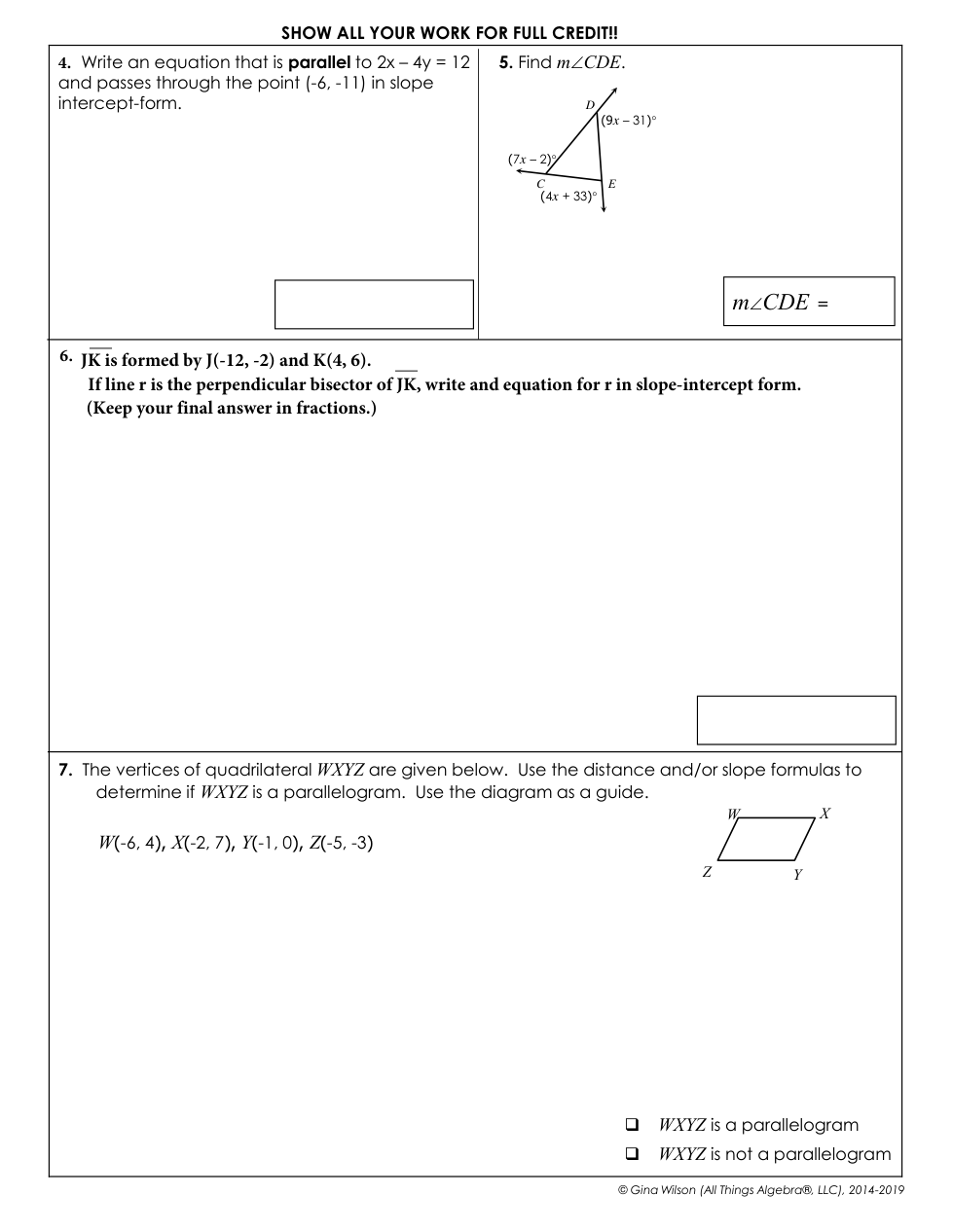
7. ***SHOW YOUR WORK HERE***The vertices of quadrilateral WXYZ are given below. Use the distance and/or slope formulas to determine if WXYZ is a parallelogram. Use the diagram as a guide. W(-6, 4), X(-2, 7), Y(-1, 0), Z(-5, -3)
Be sure to check the box if it's a parallelogram or not a parallelogram.

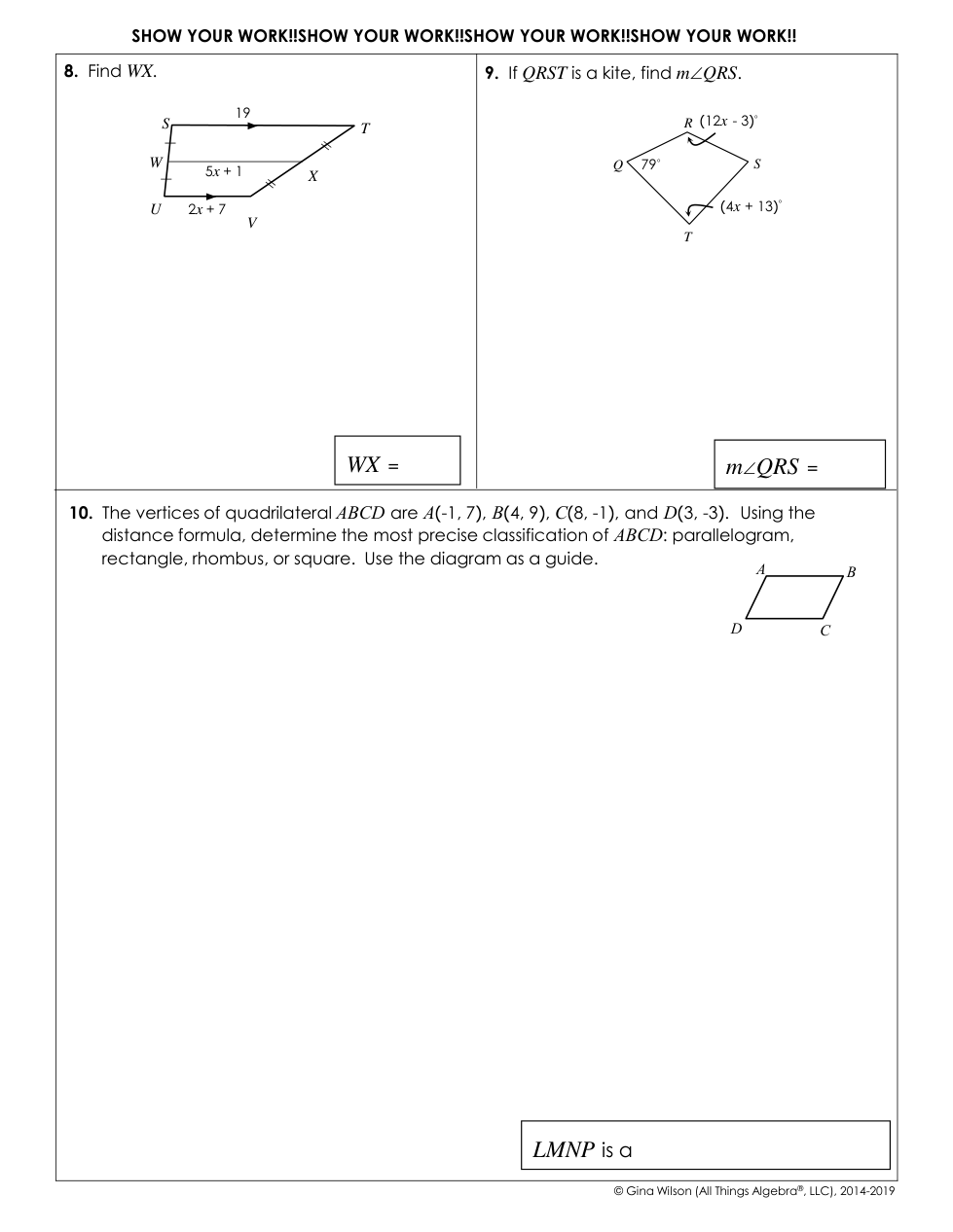
10. ***SHOW YOUR WORK HERE*** The vertices of quadrilateral ABCD are A(-1, 7), B(4, 9), C(8, -1), and D(3, -3). Using the distance formula, determine the most precise classification of ABCD: parallelogram, rectangle, rhombus, or square. Use the diagram as a guide.
3. Given C(x, 16), D(2, -4), E(-6, 14), and F(-2, 4), find the value of x so that CD EF. Show all your work for full credit.
Slope of EF:
x=
4. Write an equation that is parallel to 2x – 4y = 12 and passes through the point (-6, -11) in slope intercept-form. Show all your work for full credit.
5. Find m∠CDE.
6. JK is formed by J(-12, -2) and K(4, 6). If line r is the perpendicular bisector of JK, write and equation for r in slope-intercept form.(Keep your final answer in fractions.) Show all your work for full credit.
8. Find WX.
9. If QRST is a kite, find m∠QRS.