Wk 13: EOL 3.2 Rotations, Dilations, and Sequence of Transformations
star
star
star
star
star
Last updated 4 months ago
6 Nsɛmmisa
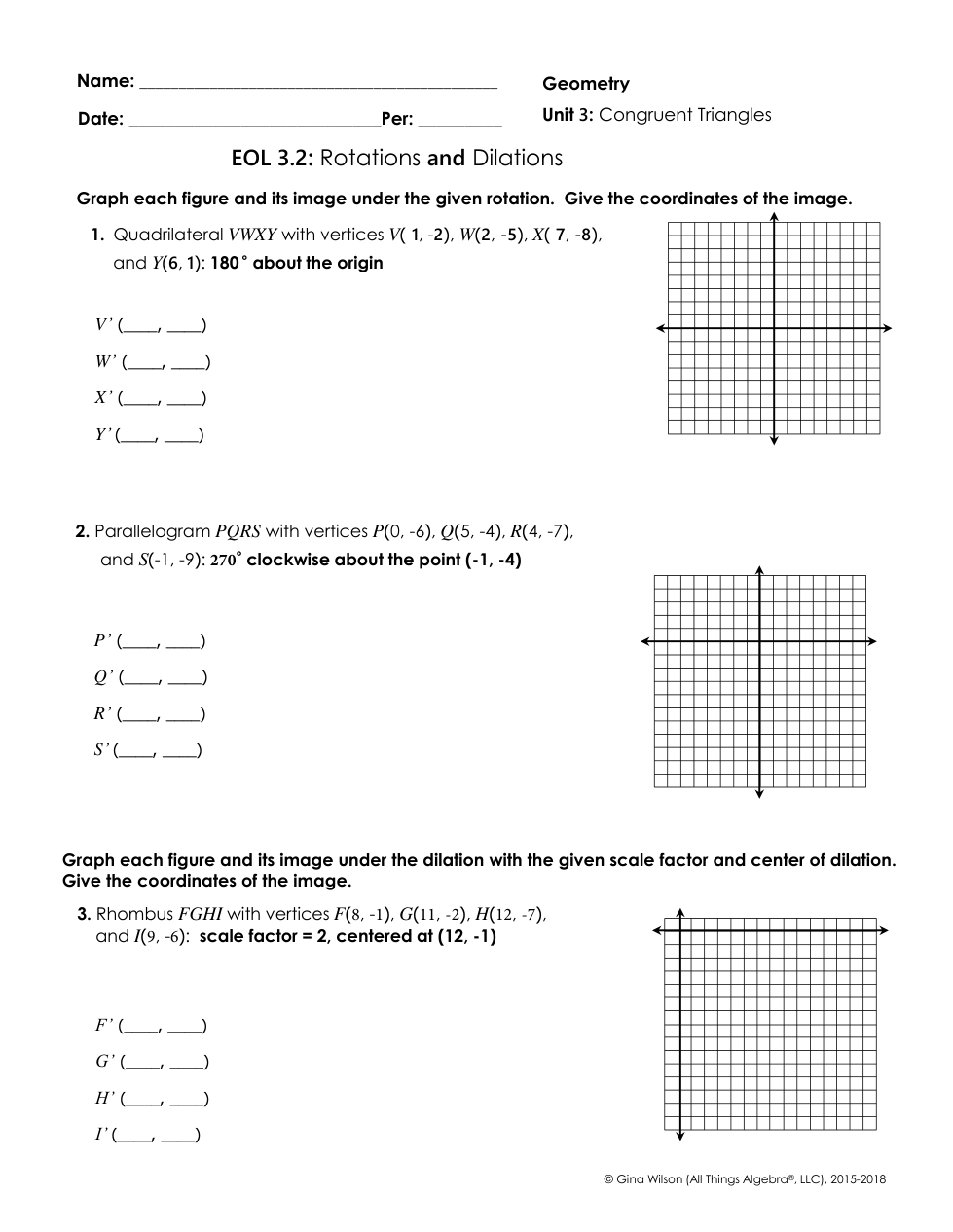
1. Graph the pre-image AND image. Then choose the coordinates of the image.
Quadrilateral VWXY with vertices V( 1, -2), W(2, -5), X( 7, -8), and Y(6, 1): 180 ° about the origin.
2. Graph the pre-image AND image. Then choose the coordinates of the image.
Parallelogram PQRS with vertices P(0, -6), Q(5, -4), R(4, -7), and S(-1, -9): 270° clockwise about the point (-1, -4).
Graph the pre-image AND image. Then choose the coordinates of the image.
Rhombus FGHI with vertices F(8, -1), G(11, -2), H(12, -7), and I(9, -6): scale factor = 2, centered at (12, -1).
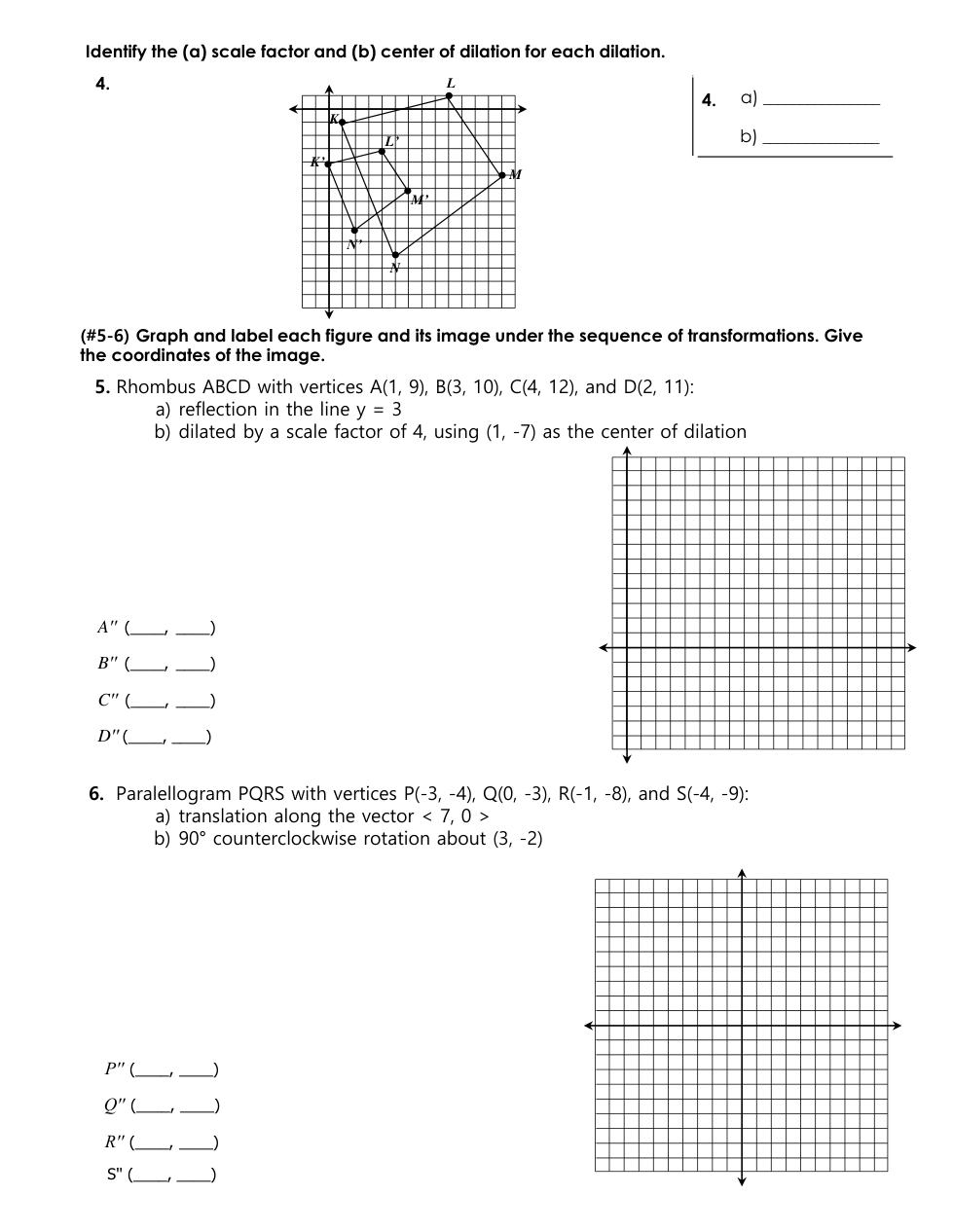
4. GRAPH: Then, Identify the (a) scale factor and (b) center of dilation for each dilation.
5. BE SURE TO GRAPH ALL THREE IMAGES! Then choose the coordinates of the final image.
Rhombus ABCD with vertices A(1, 9), B(3, 10), C(4, 12), and D(2, 11):
a) reflection in the line y = 3
b) dilated by a scale factor of 4, using (1, -7) as the center of dilation
6. BE SURE TO GRAPH ALL THREE IMAGES! Then choose the coordinates of the final image.
Paralellogram PQRS with vertices P(-3, -4), Q(0, -3), R(-1, -8), and S(-4, -9):
a) translation along the vector < 7, 0 >
b) 90° counterclockwise rotation about (3, -2)