Ɛhia
1
Sample A
# of incidents:
Ɛhia
1
Sample B
# of incidents:
Ɛhia
1
Ɛhia
1
Scenario:
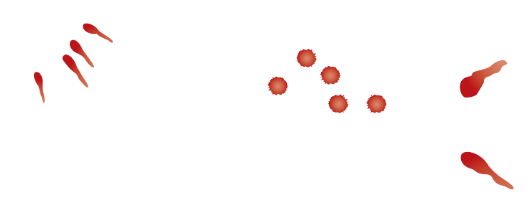
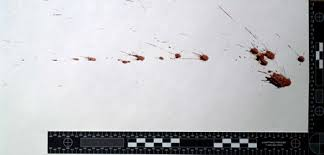
When the police arrived at a crime scene, both the victim and the attackers had already fled. Two areas of blood spatter were the only evidence that an assault had occurred. The CSI determined the direction in which the blood was traveling, the area of convergence, and the approximate location where the victim was standing when the injury occurred.
The shape of an individual drop of blood provides evidence as to the origin of the blood. A passive drop of blood with a spherical shape (equal width and length) indicates that the blood fell straight down with an impact angle of 90 degrees. When a drop of blood is elongated (longer than it is wide), it is possible to determine the direction the blood was traveling and the angle of impact when it struck a surface.
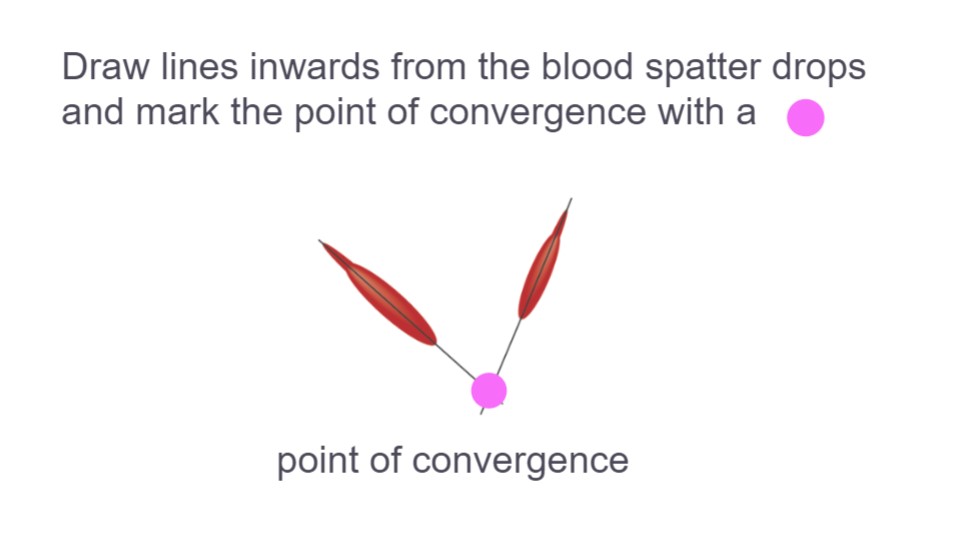
The location of the source of blood can be determined if there are at least several well-defined bloodstains. Draw lines of convergence through the center of the long axes of each bloodstain and circle the area where the lines intersect. This circle, known as the area of convergence, shows a two-dimensional view of where the victim was injured.
In this activity, you will analyze blood spatter and locate the area of convergence.
1. Refer to blood-spatter Sample A. Based on the shape of the bloodstains, determine the forward direction of each bloodstain.
2. Draw lines of convergence for each group of bloodstains. Do not include any spines.
Draw a line through the center axis of each stains starting from the tapered end.
Your line should move toward the origin of the blood (widest part of the bloodstain).
Continue the lines toward the origin until the lines intersect.
Draw the smallest circle you can around all of the intersecting lines to determine the area of convergence.
3. Determine how many incidents occurred based on the number of areas of convergence.
4. Repeat Steps 1–3 for Samples B, C, and D.
Sample A
# of incidents:
Sample B
# of incidents:
Indicate which of these blood-spatter patterns (Sample A, B, C, or D) represents bleeding from the following:
| Draggable item | arrow_right_alt | Corresponding Item |
|---|---|---|
| arrow_right_alt | A bullet wound that caused bleeding as the bullet entered the body and exited the body of an individual. | |
| arrow_right_alt | Two separate instances of bleeding, possibly from two different individuals. | |
| arrow_right_alt | A single wound from one individual. | |
| arrow_right_alt | A change in position of a victim after a wound has been inflicted. |
Describe possible scenarios consistent with the blood-spatter patterns for this sample. Include:
the number of incidents
the direction of movement
Describe possible scenarios consistent with the blood-spatter patterns for this sample. Include:
the number of incidents
the direction of movement
Sample C
# of incidents:
Note: Circular droplets are formed as blood drops at a 90-degree angle from a wound. It is not necessary to draw lines of convergence because with a round shape, the blood is known to have fallen from 90 degrees.
Sample D
# of incidents:
Note: Circular droplets are formed as blood drops at a 90-degree angle from a wound. It is not necessary to draw lines of convergence because with a round shape, the blood is known to have fallen from 90 degrees.