Ɛhia
1
BM2.3
Ɛhia
1
BM2.3
Ɛhia
1
BM2.3
Read the Scenario and Identify/List at least one (1) example for each factor of production:
The baker arrives early in the morning at the bakery shop in the center of town. He begins to prep by getting out the wheat/flout and eggs to make dough. Once the dough is mixed he has his assistant pour the mix into the doughnut pan and place it in the oven. Shortly after the doughnuts are finished Betty, the bakery owner, arrives to taste test items before the store opens for the day.
What is the opportunity cost of a decision?
Choose an example of something scarce and explain how we know that it is scarce.
Scenario: You own a successful clothing company and want to open a new store in either New York City or Los Angeles. If you choose New York City, what is the opportunity cost?
A city is facing a shortage of affordable housing. How does this situation illustrate the concept of scarcity, and what trade-offs must decision-makers consider?
Why are resources considered limited?
A technology company is designing a new smartphone. Which analysis best explains how the factors of production contribute to its success?
How are trade-offs and opportunity costs different?
A clothing brand is deciding whether to produce eco-friendly apparel. Which analysis best demonstrates how the three economic questions guide their decision?
A business owner is deciding whether to expand operations in a market economy. Which analysis best explains how ownership and regulation affect their decision-making?
In a command economy, a new factory is being built. Who determines what goods will be produced, how they will be produced, and who will consume them, and why does this matter for efficiency?
A country adopts socialism, where government owns the basic means of production but allows private businesses. How does this system balance equity and efficiency?
If the marginal cost of producing one more unit is $5 and the marginal benefit is $8, what should the firm do?
A diner has already eaten three slices. They consider buying a fourth slice for $4.
Marginal Benefit: Slight satisfaction, but they’re already full.
Marginal Cost: $4 payment and possible discomfort from overeating.
What principle applies here?
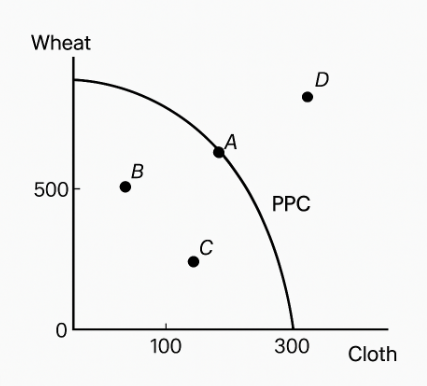
If production occurs at a point inside the PPC curve, what does this represent?
If the PPC shifts outward, what does this indicate?
If Point D lies outside the PPC curve, what does this mean?