Log in
Sign up for FREE
arrow_back
Library

BIM 7 Adv. Chapter 2 - Benchmark 7 (2023-2024)

star
star
star
star
star
Last updated 2 months ago
10 questions
4
8.G.A.4
1
8.G.A.4
3
8.G.A.3
2
8.G.A.4
1
8.G.A.4
1
8.G.A.3
1
Question 1
1.

Question 2
2.

Question 3
3.

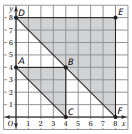
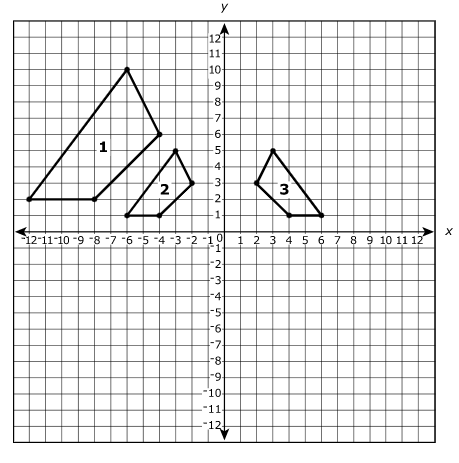
Three figures are shown on the coordinate plane.


Figure 1 can be transformed into Figure 2 with a sequence of two transformations. Describe a possible sequence of two transformations that transforms Figure 1 into Figure 2.

Question 4
4.
Other Answer Choices:
3
4
2
Question 5
5.
The figures are similar, and the ratio of the perimeters is 2 : 5. Find x.


x = _______
Question 6
6.
A scale drawing of an office space uses a scale of 1 in. : 4 yd. The scale drawing has an area of 12 square inches. What is the area of the actual office space?

_______ yd2
Question 7
7.

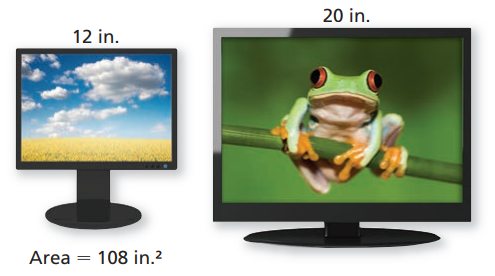
The TV screen is similar to the computer screen. What is the area of the TV screen?
On the coordinate plane shown, Figure 1 is transformed into Figure 2, which is transformed into Figure 3.

Figure 1 and Figure 3 are similar by a sequence of transformations.


1
8.G.A.4
1
8.G.A.4
1
8.G.A.4
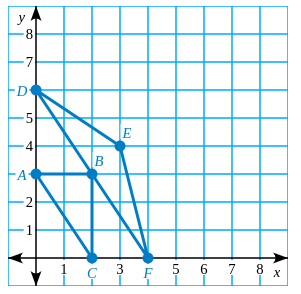
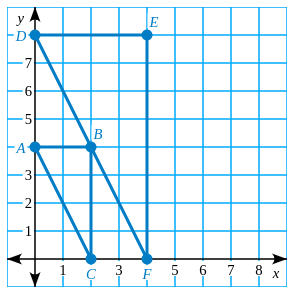
Are â–³ABC and â–³DEF similar?
YES
NO
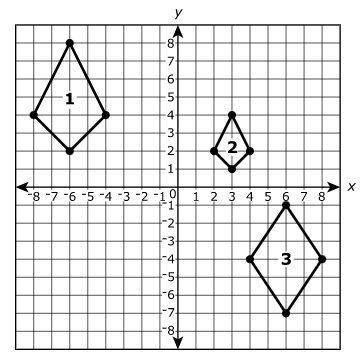
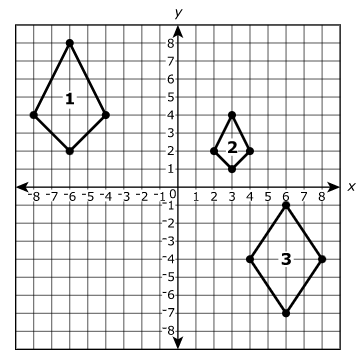
Three figures are shown on the coordinate plane.


Which statement best describes the relationship between Figure 1 and Figure 3?
A) They are similar, because Figure 3 can be obtained from Figure 1 by a reflection across the line y = x.
B) They are similar, because Figure 3 can be obtained from Figure 1 by a 180° rotation about the origin.
C) They are not similar, because the area of Figure 1 is the same as the area of Figure 3.
D) They are not similar, because there is no sequence of rotations, reflections, translations, and/or dilations that maps Figure 1 to Figure 3.
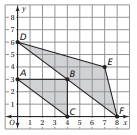
The red figure is similar to the blue figure. Complete the description of a similarity transformation between the figures.


One possible similarity transformation is to dilate the red figure with respect to the origin using a scale factor of ______ and then reflect the image in the ________ -axis.
Question 8
8.

Question 9
9.

Question 10
10.

What type of transformation was used to transform Figure 1 into Figure 2?
A) Dilation
B) Reflection
C) Rotation
D) Translation
Which statement describes the transformation of Figure 2 into Figure 3?
A) Reflection across the x-axis.
B) Reflection across the y-axis.
C) Translation 4 units to the right.
D) Translation 6 units to the right.
Which figures are similar?
A) Figure 1 is similar only to Figure 2.
B) Figure 1 is similar only to Figure 3.
C) All three figures are similar.
D) None of the figures are similar.