Log in
Sign up for FREE
arrow_back
Library

Formation of Sedimentary Rocks and Fossil Fuels Test Corrections

star
star
star
star
star
Last updated almost 2 years ago
10 questions
1
5.7.A
1
5.7.A
1
5.7.A
3
5.7.A
1
5.7.A
1
5.7.A
1
5.7.A
1
5.7.A
1
5.7.A
1
5.7.A
Question 1
1.

Question 2
2.

Question 3
3.

Question 4
4.

Provide three examples of fossil fuels. Then explain why they are given this name.

Question 5
5.

Question 6
6.

Question 7
7.

Question 8
8.

Question 9
9.

Question 10
10.

Some students make a model to show one of the first steps in the formation of sedimentary rock. The students pour 2 centimeters of light-colored sand into a clear plastic box. Then they add 1 centimeter of gravel. Finally they pour 2 centimeters of dark-colored sand on top of the gravel. Which characteristic of sedimentary rock does this model best show?
Sedimentary rock is made of layers.
Sedimentary rock is cemented bits of rock.
Sedimentary rock is often limestone.
Sedimentary rock is common in Texas.
The model below shows layers of sediment on the floor of an ocean.
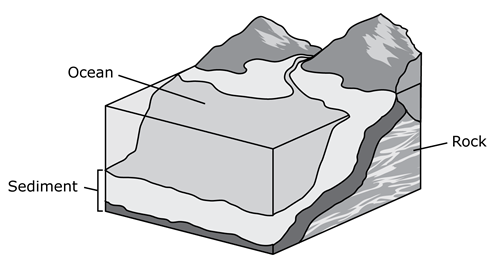

Which of the following best explains how these layers can become rock over many years?

Sand in the sediment melts and turns into rock.
The weight of the water compacts the sediment into rock.
Changing water temperatures turn sand in the sediment into rock.
Pollution caused by humans turns the sediment into rock.
The diagram below shows the processes of sedimentary rock formation.


Which processes best fit in the box marked with an X?
Weathering and compaction
Erosion and cementation
Weathering, erosion, and deposition
Melting, cooling, and deposition
Certain prehistoric events led to the formation of oil.  Which of the following was one of those events?
Giant wind storms destroyed forests.
Icebergs melted at the North and South Poles.
Microscopic life in the sea died and was buried under sediment.
Heavy flooding soaked the Earth's crust.
Over long periods of time, fossil fuels form deep underground.  Which components are related to the formation of fossil fuels?
Lava, sand, and decayed animals
Decayed plants, lava, and minerals
Decayed plants and animals and water from oceans
Decayed plants and animals and sedimentary rock
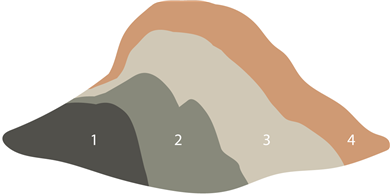
The figure below shows the rock layers in a hill. Which rock layer will have the oldest fossils?

1
2
3
4
Decayed prehistoric plants have helped in the formation of
coal, oil, and gas.
coal, shale, and quartz.
shale, quartz, and coal.
oil, shale, and granite.
The oil used today is made from the ancient remains of tiny sea creatures called diatoms. When they were alive, the diatoms converted sunlight into stored energy. Based on this information, which of the following statements is true?
The Sun turned diatoms into oil after 10-20 years.
Diatoms are the original source of energy for oil.
The Sun is the original source of energy for oil.
Diatoms converted oil into energy.
Which diagram models the process of compaction leading to the formation of sedimentary rock?