Log in
Sign up for FREE
arrow_back
Library

LT 3.3 Cellular Respiration & LT 3.4 Interconnectedness Quiz

star
star
star
star
star
Last updated almost 2 years ago
10 questions
Required
1
3.2a
Required
1
3.2a
Required
1
3.2a
Required
1
3.2a
Required
1
3.2a
Required
1
3.3a
Required
1
3.3a
Required
1
3.3a
Required
1
3.3a
Required
1
3.3a
Question 1
1.

Question 2
2.

Question 3
3.

Question 4
4.

Question 5
5.

Question 6
6.

Question 7
7.

Question 8
8.

Question 9
9.

Question 10
10.
A diagram representing the relationship between photosynthesis and cellular respiration is shown to the right. The numbered boxes in the diagram represent which of the following?
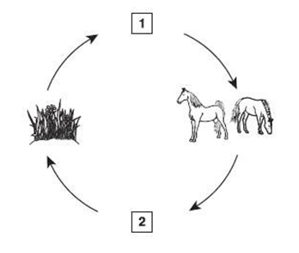
Other Answer Choices:
Carbon Dioxide
Oxygen
Which of the following substances are required for the process of cellular respiration?
Oxygen and energy
Glucose and oxygen
Carbon dioxide and glucose
Energy and water
Muscle tissues contain a large amount of mitochondria suggesting that
muscles require more oxygen to carry out its daily activities
muscles require more water to carry out its daily activities
muscles require more adenosine triphosphate to carry out its daily activities
muscles require more glucose to carry out its daily activities
When exercising at a high level for an extended period of time athletes typically experience sore cramps in their muscles.  This occurrence is explained by:
aerobic respiration effectively breaking down glucose due to inhaling a too little oxygen
aerobic respiration ineffectively breaking down glucose due to inhaling too much oxygen
anaerobic respiration ineffectively breaking down glucose due to inhaling too little oxygen
anaerobic respiration ineffectively breaking down glucose due to inhaling too much oxygen
Which statement does NOT describe a key difference between aerobic and anaerobic respiration?
Anaerobic respiration produces lactic acid as a product while aerobic respiration does not.
Aerobic respiration results in a higher yield of ATP than anaerobic respiration.
Anaerobic respiration relies on glycolysis; anaerobic respiration does not.
Aerobic respiration takes place in the presence of oxygen; anaerobic respiration does not.
Two different species of bacteria are examined. Scientists find that species X always produces CO2 and H2O during cellular respiration. Species Y always produces ethyl alcohol and CO2. Which conclusion can be made from these observations?
Species Y is anaerobic, species X is aerobic
Both species X and Y are anaerobic
Species Y is aerobic, species X is anaerobic
Both species X and Y are aerobic
Which of the following is one way that cellular respiration and photosynthesis are opposite processes?
Photosynthesis releases energy, and cellular respiration stores energy.
Photosynthesis removes carbon dioxide from the atmosphere, and cellular respiration puts it back.
Photosynthesis consumes glucose, and cellular respiration produces glucose.
Photosynthesis removes oxygen from the atmosphere, and cellular respiration puts it back.
Based on the cycle of photosynthesis and cellular respiration, one can say that the ultimate original source of energy for all living things on Earth is
Glucose
Water
Carbon dioxide
The sun
Which is not true concerning the affect of photosynthesis and respiration on the flow of energy in the ecosystem?
Photosynthesis converts light energy into chemical energy in the form of glucose.
Without photosynthesis, there would be no chemical energy to convert to ATP.
Respiration uses chemical energy produced by plants and converts it into energy in the form of ATP.
Without respiration, there would be no light energy to convert to ATP.
The carbon (in the carbon dioxide) that we breathe out has come originally from our:
Lungs
Food
Cells
Diaphragm