Interpret the parameters of an exponential function in context
Common Core Math Standards
Link to all CCSS Math
CCSS.HSF.SSE.A.1
CCSS.HSF.LE.A.2
CCSS.HSF.IF.B.5
Personal Finance Objectives
Understand the role that Social Security, pension plans, 401(k)s, and IRAs can play in funding retirement
Differentiate between 401(k)s and IRAs and the traditional and Roth versions of each
Know the importance of consistently investing every month, starting from a young age, to accumulate enough wealth to fund an adequate retirement
National Standards for Personal Financial Education
Earning Income
1d: Examine the benefits of participating in employer sponsored retirement savings plans and healthcare savings plans
10a: Identify different potential sources of retirement income
10b: Describe the importance of having multiple sources of income in retirement, such as Social Security, employer sponsored retirement plans, and personal investments
10c: Explain the importance of participating in employer sponsored retirement plans, when available, and contributing enough to qualify for the maximum employer match
Saving
6b: Compare the tax advantages of traditional and Roth IRAs
Investing
8b: Describe the advantages of investing through a tax deferred account such as an IRA or 401(k) versus a taxable account
DISTRIBUTION & PLANNING
Distribute to students
Student Activity Packet
OBJECTIVES & STANDARDS
Math Objectives
Interpret exponential expressions in context
Construct exponential functions
Interpret the parameters of an exponential function in context
Common Core Math Standards
Link to all CCSS Math
CCSS.HSF.SSE.A.1
CCSS.HSF.LE.A.2
CCSS.HSF.IF.B.5
Personal Finance Objectives
Understand the role that Social Security, pension plans, 401(k)s, and IRAs can play in funding retirement
Differentiate between 401(k)s and IRAs and the traditional and Roth versions of each
Know the importance of consistently investing every month, starting from a young age, to accumulate enough wealth to fund an adequate retirement
National Standards for Personal Financial Education
Earning Income
1d: Examine the benefits of participating in employer sponsored retirement savings plans and healthcare savings plans
10a: Identify different potential sources of retirement income
10b: Describe the importance of having multiple sources of income in retirement, such as Social Security, employer sponsored retirement plans, and personal investments
10c: Explain the importance of participating in employer sponsored retirement plans, when available, and contributing enough to qualify for the maximum employer match
Saving
6b: Compare the tax advantages of traditional and Roth IRAs
Investing
8b: Describe the advantages of investing through a tax deferred account such as an IRA or 401(k) versus a taxable account
DISTRIBUTION & PLANNING
Distribute to students
Student Activity Packet
Intro/Warm-Up
ONSIDER: Your Dream Retirement
Retirement – it’s when, after a successful career, you can stop working and enjoy life (hopefully!).
1 point
1
Question 1
1.
Draw or write: What does your ideal retirement look like?
Learn It
ACTIVITY: READ: Retirement Basics
But, HOW do you retire? You can’t just stop working and hope for the best. Follow your teacher’s directions to complete this activity.
READ: Retirement Basics
Below are questions related to an aspect of retirement such as retirement age, Social Security, pensions, and saving for retirement. Discover the answer to each question by clicking on the image, reading the information presented, and typing a response in the provided space.
Social Security: Angelo’s father says he’s going to “live off his Social Security” once he’s ready to retire. What is Social Security, and how does Angelo’s father plan to use it during retirement?
Social Security: When Social Security is taken out of your paycheck, is all of that money being saved for your eventual retirement? How does that work?
Planning For Retirement: List three reasons it’s important to save for retirement.
VIDEO: Say OK to the 401(k)
So, you can rely on Social Security income, but that PROBABLY won’t be enough to fund the dream lifestyle you’ve got planned in the intro activity. And maybe your future job will offer a pension, but those are becoming less common in today’s job market. The 401(k) is another employer-sponsored retirement account you might be offered. Here’s how it works.
1 point
1
Question 9
9.
A 401(k) plan is a ________
special type of business plan
bank account specifically for entrepreneurs
benefit for workers making $401,000 or less
benefit that helps workers invest for retirement
1 point
1
Question 10
10.
About how much more does money grow when it’s invested rather than deposited in a traditional savings account?
About 10 times more
About 50 times more
About 100 times more
About 500 times more
1 point
1
Question 11
11.
How can you invest for retirement if your employer does not offer a 401(k) plan?
You simply wouldn’t be able to invest
Open a 401(k) from a relative’s employer
Open an Individual Retirement Account (IRA)
Open a 501(c)(3) instead
1 point
1
Question 12
12.
What is one example of a service offered by a brokerage?
Offering certificate of deposit accounts
Offering high yield savings accounts
Allowing customers to buy/sell stocks
Allowing customers to sell goods online
1 point
1
Question 13
13.
How much of your income do experts recommend investing in a 401(k) account?
5%
7%
10%
12%
PODCAST: How Does an IRA Work?
As mentioned in the previous video, there is yet ANOTHER option if you want to save for retirement and your employer is not offering a pension OR a 401(k). You can set up your very own IRA. Listen to this podcast to learn more. If you prefer, you can read the transcript as well or instead.
1 point
1
Question 14
14.
Previously, you learned that a 401(k) is run through your employer. With an IRA you have to do all the work of setting it up yourself, and your employer doesn’t make any contributions to it. Why might an IRA still be a good idea?
1 point
1
Question 15
15.
The podcast host differentiates between an investment and an IRA. In your own words, explain how the two are related.
INFOGRAPHICS: Traditional vs. Roth
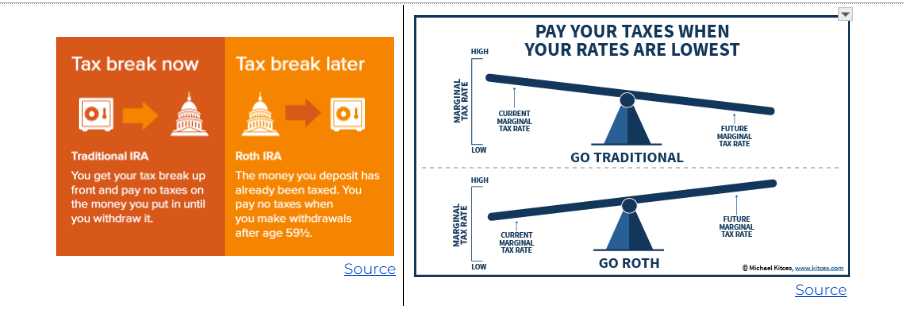
When discussing tax advantages in the last resource, the podcast host mentioned that traditional and Roth IRAs incur taxes at different times. Not only do IRAs come in these two types, but 401(k)s do as well.
Source
Source
1 point
1
Question 16
16.
Using these two images, summarize the advice you’d give to a potential investor on whether they should choose Traditional or Roth for their retirement account.
1 point
1
Question 17
17.
If Vladimir currently works part time at a sandwich shop while he also tries to launch his career as a high-end barber, do you think Traditional or Roth would be a better option for him right now? Explain your thinking.
Explore It
INTERACTIVE: Nerdwallet Retirement Calculator
Now that you know what account types you can use to invest for retirement, when should you start saving for retirement? And how much? Use this retirement calculator to investigate the following scenario.
Patrice is 27 years old and earns the mean salary for a court clerk, which is $43,490. They currently have $2800 in savings, and every month they save 6% of their monthly gross income. They plan to retire at age 67, but they hope they’ll live until age 95.
TEACHER TIP: Students will need to click the arrow on the “Optional” section of the calculator screen to access fields such as retirement age, life expectancy, and investment rate of return, among others.
1 point
1
Question 18
18.
If Patrice invests none of the money and instead puts it in a savings account earning 0.5% guaranteed interest, how “short” will Patrice be for their retirement?
1 point
1
Question 19
19.
YIKES! Saving alone isn’t going to cut it. They decide to invest, rather than save, and they assume they can get a 7% rate of return over the course of their working life. Now what is the difference between how much Patrice will need and how much they will have?
1 point
1
Question 20
20.
While there’s nothing Patrice can do about their current age, and they don't want to get overconfident and assume a higher rate of return, what happens to Patrice’s retirement goal if they instead start saving 9% of their gross pay?
1 point
1
Question 21
21.
Looking at the inputs you can change in the calculator, write a plan you THINK might get Patrice to a successful retirement.
1 point
1
Question 22
22.
Now, test your plan for Patrice by changing the inputs accordingly. Does Patrice now meet their retirement savings goal?
MATH CONNECTION - Retirement Drawdown
Retirement Drawdown
Calculating the exact amount you need for retirement involves making some predictions about your lifestyle after retirement.
1 point
1
Question 23
23.
First, watch this video to understand the basics of how your drawdown happens in retirement. List the 3 factors that impact how much you need to retire.
Now, let’s return to Patrice and their retirement goals with these new drawdown factors in mind. We will need to make some assumptions about Patrice’s post-retirement life. For all the questions below, you’ll no longer be using the Nerdwallet calculator – you’re using your own math power!
1 point
1
Question 24
24.
If Patrice expects to maintain the exact same standard of living while aging, they will need at least an annual raise of 2% to match inflation. If Patrice is earning $43,490 at age 27 and gets a 2% raise each year, what will their salary be at age 65?_______
1 point
1
Question 25
25.
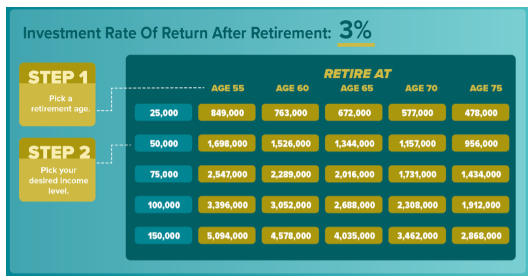
Patrice is planning to retire at age 65 and provide income until age 95. The chart below gives the required savings for a combination of retirement age and desired starting income assuming a 2% inflation rate and a 3% rate of return on investments during retirement.
Patrice wants to retire with at least 100% of their inflation-adjusted salary. Use the closest values on the chart to approximate how much they would need to have saved at retirement.
4 points
4
Question 26
26.
Imagine Patrice reaches her retirement age of 65 and has $1.4 million saved.
Based on the chart, approximately how much could she afford as a retirement income?_______
How much more money would Patrice need each year to maintain her inflation-adjusted salary from Question 2?_______
If Patrice receives $1657 per month in Social Security benefits after retirement (the average benefits in 2022), how much more money does Patrice now need to maintain her inflation-adjusted salary?_______
1 point
1
Question 27
27.
What are some possible ways that Patrice could close that gap to reach their desired income level in retirement?
3 points
3
Question 28
28.
Retirement planning involves a lot of assumptions and approximations.
Name at least two approximations you had to make in planning for Patrice’s retirement._______ _______
Explain why it is important to always be conservative in your estimates and assumptions when planning for retirement._______
Exit Ticket
1 point
1
Question 29
29.
Which list below contains four financial sources you can use to fund your retirement?
Social Security, Medicare, mutual fund, 401(k)
Social Security, Pension, IRA, 401(k)
Pension, traditional, Roth, investment manager
Traditional IRA, Roth IRA, 501(c)(3), income taxes
1 point
1
Question 30
30.
What is the key difference between a 401(k) and an IRA?
1. 401(k)s incur taxes, but IRAs do not
2. 401(k)s are offered through an employer, but individuals set up IRAs themselves
3. 401(k)s are only available to high income earners, but IRAs can be used by anyone
4. 401(k)s are available to teens, but IRAs are not
1 point
1
Question 31
31.
Which strategy is most effective to ensure you have enough money for retirement?
Put large amounts of money, monthly, into a savings account with a low interest rate
Invest every month, starting at a young age, in an investment retirement account
Retire as early as possible so you can maximize your Social Security benefits
Invest every month in well performing stocks, starting 10-15 years before your retirement date