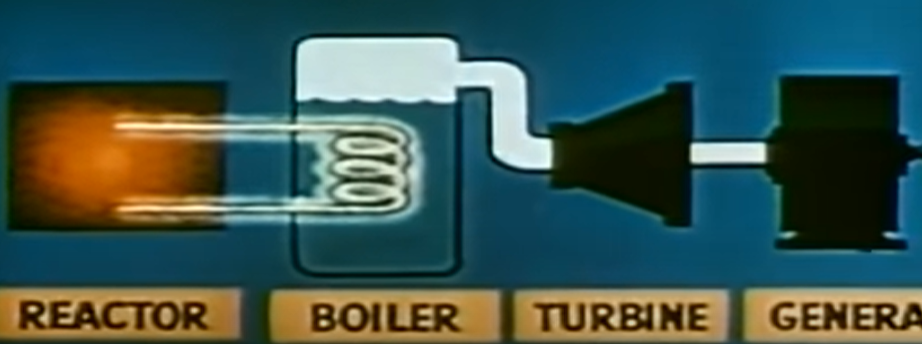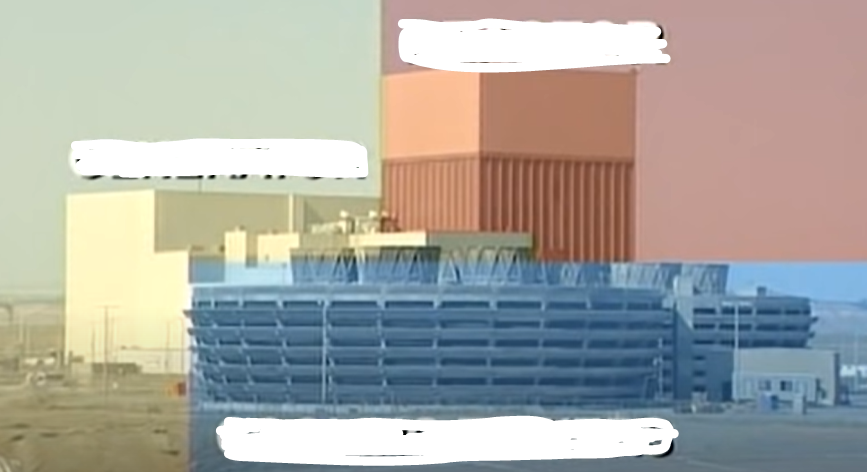
What are the three main sections of a nuclear power plant?
What are the three main sections of a nuclear power plant?
What are the three main sections of a nuclear power plant?
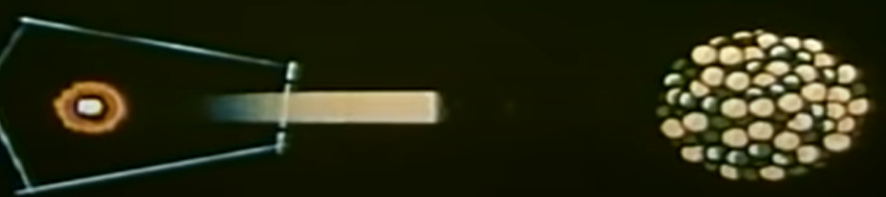
What starts the nuclear chain reaction?
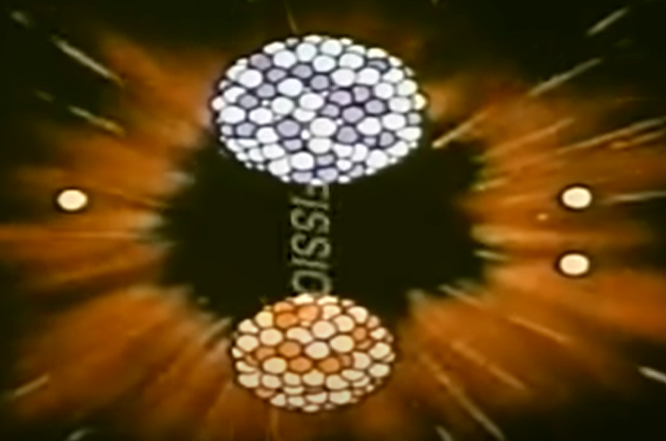
What two products are formed from the fission of uranium?
What is the main way to make energy from nuclear energy?
What does fission mean?
How much nuclear waste is produced in 60 years of a power plant operating?
How much would a coal plant produce?
Where are most of the nuclear waste and spent fuel rods currently?
What is the estimate for how long it takes nuclear waste to completely decay?
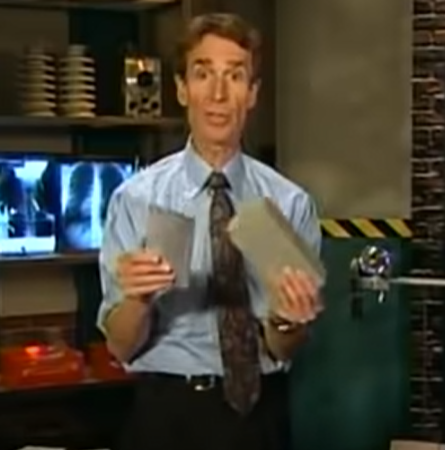
What materials are used to shield or block nuclear radiation?
Nuclear power is
What is released out of the cooling towers of a nuclear power plant?
Introduction
The discovery of radioactivity in the late 1800’s allowed scientists to develop new methods of determining the absolute age of rocks. Since it is not safe for us to play with radioactive isotopes, we will use pennies to simulate radioactive decay. The plastic box in this lab represents an imaginary rock.
Suppose that 100 heads-up pennies in your box represent atoms of an imaginary radioactive element called Headsium. When Headsium “decays”, it becomes a different imaginary element called Tailsium, which is stable (non-radioactive). After you shake the box for 15 seconds, approximately half of the pennies will have decayed (flipped over) to stable Tailsium. Thus 15 seconds is the half-life for Headsium.
Prepare a graph by plotting the number of half-lives on the X-axis and the number of radioactive Headsium on the Y-axis.
Describe the appearance of your line. Is it straight or curved?
How many undecayed Headsium atoms would remain in a sample of 600 pennies after 3 half-lives?
If 175 Headsium atom are left out of a sample of 2800, how many half-lives would have passed?
I am going to give you $1,000 (DREAM ON!) but you must spend ½ of it in the first year, ½ of the balance in the second year, etc. One year represents one half-life of the $1,000.
If you spend the maximum allowed each year, at the end of what year will you have $31.25 left?
How much money would be left after 10 half-lives?
energy is the splitting of atoms that produce heat that can be harnessed to produce electricity.
energy is collision of atomic nuclei to produce a new nucleus and energy.
Identify two positives of nuclear energy.
Identify two negatives of nuclear energy.