The three-dimensional location in space where an injury occurred in known as the .
The blood spatter pattern shown in the video at 3:01 is known as a(n) pattern.
The CSI in the video utilized to estimate the area of origin.
Crime-scene investigators detected blood spatter on the floor of the kitchen. The investigators drew lines of convergence and measured the distance from the center of the area of convergence to the leading edge of a drop of blood. That distance was recorded as 5.75 feet. After measuring the length and width of the blood droplet and using the law of sines, it was determined that the angle of impact was 27 degrees. The police wanted to determine the area of origin or the height from the floor to where the person was bleeding.
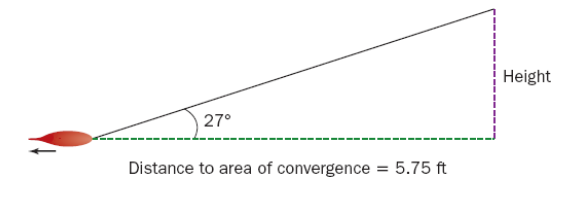
We're going to use tangent of the impact angle to determine the height!
tan
height = tan
height =
i) measure the distance in millimeters from the center of the area of convergence to the leading edge of bloodstain 1 (round to the nearest mm).
ii) Using the scale of 1 mm = 0.2 feet, convert the distance in mm to feet (round to the nearest whole number).
iii) Calculate the angle of impact for bloodstain 1 (round to the nearest whole number).
iv) Using the law of tangents, determine the area of origin, or height, of the source of blood for blood droplet 1 (round to the nearest whole number).
i) measure the distance in millimeters from the center of the area of convergence to the leading edge of bloodstain 2 (round to the nearest mm).
ii) Using the scale of 1 mm = 0.3 feet, convert the distance in mm to feet (round to the nearest whole number).
iii) Calculate the angle of impact for bloodstain 2 (round to the nearest whole number).
iv) Using the law of tangents, determine the area of origin, or height, of the source of blood for bloodstain 2 (round to the nearest whole number).
i) measure the distance in millimeters from the center of the area of convergence to the leading edge of blood droplet 3 (round to the nearest mm).
ii) Using the scale of 1 mm = 1.5 feet, convert the distance in mm to feet (round to the nearest whole number).
iii) Calculate the angle of impact for blood droplet 3 (round to the nearest whole number).
iv) Using the law of tangents, determine the area of origin, or height, of the source of blood for bloodstain 2 (round to the nearest whole number).