Free Response: Earth and Sun

Last updated over 1 year ago
21 questions
1

Explain why the gravitational attraction between the Sun and Earth increases as Earth moves from position C to position D

1

Identify the Northern Hemisphere season that is beginning at position A

1

Describe one piece of evidence shown by the diagram that indicates this is a heliocentric model.

1

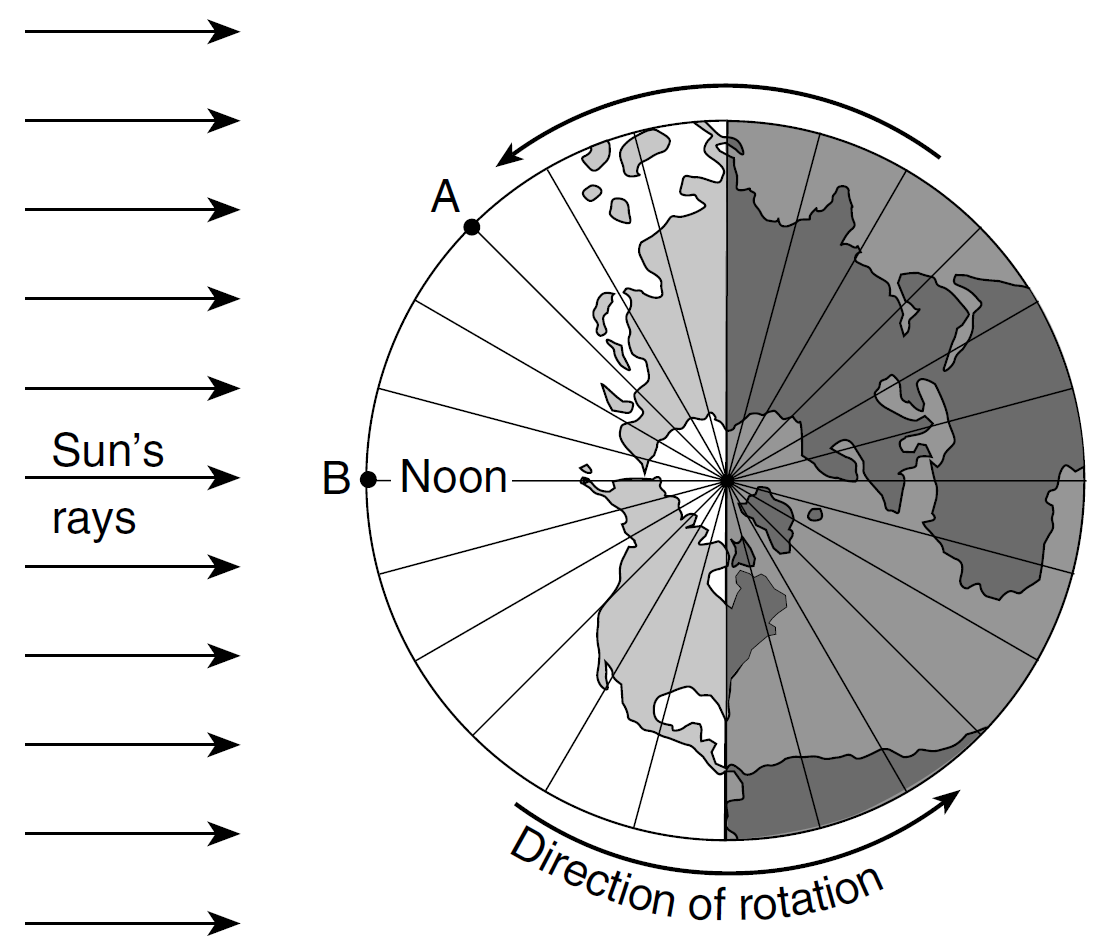
State the number of hours of nighttime that people in Syracuse will experience on March 21.

1

Base your answer to the following question on the diagram in your answer booklet and on your knowledge of Earth science. The diagram represents the Sun's apparent daily path for the first day of three seasons at 43° North latitude. The solid lines represent daytime paths as seen by an observer at this latitude. The dashed lines represent the nighttime paths that can not be seen by the observer.
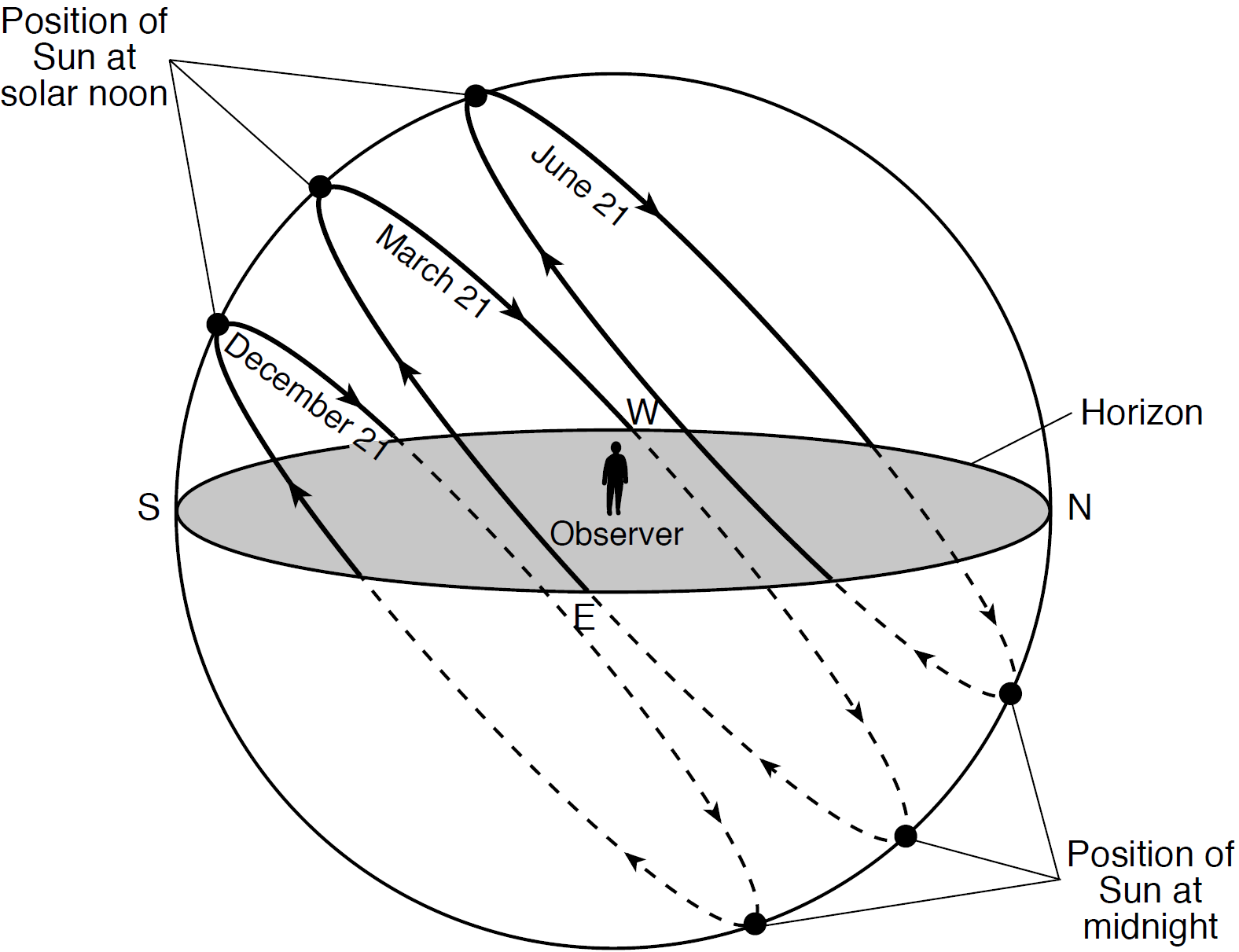
On the diagram, draw an X to represent the solar noon position of the Sun as seen by the observer on April 21.
1
State one possible date of the year represented by each apparent path of the Sun.

Path X: _______
Path Y: _______
Path Z: _______
1

Draw one arrow in each box on path Z to indicate the Sun's apparent direction of movement along path Z

1

The diagram represents a top view of the same pegs. Circle the next two pegs that would fall as the pendulum appears to change its direction of swing in the Northern Hemisphere.

1

Toward which compass direction from the object does the shadow point at solar noon?

1

Predict the length of the object's shadow in cm at 2:30 p.m.

1

11.State the number of daylight hours occurring north of the Arctic Circle on June 21.

1

Identify one possible date represented by letter A.

1

Explain why the Sun's direct rays are at different latitudes as Earth revolves around the Sun.

1

State the numerical latitude at which the Sun is directly overhead at noon on December 21.
Include the units and compass direction in your answer.

1

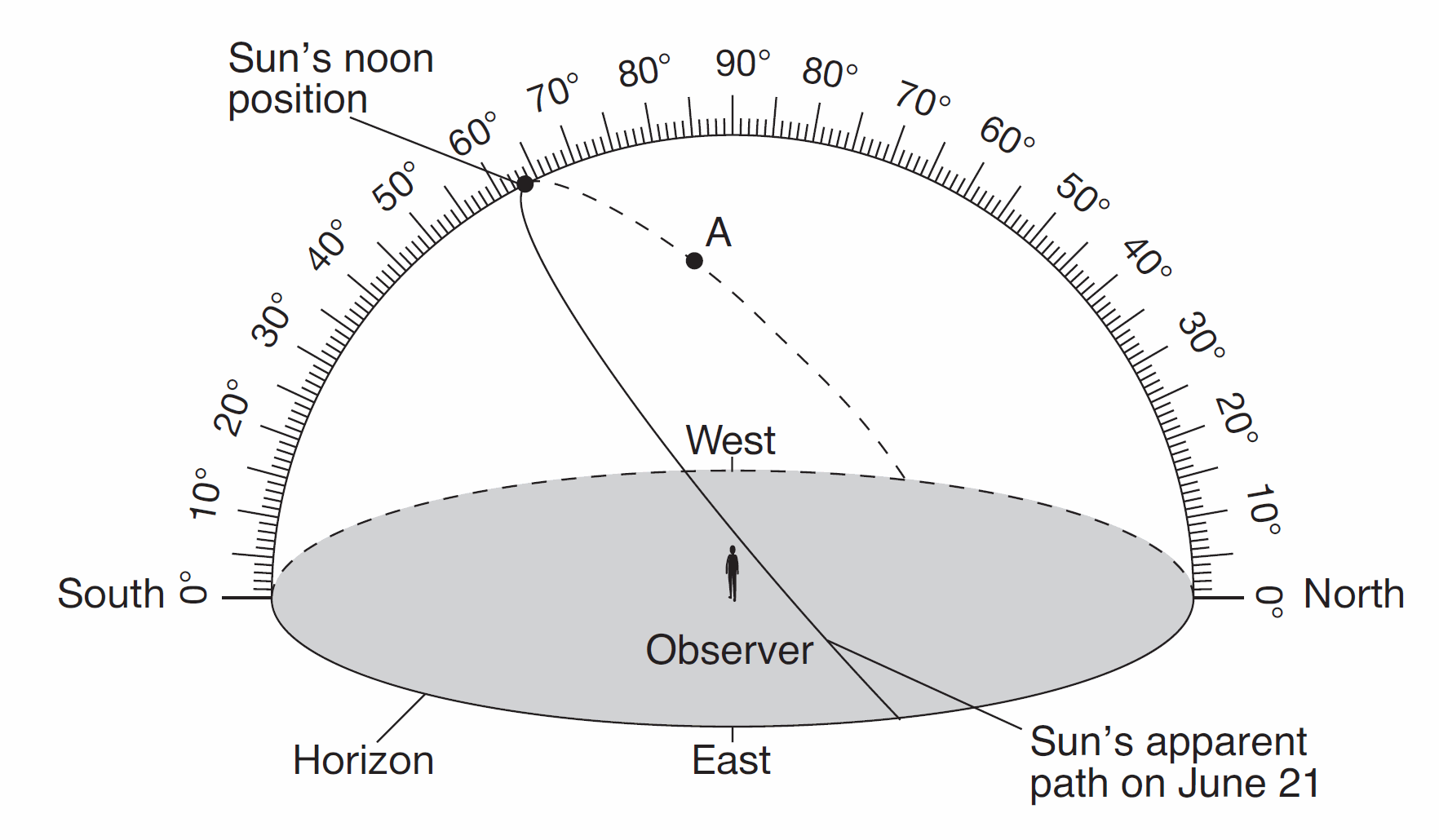
Base your answer to the following question on the diagram in your answer booklet and on your knowledge of Earth science. The diagram is a model of the sky (celestial sphere) for an observer at 50° N latitude. The Sun's apparent path on June 21 is shown. Point A is a position along the Sun's apparent path. Angular distances above the horizon are indicated.


Describe the general relationship between the length of the Sun's apparent path and the duration of daylight.

1

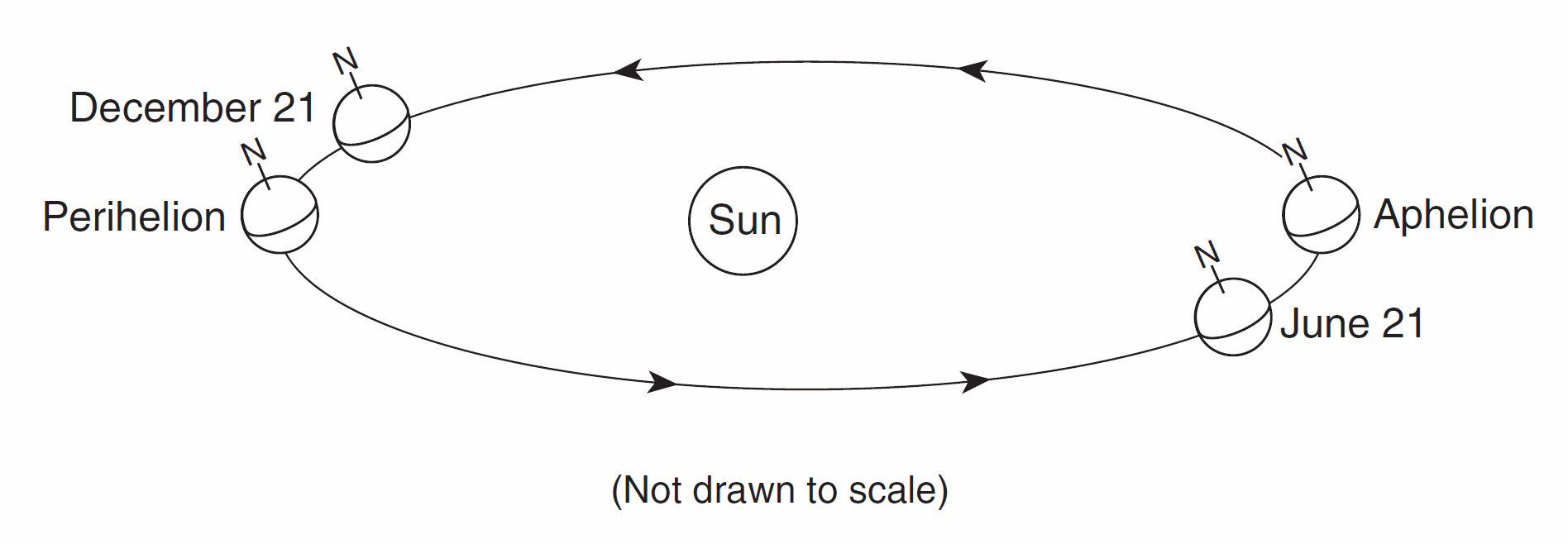
Base your answer to the following question on the diagram below, which represents an exaggerated model of the shape of Earth's orbit, and on your knowledge of Earth science. The positions of Earth in its orbit on December 21 and June 21 are indicated. The positions of perihelion (when Earth is closest to the Sun) and aphelion (when Earth is farthest from the Sun) are also indicated. Both perihelion and aphelion occur approximately two weeks after the dates shown.


Explain why warm summer temperatures occur in New York State when Earth is at aphelion.

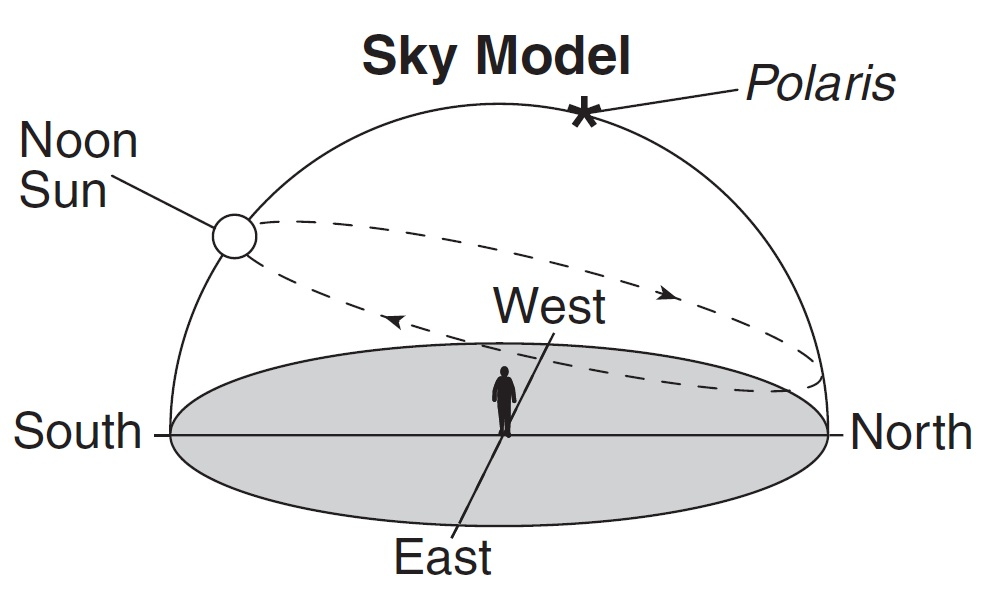
Base your answers to questions 17 and 18 on the sky model below and on your knowledge of Earth science. The model shows the Sun's apparent path through the sky as seen by an observer in the Northern Hemisphere on June 21.


1

Identify the cause of the apparent daily motion of the Sun through the sky

1

Describe the evidence, shown in the sky model, which indicates that the observer is not located at the North Pole.

1

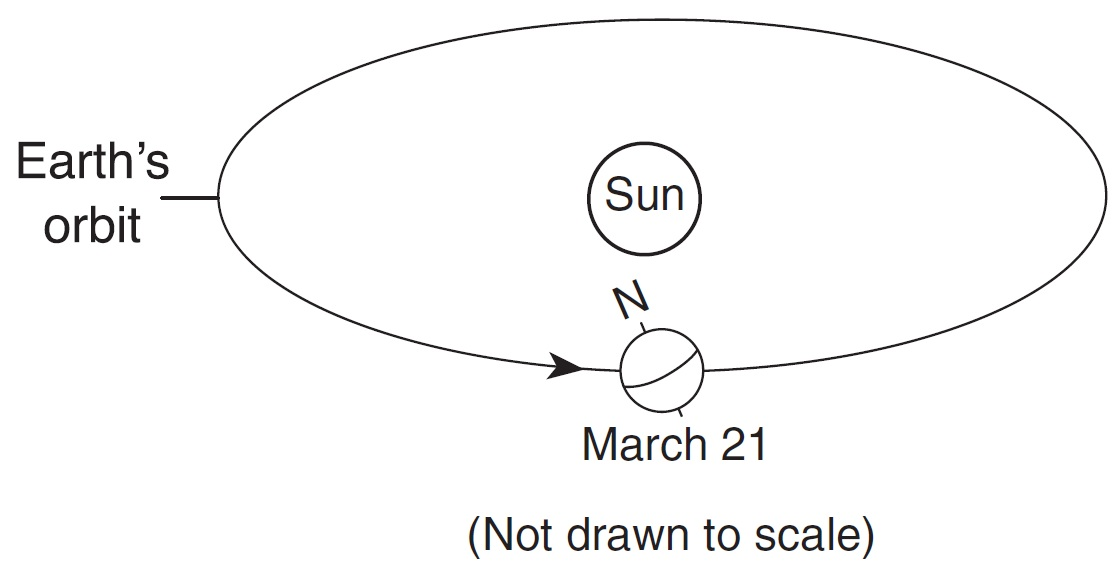
The diagram represents Earth at one position in its orbit around the Sun. Starting at the North Pole, draw a straight arrow that points to the location of Polaris.

1

Identify one date represented by this diagram.

1

On the diagram, place an X at a location on Earth's surface where the Sun was directly overhead at some time on December 21.