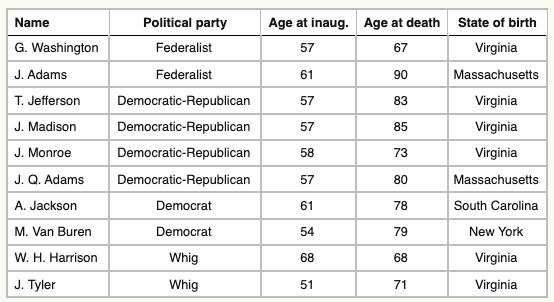
Here is some information about the first 10 U.S. presidents. Identify the individuals and variables in this data set. Classify each variable as categorical or quantitative.
State of Birth
Age at Inauguration
Political Party
Age at Death
Name
Categorical Variable
Quantitative Variable
Required
1 point
1
Question 2
2.
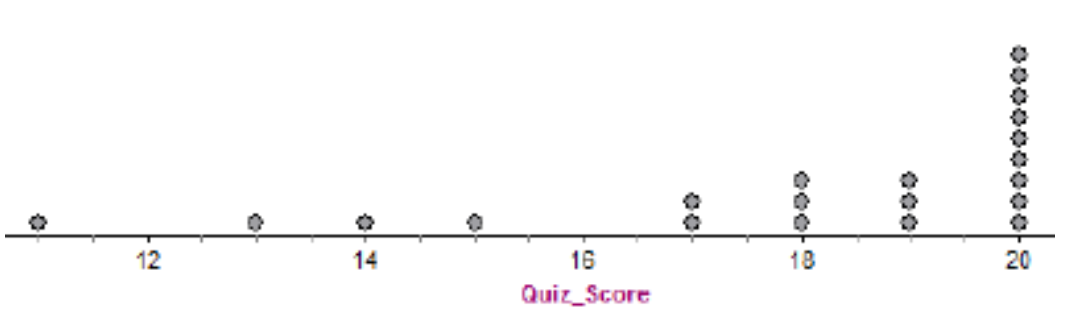
The dotplot below displays shows the scores of 21 Statistics students on a 20-point quiz.
What does one dot represent?
Required
1 point
1
Question 3
3.
The dotplot below displays shows the scores of 21 Statistics students on a 20-point quiz.
a) Describe the shape of the distribution.
b) How does the mean compare to the median?
Required
1 point
1
Question 4
4.
The dotplot below displays shows the scores of 21 Statistics students on a 20-point quiz.
a) Using the dot plot above, what is the appropriate measure of center and spread?
b) Why would you choose these?
Required
1 point
1
Question 5
5.
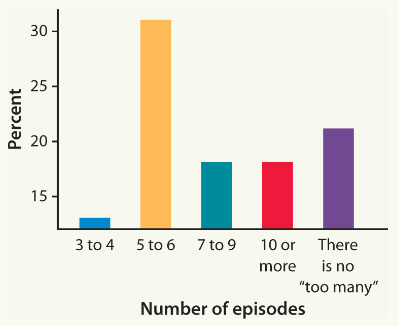
Do you “binge-watch” television series by viewing multiple episodes of a series at one sitting? A survey of 800 people who “binge-watch” were asked how many episodes is too many to watch in one viewing session.
The results are displayed in the bar chart.
Explain how this graph is misleading.
Required
1 point
1
Question 6
6.
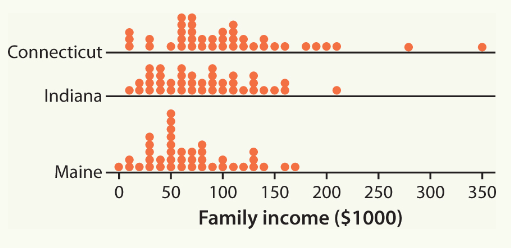
The dotplots show the total family income of 40 randomly chosen individuals each from Connecticut, Indiana, and Maine, based on U.S. Census data.
Which graph has a higher standard deviation?
ie. Which graph has greater variability?
Required
1 point
1
Question 7
7.
The dotplots show the total family income of 40 randomly chosen individuals each from Connecticut, Indiana, and Maine, based on U.S. Census data.
Which graph has a shape that is closest to being roughly symmetric?
Required
1 point
1
Question 8
8.
The dotplots show the total family income of 40 randomly chosen individuals each from Connecticut, Indiana, and Maine, based on U.S. Census data.
Which graph has the lowest mean?
Chapter 2
Required
1 point
1
Question 9
9.
For a project in their statistics class, Alex and Tempe studied the impact of different types of background music on students’ ability to remember words from a list they were allowed to study for 5 min. Here is a list of how many words one group of students who listened to Beethoven’s Fifth Symphony were able to remember.
11 12 23 15 14 15 14 15
10 14 15 9 11 13 25 11
13 13 12 20 17 23 11 12
12 11 20 20 12 12 19 13
15 10 14 11 7 17 13 18
Use statsmedic.com/applets, 1 quantitative variable. Make a histogram that effectively displays the distribution of words recalled.
Describe the histogram using D.O.F.S.
Required
1 point
1
Question 10
10.
We used technology to compute the mean and median of the distribution.
One is 13 and the other is 14.3.
Based on the histogram from #9, explain how you know which is which without doing any calculations.
Required
1 point
1
Question 11
11.
Using the same histogram from #9, what effect would removing the outliers have on the mean & standard deviation?
Required
1 point
1
Question 12
12.
Find the interquartile range of the data in #9.
Required
1 point
1
Question 13
13.
The standard deviation is 4.05.
Interpret this value in context.
Required
1 point
1
Question 14
14.
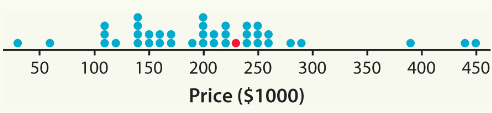
The following dotplot gives the sale prices for 40 houses in Ames, Iowa, sold during a recent month. The mean sale price was $203,388 with a standard deviation of $87,609.
Find the percentile of the house that is indicated on the dotplot. Remember percentile means the percent to the LEFT of a value.
Required
1 point
1
Question 15
15.
At what age do babies learn to crawl? Does it take longer to learn in the winter, when babies are often bundled in clothes that restrict movement? There might even be an association between babies’ crawling age and the average temperature during the month when they first try to crawl (around 6 months after birth).
Data were collected from parents who reported the birth month and the age at which their child was first able to creep or crawl a distance of 4 feet within 1 minute. Information was obtained on 414 infants, 208 boys and 206 girls.
Average crawling age is given in weeks, and the average temperature (in degrees Fahrenheit) is for the month that is 6 months after the birth month.
Copy and paste the data into statsmedic.com/applets, 2 quantitative variables.
Birth Month: Jan. Feb. Mar. Apr. May. Jun. July. Aug. Sept. Oct. Nov. Dec.
Work with a partner, use statsmedic.com to make a scatterplot to display the relationship between average 6-month temperature and average crawling age.
Describe the relationship shown in the scatterplot.
Select all that apply.
If you're not sure of the strength, calculate the correlation.
Required
1 point
1
Question 16
16.
What does a correlation coefficient tell us?
Required
1 point
1
Question 17
17.
How would the correlation value change if the age of crawling was entered in days?
Required
3 points
3
Question 18
18.
Using your scatterplot from above:
a) Describe what is unusual about the point representing May.
b) How does the point representing May affect the equation of the least-squares regression line? Explain.
Required
1 point
1
Question 19
19.
Using your scatterplot, if the point representing May was removed, how would that affect the equation of the least-squares regression line? Explain.
Required
2 points
2
Question 20
20.
The principal of a high school read a study that reported a positive correlation between the number of calculators owned by high school students and their math achievement. Based on this study, he decides to buy each student at his school 2 calculators, hoping to improve their math achievement.
Explain the flaw in the principal’s reasoning.
Required
1 point
1
Question 21
21.
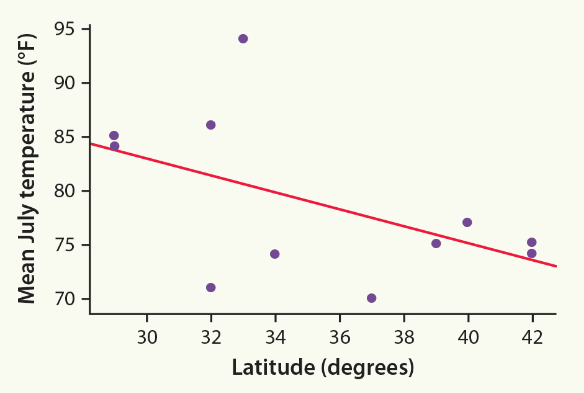
The scatterplot shows the relationship between latitude and mean July temperature (in degrees Fahrenheit) for 12 cities in the United States.
If you were to predict the mean July temperature in Fairbanks, Alaska, at latitude 65º, how confident would you be in this prediction?
Required
1 point
1
Question 22
22.
Continue with the information from above:
The equation of the regression line relating these variables is
Los Angeles, California, is at latitude 34º and actually has a mean July temperature of 74º.
Calculate the predicted temperature value for July.
Keep all places past the decimal point, no units.
Required
1 point
1
Question 23
23.
Use the information from above:
Los Angeles, California, is at latitude 34º and actually has a mean July temperature of 74º.
Calculate the residual for the July prediction. Keep all decimal points, no units.
Required
1 point
1
Question 24
24.
Use the information from the regression model:
Interpret the slope of the regression line.
Required
1 point
1
Question 25
25.
Use the information from above:
Does the value of the y intercept have meaning in this context?
If so, interpret the y intercept. If not, explain why.
Required
1 point
1
Question 26
26.
We used a least-squares regression line to model the relationship between x = latitude
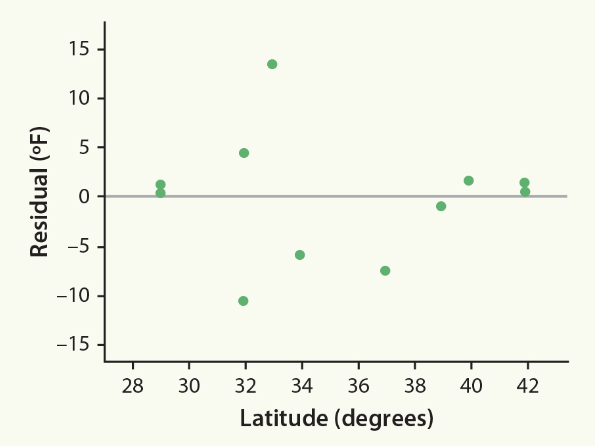
and y = mean July temperature (in degrees Fahrenheit) for a sample of 12 cities in the United States. Here is the residual plot for this model.
Explain what the residual plot suggests about the appropriateness of the linear model.
Chapter 3
Required
1 point
1
Question 27
27.
Indicate the following is a valid statistical question. Explain your reasoning.
'How many people visited Acadia National Park last Tuesday?'
Required
1 point
1
Question 28
28.
Indicate if the following is a valid statistical question. Explain your reasoning.
'How many people visit Acadia National Park on a typical weekday in August?'
Required
1 point
1
Question 29
29.
In a recent study of a random sample of 250 U.S. residents, it was found that 85% rated the honesty and ethical standards of nurses as very high or high.
Do you think that the proportion of all U.S. residents who rate the honesty and ethical standards of nurses as very high or high is exactly 0.85? Explain.
Required
1 point
1
Question 30
30.
Use the previous question information:
If the size of a sample in the poll was increased to 1250 residents, what effect would this have on the variability? Explain.
Required
1 point
1
Question 31
31.
The administration at a high school with 1800 students wants to gather student opinion about parking for students on campus. It isn’t practical to contact all students.
Send an email to all the students and ask them to fill out the survey online.
Number all students in the school, use a random number generator to draw 50 numbers, survey those corresponding students.
Stand at the doors to the courtyard and by the bus drop off and survey students as they enter the school.
Voluntary Response Sample
Convenience Sample
Simple Random Sample (SRS)
Required
1 point
1
Question 32
32.
An opinion poll calls 2000 randomly chosen residential telephone numbers, then asks to speak with an adult member of the household.
The interviewer asks, “Box-office revenues are at an all-time high. How many movies have you watched in a movie theater in the past 12 months?”
In all, 1131 people responded. The researchers used the responses to estimate the mean number of movies adults have watched in a movie theater in the past 12 months.
Categorize the types of bias with the descriptions.
Using only residential phone numbers to contact the sample to be surveyed
2000 Randomly chosen phone numbers were called, response from 1131 people were received.
Wording of the question could cause people to be more likely to respond favorable
Response Bias
Undercoverage Bias
Nonresponse Bias
Required
1 point
1
Question 33
33.
A recent random sample of n = 805 adult U.S. residents found that the proportion who rated the honesty and ethical standards of nurses as very high or high is 0.85.
This is 0.15 higher than the proportion recorded for doctors, the next highest-ranked profession.
Identify the sample and the population in this setting.