Year 11 CHE titration questions
star
star
star
star
star
Last updated about 2 years ago
11 questions

1
1
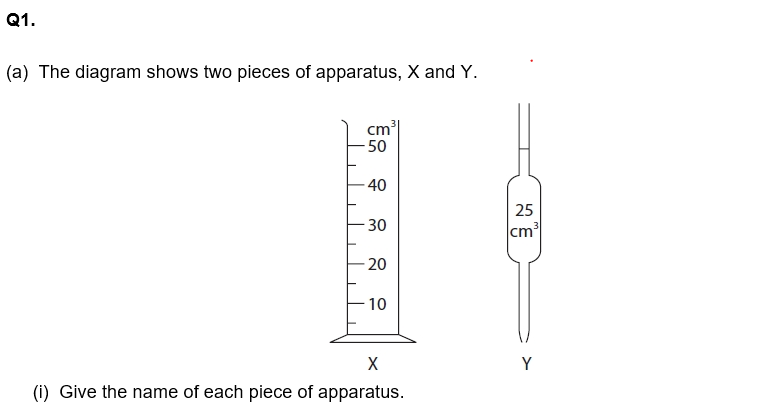
(ii) In a titration, a student adds 25.0 cm3 of barium hydroxide solution to a conical flask.Give a reason why it is better to use Y rather than X.
(ii) In a titration, a student adds 25.0 cm3 of barium hydroxide solution to a conical flask.
Give a reason why it is better to use Y rather than X.
1
(b) The student uses methyl orange indicator in the titration.(i) State the colour of methyl orange in barium hydroxide solution.
(b) The student uses methyl orange indicator in the titration.
(i) State the colour of methyl orange in barium hydroxide solution.
1
(ii) Give a reason why universal indicator is not suitable for use in a titration.
1
The student adds some dilute nitric acid to a burette and does the titration.The equation for the reaction isBa(OH)2 + 2HNO3 → Ba(NO3)2 + 2H2OThe student finds that 21.50 cm3 of nitric acid of concentration 0.600 mol/dm3 neutralises 25.0 cm3 of barium hydroxide solution.Calculate the concentration, in mol/dm3, of the barium hydroxide solution.
The student adds some dilute nitric acid to a burette and does the titration.
The equation for the reaction is
Ba(OH)2 + 2HNO3 → Ba(NO3)2 + 2H2O
The student finds that 21.50 cm3 of nitric acid of concentration 0.600 mol/dm3 neutralises 25.0 cm3 of barium hydroxide solution.
Calculate the concentration, in mol/dm3, of the barium hydroxide solution.
1
(d) State why sulfuric acid would not be a suitable acid to use in this titration.
1
Question 2 a)
A student investigates the reaction between sodium hydroxide solution and dilute sulfuric acid.He does a titration to find the concentration of the sulfuric acid.This is his plan for the titration. There are some mistakes and omissions in his plan.· rinse a conical flask with the sodium hydroxide solution
· use a measuring cylinder to measure out 25 cm3 of the sodium hydroxide solution and add it to the conical flask
· add a few drops of methyl orange indicator to the conical flask
· rinse a burette with water and then fill it with the sulfuric acid
· add the acid from the burette to the conical flask until the indicator changes colour at the end-point of the titration
· record the final burette reading
(a) Give the colour change of the methyl orange indicator at the end-point.
Question 2 a)
A student investigates the reaction between sodium hydroxide solution and dilute sulfuric acid.
He does a titration to find the concentration of the sulfuric acid.
This is his plan for the titration. There are some mistakes and omissions in his plan.
· rinse a conical flask with the sodium hydroxide solution
· use a measuring cylinder to measure out 25 cm3 of the sodium hydroxide solution and add it to the conical flask
· add a few drops of methyl orange indicator to the conical flask
· rinse a burette with water and then fill it with the sulfuric acid
· add the acid from the burette to the conical flask until the indicator changes colour at the end-point of the titration
· record the final burette reading
(a) Give the colour change of the methyl orange indicator at the end-point.
1
(b) Describe four changes that the student could make to improve his plan.
1
(c) The student then does the titration correctly.He finds that 16.70 cm3 of the dilute sulfuric acid neutralises 25.0 cm3of sodium hydroxide solution of concentration 0.200 mol/dm3The equation for the reaction is2NaOH + H2SO4 → Na2SO4+ 2H2OCalculate the concentration, in mol/dm3, of the sulfuric acid.
(c) The student then does the titration correctly.
He finds that 16.70 cm3 of the dilute sulfuric acid neutralises 25.0 cm3of sodium hydroxide solution of concentration 0.200 mol/dm3
The equation for the reaction is
2NaOH + H2SO4 → Na2SO4+ 2H2O
Calculate the concentration, in mol/dm3, of the sulfuric acid.
1
A student does a titration using dilute sulfuric acid to find the concentration of a solution of potassium hydroxide.
The student adds 25.0 cm3 of the potassium hydroxide solution to a conical flask. He then adds a few drops of methyl orange indicator.The student does the titration four times.
(a) (i) Name the piece of apparatus the student should use to add the potassium hydroxide solution.
A student does a titration using dilute sulfuric acid to find the concentration of a solution of potassium hydroxide.
The student adds 25.0 cm3 of the potassium hydroxide solution to a conical flask. He then adds a few drops of methyl orange indicator.
The student does the titration four times.
(a) (i) Name the piece of apparatus the student should use to add the potassium hydroxide solution.
1
(ii) What is the colour of methyl orange in an alkaline solution?