Please watch the class recording if you need help.
There have been technical issues with #2-4 & #7-10. If you can't see them, please don't worry. I won't count them against you.
Please watch the class recording if you need help.
There have been technical issues with #2-4 & #7-10. If you can't see them, please don't worry. I won't count them against you.
Learning Target #1: Describe the use of models in science and how they can change
Question 1
1.
Scientific thinking changes based on new information and technology.
Before watching the video below to learn more about how scientists determined the age of the Earth, make a prediction: How old is the Earth?
Question 2
01:52
keyboard_arrow_down
0.3
Question 3
02:50
keyboard_arrow_down
0.3
Question 4
03:50
keyboard_arrow_down
0.3
Question 5
5.
Scientists use models to help visualize something that may be difficult to understand.
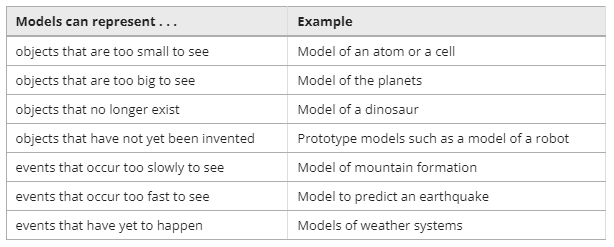
What tools can be used to create models?
Question 6
6.
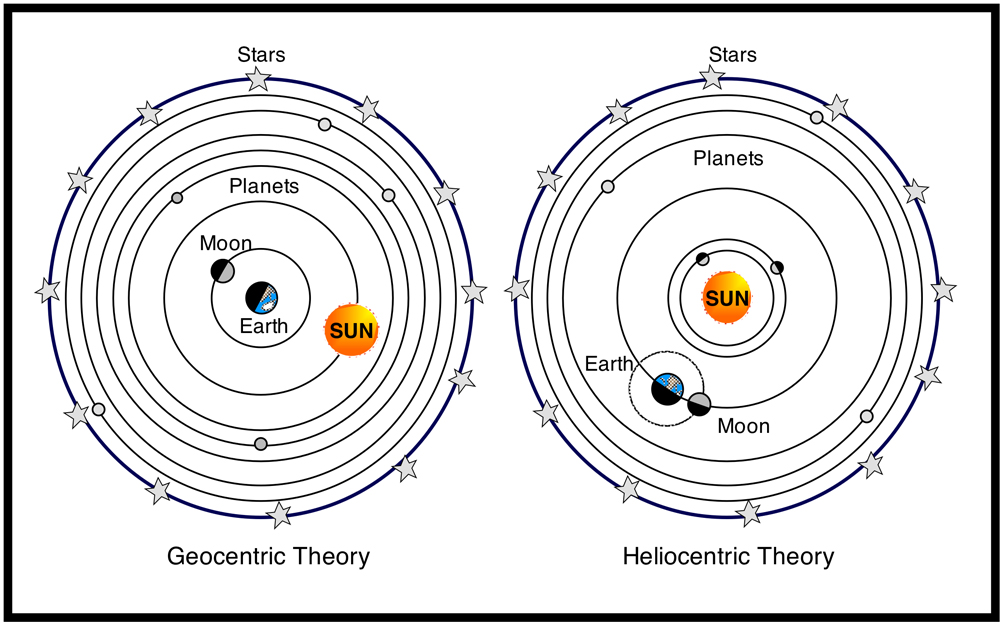
Models can change as new information and technology become available.
Below are 2 models.
The Ancient Greeks developed the __________ model, which placed the __________ at the center of the solar system.
However based on his observations, Copernicus proposed the __________ model, which placed the __________ at the center of the solar system.
Learning Target #2: Define negative and positive feedback loops and explain how they are different
Feedback loops help us understand cause and effect relationships. A feedback loop occurs when an action or event leads to a certain result, which then influences the original action or event.
In a positive feedback loop, the effect of an action amplifies the original action, creating a self-reinforcing cycle.
In a negative feedback loop the effect of an action seeks to stabilize and balance a system or condition.
Question 7
00:47
keyboard_arrow_down
0.3
HS-ESS2-2
Question 8
01:12
keyboard_arrow_down
0.3
HS-ESS2-2
Question 9
02:31
keyboard_arrow_down
0.3
HS-ESS2-2
Question 10
02:47
keyboard_arrow_down
0.3
HS-ESS2-2
Required
0.9
Question 11
11.
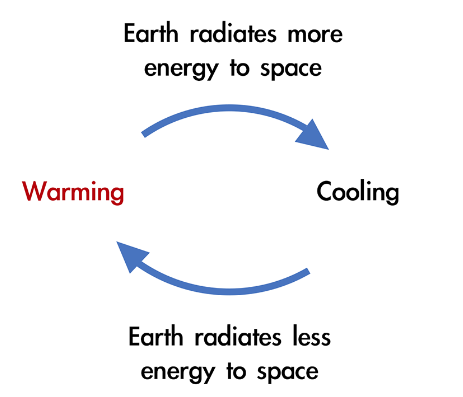
This image is a model of a negative feedback loop here on Earth (and Daisyworld).
Why is this considered a negative feedback loop?
HS-ESS2-2
Question 12
12.
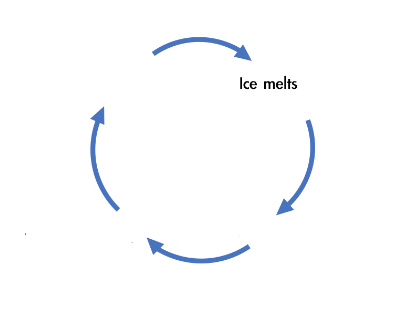
Consider this model of a positive feedback loop briefly mentioned at the end of the Daisyworld video.
Determine the effects of polar ice caps melting.
Other Answer Choices:
More solar radiation is absorbed
Albedo decreases
Warming
Question 13
13.
Why is the previous model of melting ice considered a positive feedback loop?
Question 14
14.
Question 2
2.
Question 3
3.
Scientists frequently use __________ (found in zircon crystals) in radiometric dating, which decays into __________
Question 4
4.
Scientists used radiometric dating on _______ to arrive at the 4.565 billion year age of the Earth.
Question 7
7.
When the planet is cool, __________ daisies grow, absorb the Sun's energy, and cause temperatures to __________.
When the planet is warm, __________ daisies grow, reflect the Sun's energy, and cause temperatures to __________
Question 8
8.
The albedo of a mirror would be _______ % and the albedo of a black surface would be _______ %.
Question 9
9.
Question 10
10.
What functions similar to the white daisies and reflects sunlight here on Earth? _______
Self Assessment: Rate your mastery of each learning target.
1 - I need help!
2
3
4
5 - I could teach this to another student
Learning Target #1: Describe the use of models in science and how they can change
Learning Target #2: Define negative and positive feedback loops and explain how they are different
When half of the parent atoms have become daughter atoms, that's called the half life of that element.
True
False
Which type of feedback loop does Daisyworld represent?