Digital Inquiry - Glacier Erosion

Last updated over 1 year ago
6 questions

TEXT: BREAK IT & MOVE IT

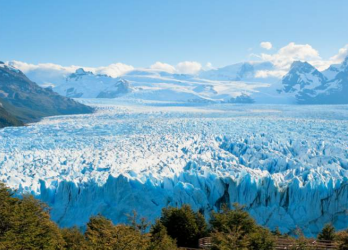
Glaciers could never make the track team. Most of them move too slowly – only 25 centimeters a day. They creep along, changing everything underneath them. Glaciers melt and refreeze which weakens the structure of the rocks in and under them. Great force from a glacier’s weight presses down on the rocks. Glaciers weather (break down) rocks as they move.

Force from the weight, along with melting and refreezing, moves the ice along. Water that melts from the glacier collects below and also helps the heavy ice to move. It carries and pushes the weathered rocks. The glacier erodes (moves) rocks from their original place. These weathered and eroded rocks can be found hundreds of miles away. This is called deposition (adding sediments to land).

As a glacier weathers and erodes the land in its path, it carves out a specific kind of valley. Because glaciers are wide, their valleys are U-shaped, with steep sides and a round valley floor. Glaciers may not be fast, but they are stronger than the whole weight-lifting team.

1

Explain how weathering and erosion change Earth’s surface.

VIDEO: HOW DO GLACIERS MOVE?


Before we learn how glaciers change Earth’s surface, let’s learn how they move.

Click the link to watch the 7 minute video clip to learn how the Mendenhall Glacier in Juneau, Alaska moves.
1

Describe how glaciers move and change the land.

INTERACTIVE: CHANGES TO EARTH'S SURFACE


As glaciers move, they change Earth’s surface. The hydrosphere (water and ice) interacts with the geosphere (rocks and land).

The link will take you to an interactive diagram. Read the short text and study the diagram. Click each blinking dot in the diagram to learn more about the changes to land.
1

List a few landforms formed by glaciers and what they are.

ENCYCLOPEDIA: MORAINE


Moraines are formed when glaciers deposit (leave behind) rocks and sediments.

Click the link to view an encyclopedia entry about moraines. Be sure to view all 6 images and captions.
1

Explain what a moraine is and how you can describe it.

PHOTO & CAPTION: U-SHAPED VALLEY


U-shaped valleys:
• are wide
• have steep, vertical sides
• have round-bottom floor

Click the link to view the photo and read the caption.
1

Explain what a U-shaped valley is and how you can describe it.

9
Glaciers, massive chunks of ________ that move very slowly, have changed Earth’s surface over time. They change the land through weathering, erosion, and _______________ .

Glaciers break down, or ____________, rocks in sediments as they slowly move. They __________ , or carry, those sediments to a new place.

When glaciers deposit sediments and rocks in a new place, they form moraines. Moraines
are piles of soil and _________ left behind by glaciers.

Glaciers can form _____________ valleys. These valleys are formed due to weathering and erosion. The valleys are _________ and __________________________. The valleys have ________________ .

Glaciers have been changing Earth’s surface for many years, leaving us with interesting
landforms.
Other Answer Choices:
rock
deposition
wide
flat along the bottom
U-shaped
steep sides
erode
weather
ice