Ɛhia
2
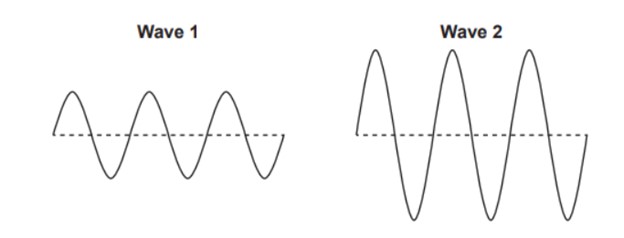
The drawings show two waves.Which statement best compares these two waves?
The drawings show two waves.Which statement best compares these two waves?
The distance between crests of waves is called the ___________.
Changing the amplitude of a sound waves changes...
What do all waves have in common?
Select all of the true statements about waves.
The drawings show two waves.Which statement best compares these two waves?
When the frequency of a wave decreases, the____________________
of the wave increases.
If you press down on a piano key, let's say middle C, it generates a sound wave. Now, imagine that you press it down much harder so that it still plays the same tone but much more loudly. How would pressing the key down harder change the sound wave produced?
The amplitude of a sound's waves determines the sound's ___________________.
Passage
Sound Waves
What Is a Sound Wave? Sound waves are vibrations that move the air around us. The waves travel towards your ear by vibrating the air near to where the sound was made which then vibrates the next bit of air and so on until the wave arrives at your ear. Sound waves travel in lots of different directions from where the sound first started. Your ear ‘catches’ the bit that comes in your direction. Once your ear has ‘caught’ the sound, it carries on vibrating inside your ear all the way to your ear drum. These vibrations are then turned into an electric message that your brain reads and tells you what sound you have heard. What Is Pitch? Pitch can be high or low. A high pitch sound is like chalk screeching on a blackboard and a low pitch sound is like the rumble of thunder. The pitch of a sound tells us how fast the sound vibrated when it was first made. A low note will have a slow vibration and a lower frequency. A high note will have a fast vibration and a higher frequency. You can make a string on an instrument have a higher pitch by shortening the string or making it tighter. What Is Volume? Volume is how loud a sound is, no matter the pitch of the note. It is measured in decibels (dB). Volume is the strength of the vibration the sound makes. A quiet sound has a gentle vibration and moves the air gently. A loud sound has lots of strength, moves the air with greater force and travels further. If we wanted to make the sound from a guitar string louder, but the same pitch, we would simply pluck it harder.
More rapid vibrations give ___________ pitch.
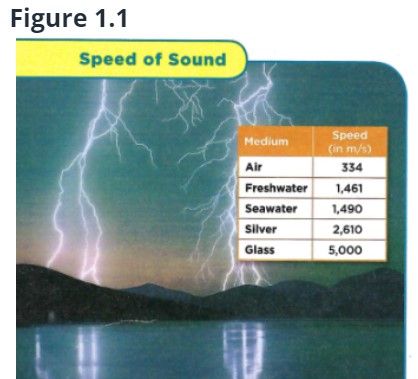
Use the Sound Waves passage and Figure 1.1 to help you answer the following question.
Part A.
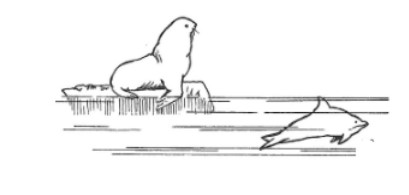
Which animal's sound will travel faster?
Part B to the Sound Waves Passage Part A. Which statement below supports your answer to Part A?
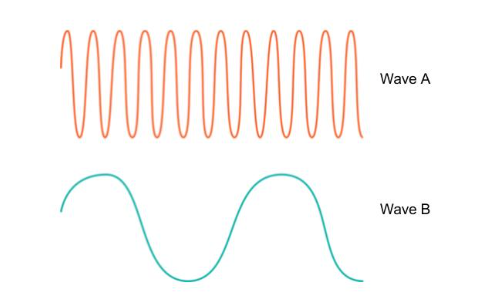
Which wave is a high frequency wave and why?
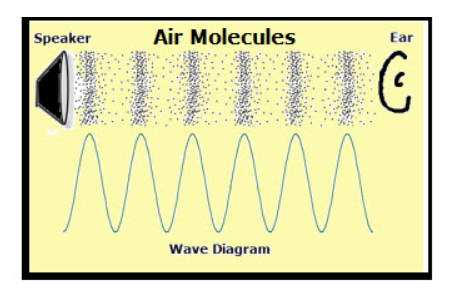
Low-frequency sound waves have a wavelength and a pitch.
What is the relationship between frequency and wavelength? (Select 2)
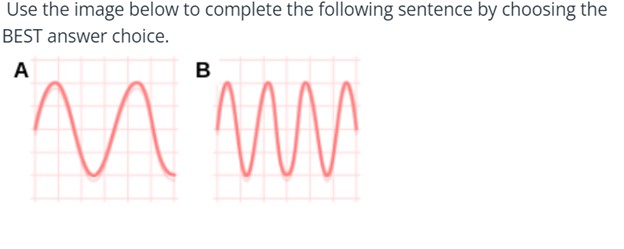
The lower the frequency of the wave
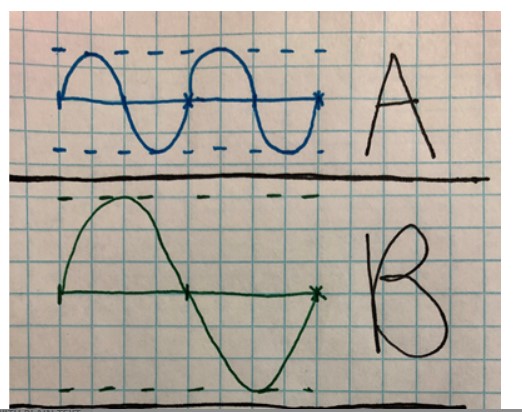
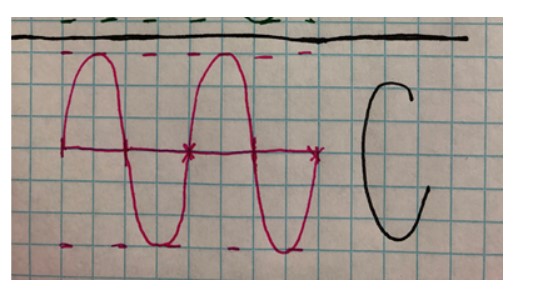
Identify the two waves that have the same frequency (assume each graph box is 1 square centemeter)
Increasing the frequency of a wave means you are increasing the energy and the _________ of a wave.
What is the highest point on a wave called?
What is the lowest point on a wave called?
How do vibrations of the sound source compare for higher vs. lower pitch sounds?
Why does a stronger force cause louder sounds? What did we do differently to create louder sounds?
The distance from one trough to another trough is called a(n)_________________.
What produces sound waves?