Role of p53 in the Cell Cycle
star
star
star
star
star
Last updated over 2 years ago
8 Nsɛmmisa
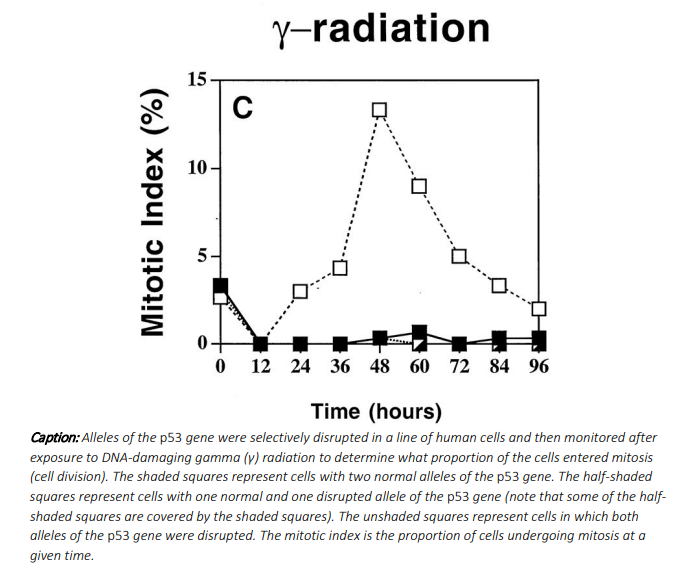
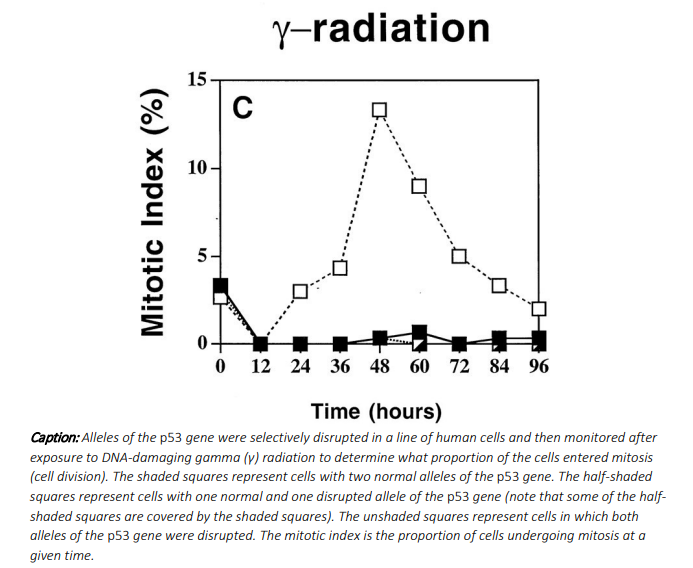
The graph below depicts the results from an investigation looking at the relationship between p53 and mitosis. The investigation is described in more detail in the BACKGROUND INFORMATION below.
The white squares represent cells with TWO MUTATED versions of the p53 gene.
The black squares represent cells with TWO FUNCTIONAL versions of the p53 gene.
The half shaded square represents cells with ONE MUTATED copy of p53 and ONE FUNCTIONAL version. Most of the half shaded squares are hidden under the black squares (60 hours shows a visible example of a half shaded square).
The "mitotic index" is the percentage of cells in mitosis at that time. A higher mitotic index means many cells are actively dividing.
Identify TWO trends that you notice in this graph?
Which cells appear to have a properly functioning p53 protein? Select all that apply.
BACKGROUND INFORMATION
The p53 protein is a tumor suppressor that plays an important role in stopping the division of cells (mitosis) that have DNA damage. The p53 protein can stop the cell cycle at two different times: before DNA replication (between phases G1 and S) and before cell division (between phases G2 and M). Stopping the cell cycle at these points helps prevent cells with damaged DNA from dividing. Cells with damaged DNA (mutations) can become cancerous if they continue to divide unregulated.
The gene that codes for p53 is often not functional in cancers. In fact, this gene is mutated more often than any of the other 20,000 human genes in cancer cells. A deeper understanding of the role of p53 in the cell cycle can help improve our understanding of cancers and perhaps lead to new forms of treatment
In this study, researchers investigated the role of p53 in cell cycle regulation at the checkpoint between the G2 and M phases (after the DNA has been replicated and right before the cell divides). Most human cells contain two versions of every gene, one version inherited from the mother and the other from the father.
Normally, genes can be used to produce a protein, like the p53 protein. However, researchers can change the DNA of a cell to "disrupt" a gene, making it unable to produce a functioning protein. In this experiment, the researchers changed the DNA in cells, mimicking what might happen in cells with non functioning versions of p53. In one cell type, a single copy of the p53 gene was mutated or disrupted. In a second cell type, both copies were mutated or disrupted. In a third cell type, the researcher did not change the DNA and both copies of the p53 gene were functional.
After changing the p53 genes in the three cell types, they exposed all three types to DNA-damaging radiation and observed how this exposure and the resulting DNA damage impacted cell division. They measured the impact of the radiation by measuring the proportion of cells undergoing mitosis, called the mitotic index, for each cell line every 12 hours for four days.
Based on the figure, what role does the p53 protein play in cell division?
Give one example to why a cell might need to stop dividing?
Why were the cells exposed to radiation in this experiment?
How many functional copies of the p53 gene do cells need to stop cell division in damaged cells? Use evidence from the figure to support your claim.
In the cells that entered mitosis, why do you think there was a delay before the start of mitosis after exposure to radiation?
At what point in time were the highest percentage of cells without the functioning p53 gene undergoing mitosis?