Log in
Sign up for FREE
arrow_back
Library

V 2.0M 2023 Semester 1 Chem Final (12/20/2023) (12/21/2023)

star
star
star
star
star
Last updated 11 months ago
22 questions
Note from the author:
Required
2
Required
2
Required
2
Required
2
Required
2
Required
2
Required
2
Required
2
Required
6
Required
2
Required
2
Required
2
Required
1
Required
2
Required
2
Required
2
Required
2
Required
2
Required
1
Required
1
Required
1
Required
2
You may use your notes/work papers to complete the final. NO PHONES OR INTERNET.
Question 1
1.

Question 2
2.

Question 3
3.

Question 4
4.

Question 5
5.

Question 6
6.

Question 7
7.
All the elements in each column on the periodic table have the same number of __________, making their __________ properties very similar.
Question 8
8.

Question 9
9.
Using the periodic table as a model, students are asked to complete a graphic organizer that could be used to predict the charges of stable ions formed from atoms in a group on the periodic table.
Atoms are __________ because they have the same number of protons and electrons. However, based on valence electrons, some atoms will easily gain or lose electrons to other atoms in order to achieve noble gas electronic structure. __________are atoms that have gained or lost electrons.  Atoms that have __________ electrons have a positive charge and are called __________.  Atoms that have __________ electrons have a negative charge and are called __________.
.
Question 10
10.

Question 11
11.

Question 12
12.

Question 13
13.
Elements in group 13 of the periodic table form ions with a charge of _______ [Make sure you use a + or - with the numerical value]
Question 14
14.

Question 15
15.

Question 16
16.

Question 17
17.

Question 18
18.

Question 19
19.

Question 20
20.

Question 21
21.

Question 22
22.

A user is constructing an ionic bond between magnesium and fluorine and has reached the stage below. What should the user do next? [Take time to study the picture before you answer]
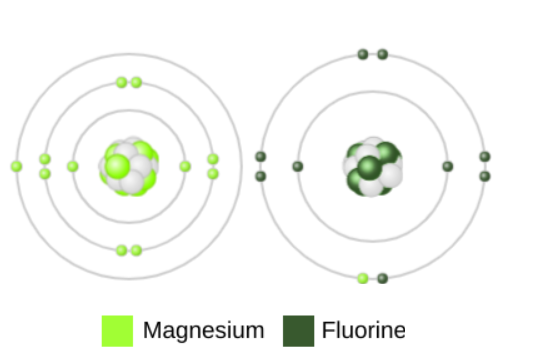
Add another magnesium atom.
Transfer an electron from the magnesium atom to the fluorine atom.
Add another fluorine atom.
Transfer an electron from the fluorine atom to the magnesium atom.
Lithium nitride has the chemical formula Li3N. Rubidium is in the same chemical family as lithium. What is the formula of rubidium nitride?
RbN
RbN3
Rb3N
Rb2N3
How many protons and neutrons does iron-56 have?
26 protons and 26 neutrons
26 protons and 30 neutrons
26 protons and 56 neutrons
30 protons and 56 neutrons
A and B are isotopes of the same element.
Only atom B is an isotope.
A and B are isotopes of different elements.
The two atoms have the same mass.
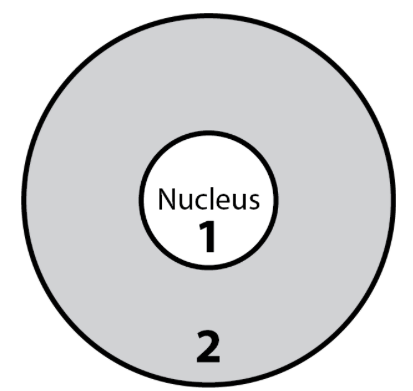
The diagram of an atom above shows two regions, the nucleus (1) and the area surrounding the nucleus (2). How are the protons, neutrons, and electrons that make up an atom distributed?
Protons in region 1, neutrons and electrons orbiting in region 2
Protons and neutrons in region 1, electrons orbiting in region 2
Electrons and neutrons in region 1, protons orbiting in region 2
Protons and electrons in region 1, neutrons orbiting in region 2
The diagram shows a simplified version of the periodic table along with two arrows indicating down and across (left to right).
What trend is there in atomic radius from element to element moving down and across the periodic table as indicated by the arrows?
Down = decreases, Across = increases
Down = decreases, Across = decreases
Down = increases, Across = decreases
Down = increases, Across = increases
The diagram above represents the formation of lithium oxide from its elements. Which of the following statements provides the best explanation of the chemical reaction?
Two atoms of lithium each donate one electron to oxygen, forming two positively charged lithium ions and one negatively charged oxygen ion that are attracted to one another, forming a covalent bond.
Two atoms of lithium and one atom of oxygen share electrons, forming an ionic bond.
Two atoms of lithium and one atom of oxygen share electrons, forming a covalent bond.
Two atoms of lithium each donate one electron to oxygen, forming two positively charged lithium ions and one negatively charged oxygen ion that are attracted to one another, forming an ionic bond.
A portion of the periodic table is shown below. Which column of elements would be most likely to chemically combine with potassium in a 1:1 ratio?
None of these groups would combine with potassium in a 1:1 ratio
Nitrogen, Phosphorus, Arsenic group
Fluorine, Chlorine, Bromine group
Oxygen, Sulfur, Selenium group
Select the best statement to describe the phenomenon of light emission from an excited hydrogen atom. (There may be more than one correct statement, but choose the "fullest" correct statement)
When electrons release light from an excited hydrogen atom, it can be of any wavelength, even more than the four shown in the model.
As the electrons absorb energy, they release light.
When the electrons return to ground state, they release light of varying wavelengths, depending upon which energy shell they are returning from.
When electrons absorb energy, they release light of varying wavelengths, depending upon which energy shell they are going to.
Based on the Lewis dot structures above, which two elements are expected to be located in the same group on the periodic table?
A and R
A and Z
R and X
X and Z
What type of bond will these elements form?
Metallic
Ionic
Covalent


What type of bond will these elements form?
Covalent
Ionic
Metallic
Of the elements shown in the portion of the periodic table, which element is the most electronegative (has the highest electronegativity)?
N - Nitrogen
As - Arsenic
Br - Bromine
F - Fluorine
The image shows Force of Attraction values for four scenarios. Select the best description of the trend shown.
The force of attraction decreases as the number of protons increases
The force of attraction increases as the number of protons decreases
The force of attraction increases as the distance increases
The force of attraction increases as the number of protons increases.
Which statement best describes the relationship between distance and force of attraction.
As the distance between the oppositely charged particles increases, the force of attraction increases.
As the distance between the oppositely charged particles increases, the force of attraction decreases.
As the number of positive particles increases, the force of attraction decreases.
The shorter the distance between oppositely charged particles, the weaker the force of attraction is.
Choose the correct name for this molecule: CCl4
monochlorocarbon
carbon tetrachloride
carbon chloride
tetracarbon chloride
Which of the following would be the best formula for nickel (III) bromide?
Ni2Br6
NiBr3
Ni3Br
Ni3Br3
How many valence electrons are in the atom shown in the image above?
4
0
8
2
What does the number of dots in a Lewis Dot structure indicate about the atom?
number of valence electrons
number of electrons
number of neutrons
number of protons