Lab: How does the total amount of a substance affect its energy?

Last updated 9 months ago
15 questions

How does the total amount of a substance affect its energy?

You have learned that particles have kinetic energy due to motion. Kinetic energy can be measured by comparing temperatures of substances. Kinetic energy is just one part of the total energy a substance contains.
1
1

Prediction


In this lab you will add different amounts of water at different temperatures to the same amount of room water.

How do you think this will affect the kinetic energy of the water?


Word Bank:

Mass
Temperature
Time
Amount
Faster
Colder
Motion
Particles

Materials you will need to gather for the lab:

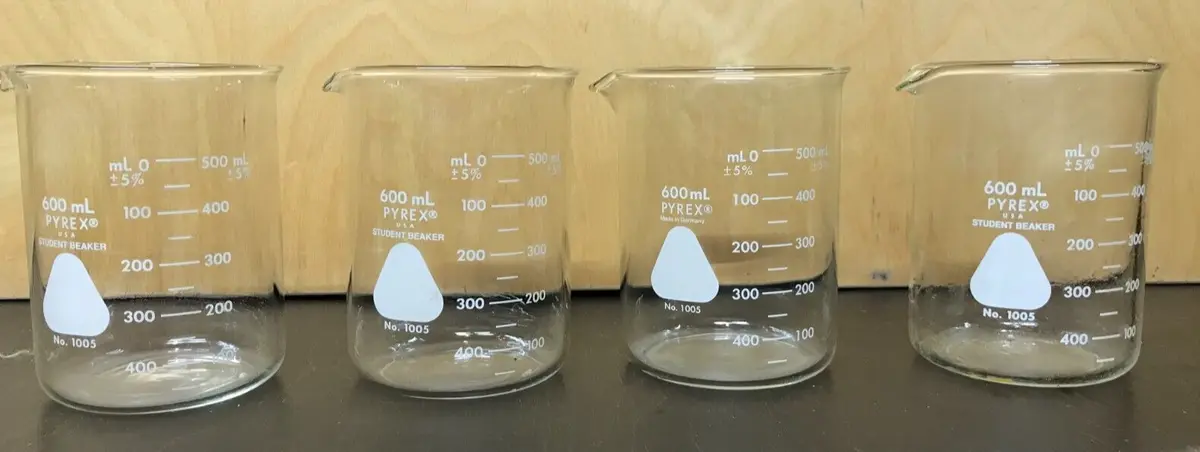
  • Four 600 mL beakers or 4 large cups
  • Room Temperature Water
  • 30 o C water (warm water)
  • 50 o C water (hot water)
  • Thermometers
  • Graduated cylinder
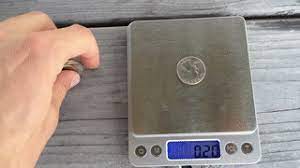
  • Pocket scale
  • Stopwatch (google or phone will work)


1

Select the materials that you have

Procedure:

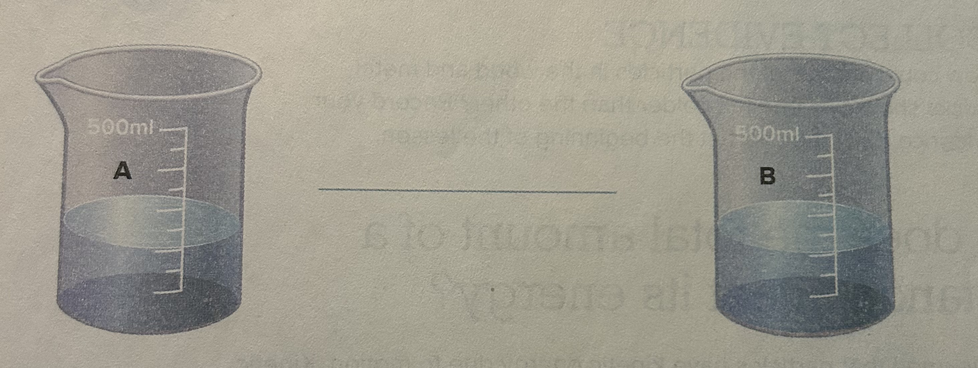
Step 1. Predict the temperatures of the two beakers. Each beaker contains 200g of room temperature water. 100g of 30oC water is added to beaker A. 20g of 30oC water is added to Beaker B. Record your predictions of the temperatures after the water is added by entering >, =, or <.


Step 2. Test your prediction. Label one beaker A and one beaker B. Fill each beaker with 200g of room temperature water. Measure the temperature of the water in each beaker and record the measurements in the Data and observations.


Step 3. Measure 100g of 30oC water. Add to beaker A. Measure the temperature of the water after 1 min. Record your measurement.

Step 4. Measure 20g of 30oC water. Add to beaker B. Measure the temperature of the water after 1 min Record your measurement.

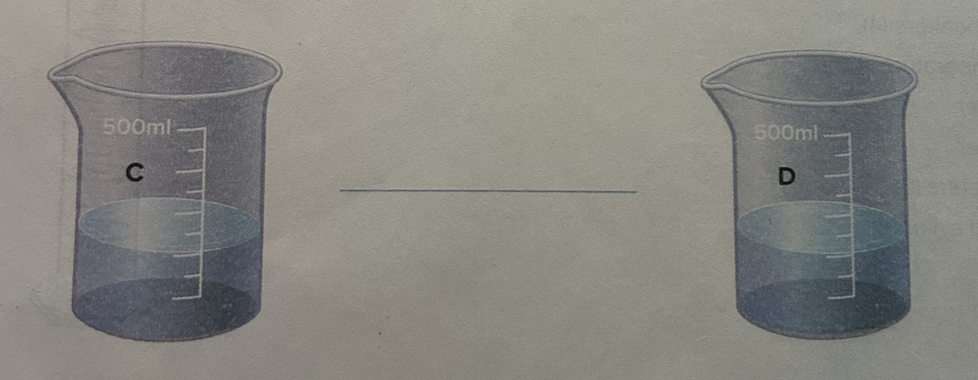
Step 5. Make another prediction. Again each beaker starts with 200g of room temperature water. 100g of 30oC water is added to beaker C. 20g of 50oC water is added to beaker D. Predict the relative temperatures of the two beakers. Record your predictions of the temperatures after the water is added by entering >, =, or <.

Step 7. Test your prediction. Fill each beaker with 200 g of room temperature water. Measure and record the temperature of the water in each beaker on the Data and observation section.

Step 8. Measure 100g of 30oC water. Add to beaker C. Measure the temperature of the water after 1 min. Record your measurement.

Step 9. Measure 20g of 50oC water. Add to beaker D. Measure the temperature of the water after 1 min. Record your measurement.

Step 10. Clean up your station.
8

DATA and OBSERVATION SECTION

Follow the steps below and record your data on this table.

1

Predict the temperatures of the two beakers. Each beaker contains 200g of room temperature water. 100g of 30oC water is added to beaker A. 20g of 30oC water is added to Beaker B. Record your predictions of the temperatures after the water is added by entering >, =, or <.

1
Complete steps 2-4, then type "ok"


Step 2. Test your prediction. Label one beaker A and one beaker B. Fill each beaker with 200g of room temperature water. Measure the temperature of the water in each beaker and record the measurements in the Data and observations.

Step 3. Measure 100g of 30 oC water. Add to beaker A. Measure the temperature of the water after 1 min. Record your measurement.

Step 4. Measure 20g of 30 oC water. Add to beaker B. Measure the temperature of the water after 1 min Record your measurement.

_______
1

Make another prediction. Again each beaker starts with 200g of room temperature water. 100g of 30oC water. 100g of 30oC water is added to beaker C. 20g of 50oC water is added to beaker D. Predict the relative temperatures of the two beakers. Record your predictions of the temperatures after the water is added by entering >, =, or <.

1
Complete steps 7-10, then type "ok"


Step 7. Test your prediction. Fill each beaker with 200 g of room temperature water. Measure and record the temperature of the water in each beaker on the Data and observation section.

Step 8. Measure 100g of 30oC water. Add to beaker C. Measure the temperature of the water after 1 min. Record your measurement.

Step 9. Measure 20g of 50oC water. Add to beaker D. Measure the temperature of the water after 1 min. Record your measurement.

Step 10. Clean up your station.
_______
1

A) Thinking about the predictions you made above and considering your DATA and OBSERVATION section, develop an explanation for any similarities or differences between your predictions and your results. 2-3 full sentences

B) What claim can you make about the relationship between mass and energy?
Use reasoning to explain how your evidence supports your claim. 1-2 full sentences

Energy and Mass


Two Substances have the same average kinetic energy being at the same temperature. when one substance has more particles, that substance has more energy. For example, there are five times as many water particles in 100 grams of water than in 20 grams of water. If the temperatures of the two water samples are the same, the sample with more mass will contain more total energy. The more particles present, the more total energy present in the substance.
1
1

Use what you just read to formulate a conclusion of "how the total amount of a substance affect its energy."

How fast do particles move given the temperature?


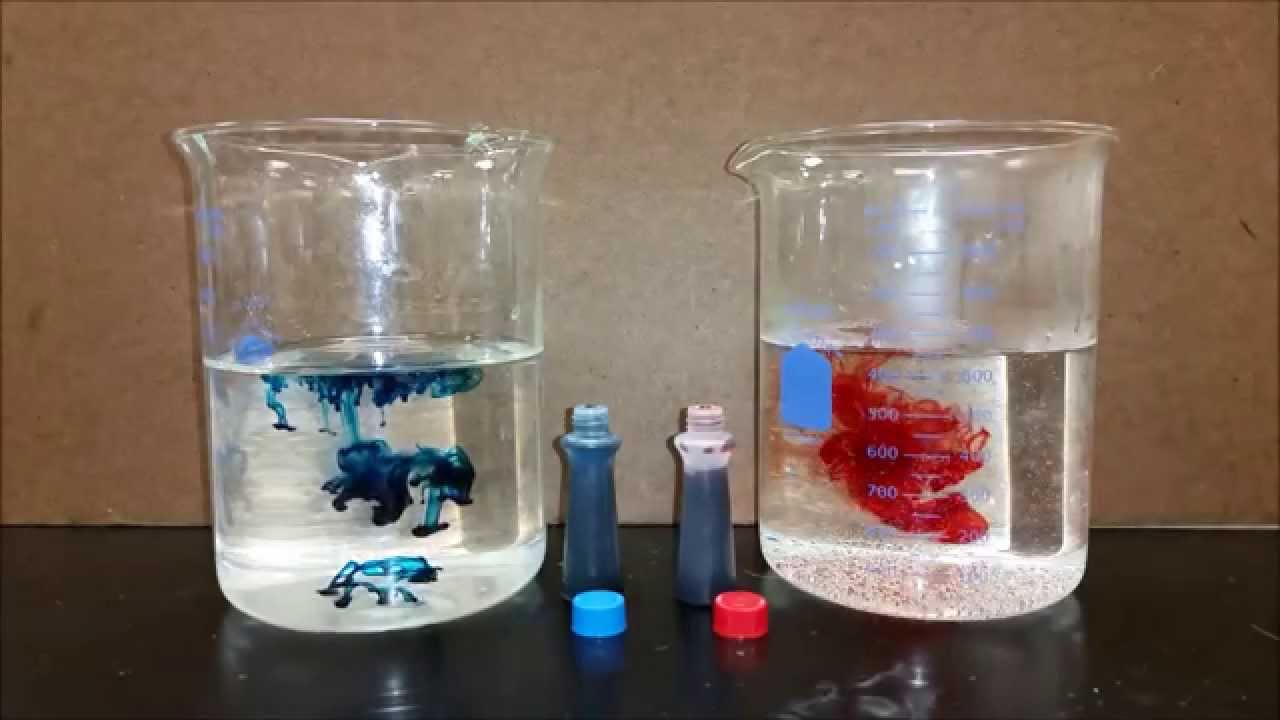
In this lab you will measure the average kinetic rate that food coloring travels in two types of liquids.

Procedure:


Step 1. Prepare one cup of cold water (melted ice added to water) and one cup of warm water (warmed water by a kettle or microwave, etc.. be very careful of the temperature and be safe). Then acquire red and blue food coloring.

Step 2. Set both beakers on a still surface. At the same moment, carefully add red food coloring to the hot water cup only and blue food coloring to the cold cup only. Do not disturb the water. Record your observations after 30 seconds, 1 minute, and 5 minutes in the data and observation section.

Step 3. Clean up your station.

1
1
Complete steps 1-2, then type "ok"


Step 1. Prepare one cup of cold water (melted ice added to water) and one cup of warm water (warmed water by a kettle or microwave, etc.. be very careful of the temperature and be safe). Then acquire red and blue food coloring.

Step 2. Set both beakers on a still surface. At the same moment, carefully add red food coloring to the hot water cup only and blue food coloring to the cold cup only. Do not disturb the water. Record your observations after 30 seconds, 1 minute, and 5 minutes in the data and observation section.

Step 3. Clean up your station.

_______
1

DATA and OBSERVATIONS
*Please record your observations to steps 1-2 here.

1

By looking at your data:

Explain your observations in a few general statements and explain how this makes sense considering your knowledge of thermal expansion, contraction, and kinetic energy.