5.6b: Graphing Inequality
star
star
star
star
star
Last updated over 2 years ago
13 Nsɛmmisa
Do Now
1
Today's Lesson: Graphing Inequalities (Day 2)
1
4
4
3
1
2
A.REI.12
Inequality Word Problems
1
2
2
2
Review of Systems of Equations
0
A1.A.CED.A.3
0
Would you rather live in a world where it constantly snows or always rains?
Would you rather live in a world without music or a world without movies?
Write your responses directly on the screen.
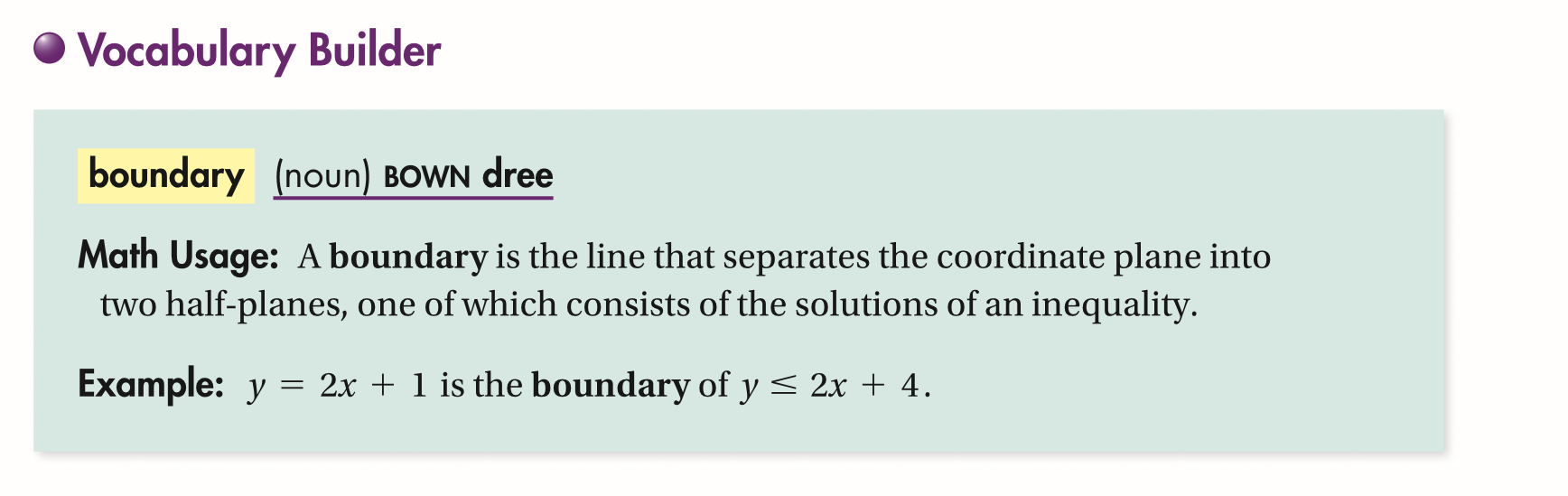
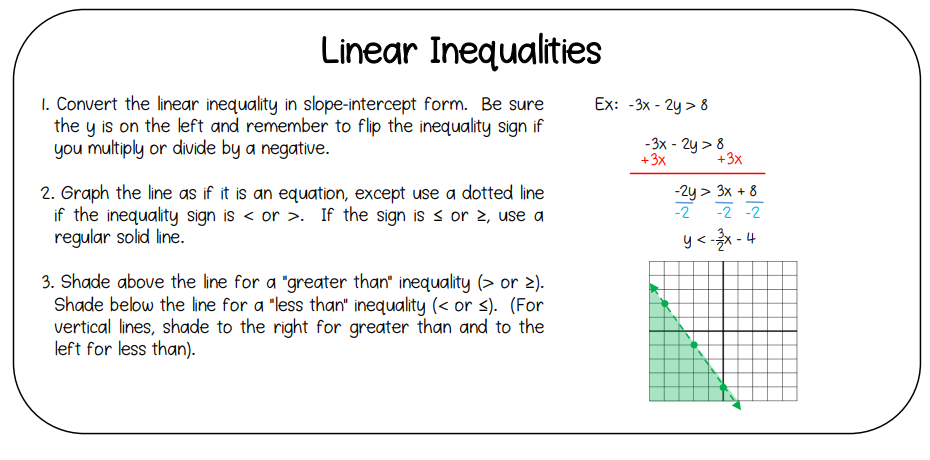
Place each inequality symbol from the left column below into two categories. One to describe its graph's boundary line (dashed or solid) and one to describe its graph's shaded half-plane relative to the boundary line (above or below).
SOLID boundary line
DASHED boundary line
Use Your Vocabulary: Categorize each inequality based on the boundary line of its graph.
y < 3x
2y - 3x ≤ 9
4y ≥ x - 1
y > -5x + 4
Solid boundary line
Dashed boundary line
Of the 10 points added to the graph, which represent solutions of the inequality?
Select all that apply.

Graph the following inequality by drawing on the image. Remember to emphasize whether your line is dotted or solid, and which side of the line should be shaded.
What is the graph of the inequality below?
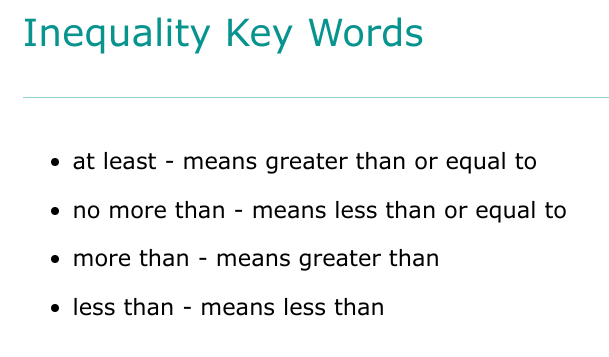
An electronics store sells DVD players and cordless telephones. The store makes a $75 profit on the sale of each DVD player (d) and a $30 profit on the sale of each cordless telephone (c). The store wants to make a profit of at least $255.00 from its sales of DVD players and cordless phones. Which inequality describes this situation?

Mary babysits for $4 per hour. She also works as a tutor for $7 per hour. She is only allowed to work 13 hours per week. She wants to make at least $65. Write and graph a system of inequalities to represent this situation.
Inequality Representing Hours:
Inequality Representing Money Earned:
You can work a total of no more then 41 hours each week at your two jobs. Housecleaning pays $5 per hour and your sales job pays $8 per hour. You need to earn more than $254 each week to pay your bills. Write a system of inequalities that shows the various numbers of hours you can work at each job.
Inequality Representing Hours Worked:
Inequality Representing Money Earned:
Suppose you buy flour and cornmeal in bulk to make flour tortillas and corn tortillas. Flour costs $1.50 per pound and cornmeal costs $2.50 per pound. You want to spend less than $25 on flour and cornmeal, but you need at least 6 pounds altogether.
Let's write a system of linear inequalities to represent this situation.
Inequality Representing Pounds:
Inequality Representing Cost:
Review!
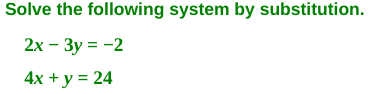
Solve the system by substitution.
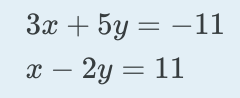
Solve the system by elimination.