Changes Between Solids and Liquids - Teacher Paced
star
star
star
star
star
Last updated 9 months ago
15 questions
When the temperature of ice reaches reaches 0oC, solid ice begins to change to a liquid. While a substance is melting or freezing, the temperature remains constant until the phase change is complete. The point at which a substance changes between a solid and a liquid is referred to as the melting point or the freezing point. The melting point and the freezing point are always the same for a given substance.
When Ice changes to a liquid, the temperature remains constant. What do you think happens when water changes to a gas?
1
1
What does it mean to "keep a constant temperature"?
1
Which of these is not a "phase change"?
1
While a substance is melting or freezing, the temperature remains __________ phase change is complete.
1
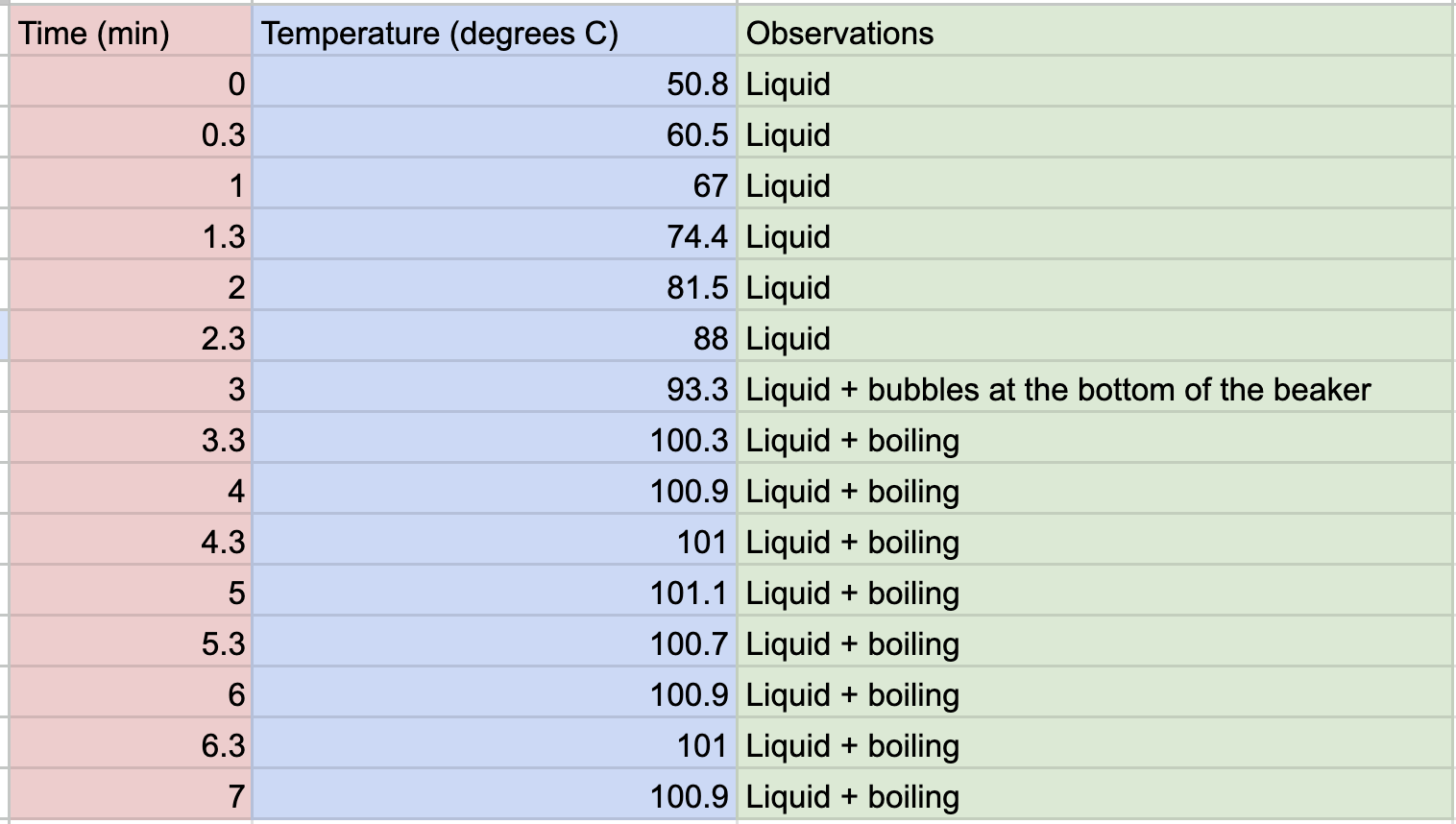
1. Plot the temperature (y-axis) and time (x-axis) data. Label the axes and title.2. For each data set, draw a line that goes through the points.
3. Label the Data with the states of matter that are present.
1. Plot the temperature (y-axis) and time (x-axis) data. Label the axes and title.
2. For each data set, draw a line that goes through the points.
3. Label the Data with the states of matter that are present.
Particle Arrangement
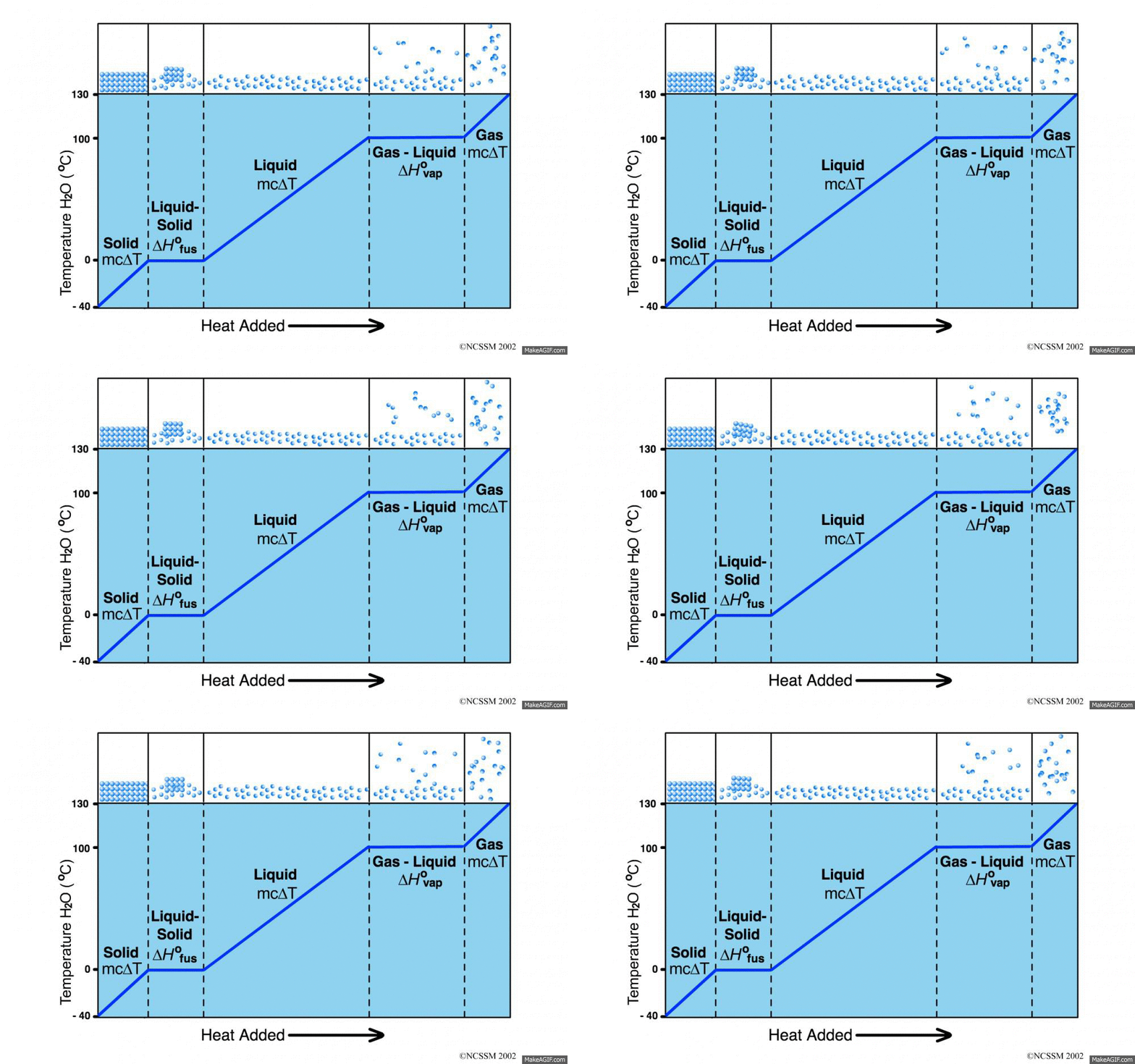
If energy is continually added to a substance, there reaches a point where the particles cannot go any faster without changing into another state of matter - this is called a phase change. Recall that particles in gases are fast moving and spread out from each other. In liquids, particles are closely packed but can slide past each other. In solids, the particles are closely packed and held in a rigid formation. The reason each state of matter had different shapes is because of the particle attractions in each state of matter.
Particle Attraction
When energy is added and the particles cannot move any faster in the current state of matter, the energy is used to overcome the attraction between particles and causes a change of state. The additional energy increases the potential energy of the particles. Potential energy is stored energy due to the interactions between particles or objects. Potential energy increases as the distance between particles increases. Conversely, the potential energy decreases as the distance between the particle decreases. The particles that are farther apart have greater potential energy. The potential energy of the particles, determined by the state of matter present, contributes to the total energy of a substance.
1
2
__________this is called a phase change.
If energy is continually __________ to a substance, there reaches a point where the particles cannot go any faster without changing into another state of matter.
1
"When energy is added and the particles cannot move any faster in the current state of matter, the energy is used to overcome the attraction between particles and causes a change of state."
The additional energy increases the__________. Potential energy increases as the __________.
3
A) Particles close together have__________________________to collide into each other.
B) Particles far apart have__________________________ to collide into each other.
C) In order to separate particles, energy needs to be added to overcome __________________________________________________
Other Answer Choices:
the force of attraction between the particles
less potential energy
more potential energy
the force of gravity
Heating Curves
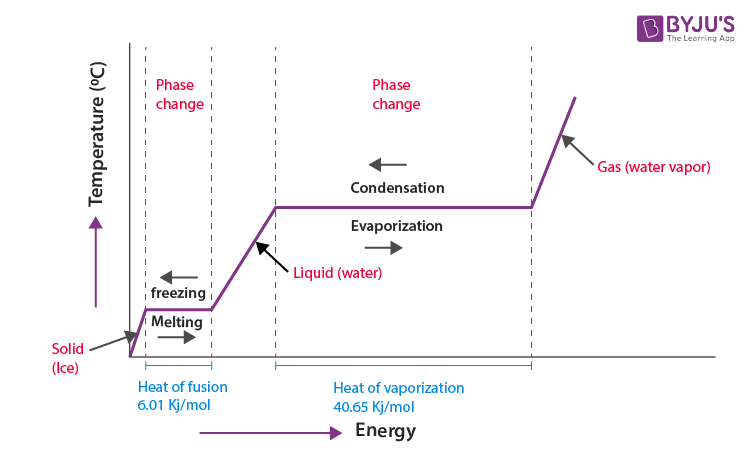
The graph below is the heating curve of water. Just as in the graphs you created, it shows what happens to temperature as energy added to a substance. As energy is transferred to a material, temperature increases when the state of material is not changing. The kinetic energy of the particles increases. This increases of the speed of the particles.
When substance is changing state, temperature stays the same at the melting and boiling points. The increases the distance between the particles.
1
1
Phase changes
solid to liquid ____________
solid to gas ________________
liquid to gas ________________
liquid to solid _____________
gas to liquid _________________
gas to solid _______________
Other Answer Choices:
condensation
sublimation
deposition
evaporation
melting
freezing
1
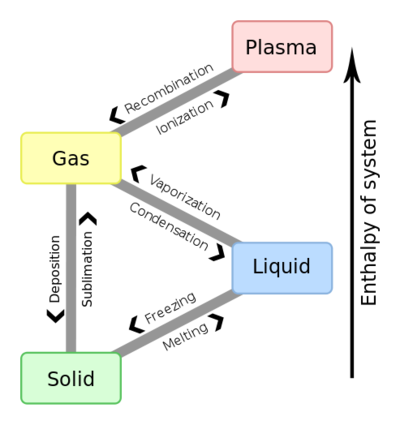
Indicate the process that causes a phase change
MeltingFreezing SublimingDepositionEvaporation/VaporizationCondensation
Indicate the process that causes a phase change
Melting
Freezing
Subliming
Deposition
Evaporation/Vaporization
Condensation
Particles and Melting Points
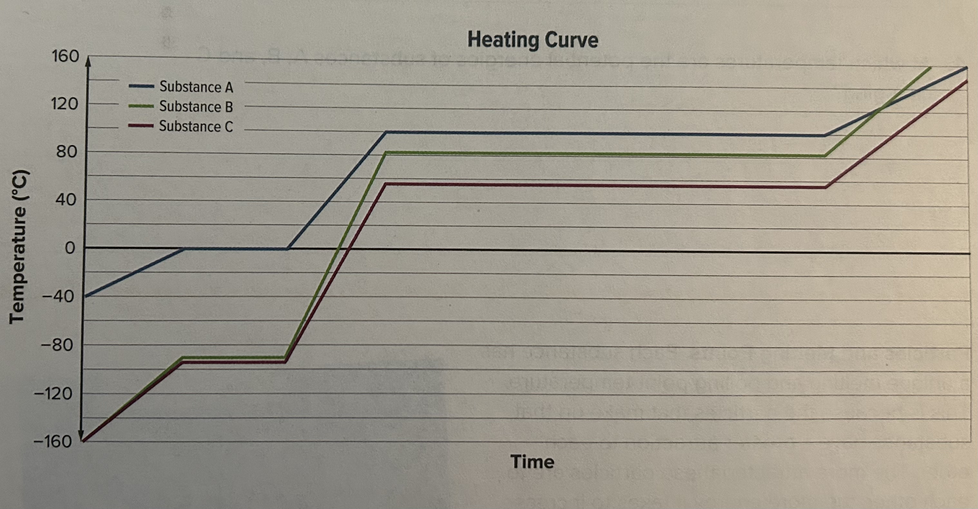
Each substance has a unique melting and boiling point temperature. This is because the particles that make up that substance have greater attraction to each other. The more attracted these particles are to each other, the more energy it takes to increase the distance between particles. This results in higher melting and boiling points. The type of particles that make up a substance affect how much energy is needed to cause a phase change. This is why different substances are in different states at the same temperature.
1
As you are looking at the diagram,
A) The substance that will melt first is __________.
B) The substance that will melt last is __________.
C) Which has the highest melting point __________.
D) Which has the lowest melting point __________.
1
As you are looking at the diagram,
What are the boiling points of?
Substance C degrees C _______
Substance B degrees C _______
Substance A degrees C _______
1