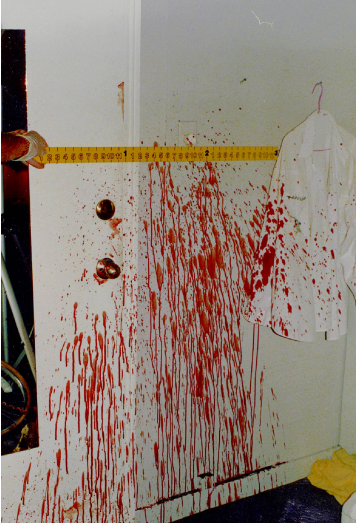
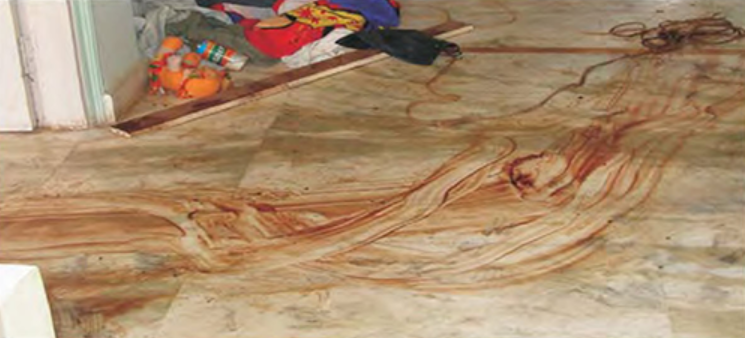
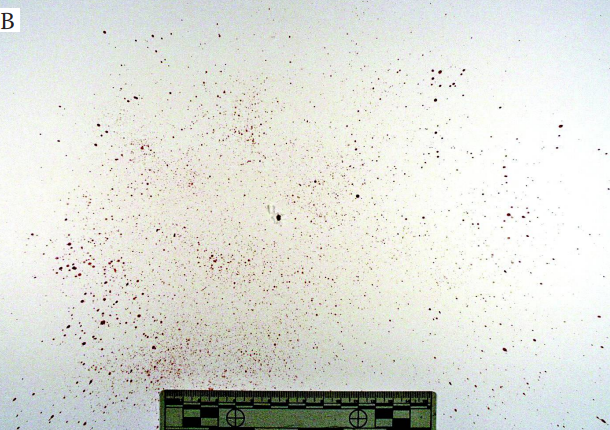
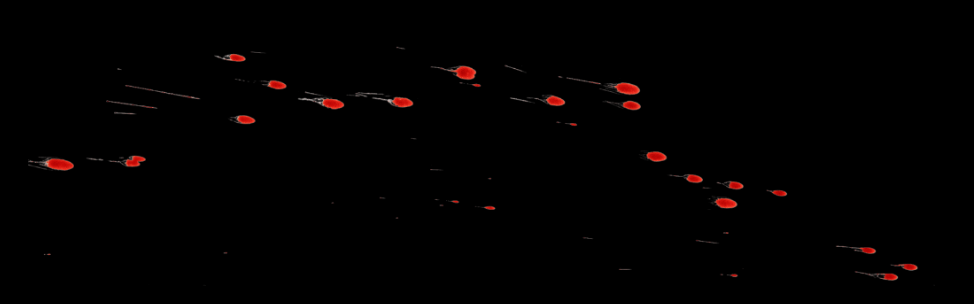
Match the blood spatter/non-spatter patterns to their appropriate description.
| Stavka koja se može prevući | arrow_right_alt | Odgovarajuća stavka |
|---|---|---|
| arrow_right_alt | pattern transfer | |
| arrow_right_alt | impact | |
| arrow_right_alt | wipe | |
| arrow_right_alt | mist | |
| arrow_right_alt | arterial spurt | |
| arrow_right_alt | castoff |
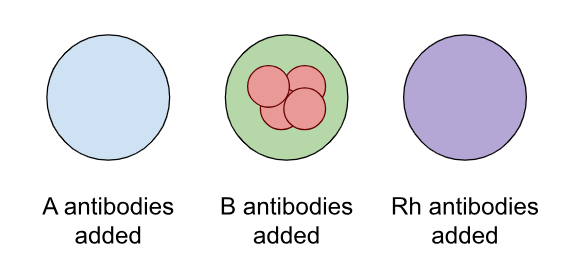
The person above has blood type.
Calculate the impact angle of the following blood droplet.
Cohesion between blood molecules makes them want to .
"Passive" drops (select all that apply):
Passive drops tend to be in shape.
The impact angle for a passive drop is always
The "tail" on the blood drops is known as a(n) . It points in the of motion.
In order to calculate the impact angle of a blood droplet you use the of its width divided by the length.
The students utilize the to estimate the , or height of the event that produced the blood spatter.
It is to calculate the impact angle of high velocity blood spatter.
An example of an event that would produce a high velocity spatter is a