The banana is the most popular fruit in the world, currently making up almost half of all global production of fruit. Every banana you buy at the store is genetically identical to the one next to it! This is because the banana only reproduces by creating clones of itself.
Most bananas grow in tropical climates between the equator and 30 degrees south of the equator. In the wild, bananas sexually reproduce like other plants. In farmed bananas, farmers do not allow the bananas to sexually reproduce. They clone the variety of plants that is best for commercial growing, harvest, and shipping to locations around the world.
Before the 1950s, the world’s choice of banana was the Gros Michel variety because it was creamier, sweeter, and easier to transport than other bananas (they had thick peels, which protected the bananas from bruising). However, between 1890 and 1950, the banana crop in Latin America was almost entirely destroyed. The culprit was a fungus called Fusarium oxysporum. The fungus lives in the soil and infects the roots of the banana plant. It slowly works its way up the plant, eventually choking the plant of nutrients and killing it. Because all Gros Michel individuals were genetically identical, the disease devastated their populations.
Analyze the maps below illustrating the Gros Michel populations in Latin America
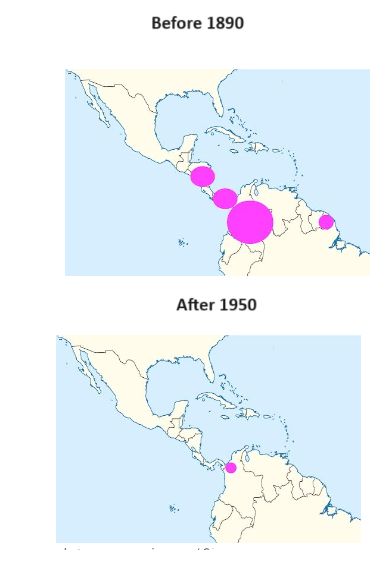
1
1
1
1
Switching to the Cavendish
After almost all the Gros Michel bananas were gone, farmers switched to a different banana variety that was resistant to the Fusarium oxysporum fungus. Currently, 99% of all global banana exports are made up of one variety–the Cavendish banana. But the Cavendish banana might be in danger as well!
A New Environmental Pressure
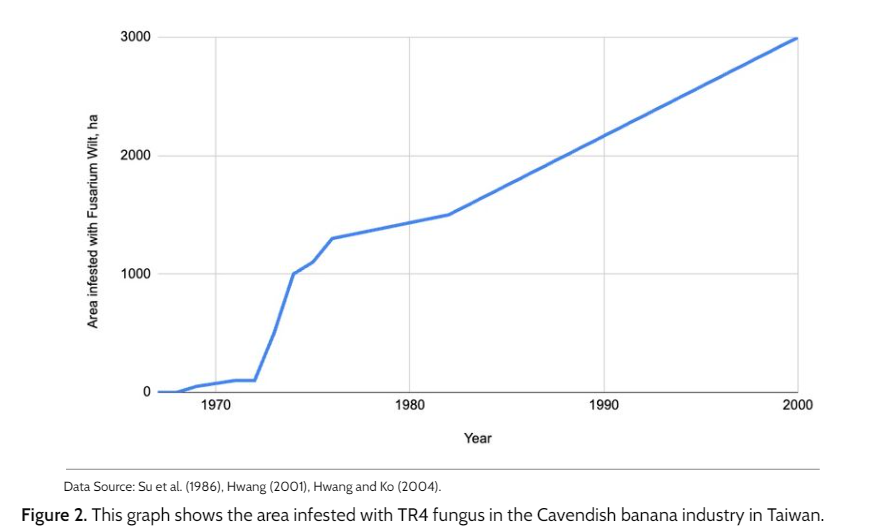
Bananas are facing a new threat. Increasing numbers of Cavendish bananas across Asia, Australia, and Africa are becoming infected by a new fungus. The tropical race 4 (TR4) fungus is unaffected by pesticides and kills Cavendish banana plants. Analyze the graph below (Figure 2) from a case study of TR4 fungus infestation in Taiwan from 1967-1999:
1
1
A Possible Solution to the Banana Crisis
Currently, there are no banana varieties that are resistant to the TR4 fungus, so banana farmers are looking for another solution to their problem.
A scientist named James Dale found a wild banana called Musa acuminata malaccensis that is resistant to TR4, but it has hard seeds that make it difficult to eat. Dale was able to isolate the gene for resistance, RGA2, from the wild banana and insert it into the Cavendish banana plant. This created what is called a genetically modified variety. Dale created six versions.
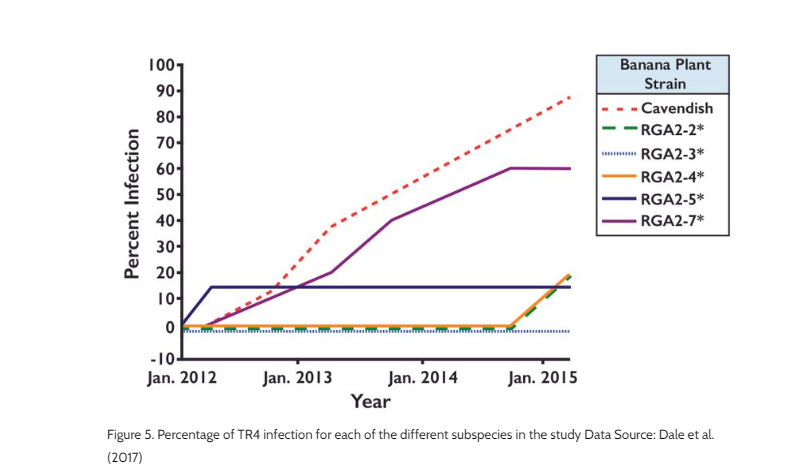
Dale conducted a three-year trial on a banana plantation in Australia where TR4 infection was common and most Cavendish bananas had been killed by the fungus. He planted all Cavendish bananas–a typical variety that was not genetically modified and five genetically modified varieties of the RGA2 resistance gene from the Musa acuminata malaccensis, called RGA2-2, RGA2-3, RGA2-4, RGA2-5, and RGA2-7. The Cavendish and five genetically modified varieties were all grown in the same area, exposed equally to the TR4 fungus.
1
1
Question 9
9.
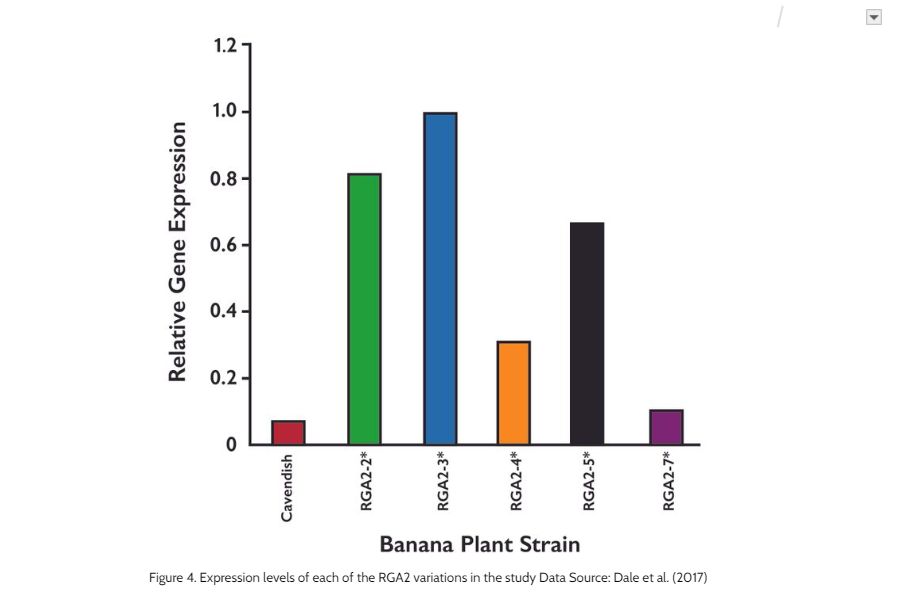
Based on the figure (bar graph), the RGA2 gene is expressed the most in what Banana Plant Strain? Click 2
Question 10
10.
Based on the figure (bar graph), the RGA2 gene is expressed the LEAST in what Banana Plant Strain? Click 2
2
3
Question 12
12.
What relationship do you see between the RGA2 gene expression (Figure 4 bar graph) and the percent infection (Figure 5 line graph)?
0
1
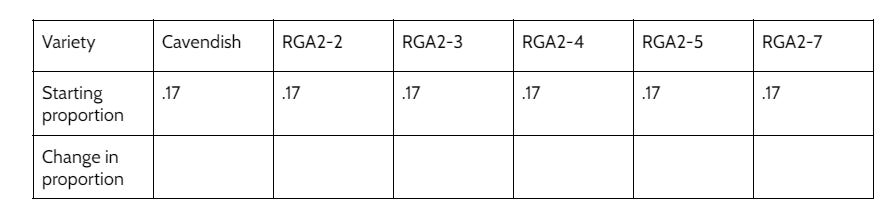
Imagine after the TR4 infection that Dale left his experimental population to reproduce on its own and the environmental conditions did not change. If he came back in 20 years, predict whether each variety would increase or decrease in proportion in the population
1
1
1
1
0
1
Question 21
21.
Although many farmers prefer to grow a single variety of banana with no genetic variation for commercial purposes, some scientists believe that banana farmers should grow multiple banana varieties that can sexually reproduce to prevent future outbreaks of disease that devastate whole populations. Use your understanding of natural selection to explain how this could protect the banana crop from disease. Support your response with evidence and patterns from different cases (like the Florida panthers) you have investigated in this unit.
Question 1
1.
Farmers clone bananas that are best for harvest and shipping to locations.
Question 2
2.
Before 1950's the choice of banana was the Gros Michel because it was creamier, sweeter, and easy to transport.
Question 3
3.
What happened to the population of Gros Michel bananas?
Question 4
4.
The Gros Michel banana populations were so vulnerable to a single fungus because the bananas were genetically identical.
Question 5
5.
Banana farmers are trying to understand the urgency of this problem with the TR4 fungus.
What kind of relationship can you identify between the area infected with TR4 and the number of years passed?
Question 6
6.
Based on this data, what do you predict will happen to the Cavendish banana in the future?
Question 7
7.
Currently how many banana varieties are resistant to the TR4 fungus?
Question 8
8.
The gene for TR4 resistance is
Question 11
11.
Using figure 5 (line graph), identify the TWO banana variations that were most infected by the fungus.
Question 13
13.
When scientists calculated the r value (correlation coefficient) for the relationship between percent infection and RGA2 expression, they got a value of 0.84. Is this a strong or weak relationship?
REMEMBER that the number 1 indicates a strong relationship.
Question 14
14.
Which variations have the greatest resistance to TR4 and will survive the best (choose 3)
Question 15
15.
Do you think the Cavendish banana will increase or decrease in proportion?
Question 16
16.
Do you think the RGA2-2 banana will increase or decrease in proportion?
Question 17
17.
Do you think the RGA2-3 banana will increase or decrease in proportion?
Question 18
18.
Do you think the RGA2-4 banana will increase or decrease in proportion?
Question 19
19.
Do you think the RGA2-5 banana will increase or decrease in proportion?
Question 20
20.
Do you think the RGA2-7 banana will increase or decrease in proportion?