Log in
Sign up for FREE
arrow_back
Library

7.2 Photochemical Smog

star
star
star
star
star
Last updated 12 months ago
20 questions
1
1
1
1
1
1
1
1
1
1
1
1
1
1
1
1
1
1
1
1
Question 1
1.

Use the PDF below for questions 2-12

Question 2
2.

Describe why can ozone be both good and bad?

Question 3
3.

Question 4
4.

Question 5
5.

Explain #4

Question 6
6.

Question 7
7.

Describe what is being done about ozone depletion?

Question 8
8.

Question 9
9.

Question 10
10.

Question 11
11.

Describe what is being done about “bad” ozone?

Question 12
12.

GO HERE for questions 13-14

Question 13
13.

Identify the current air quality index (AQI) in Houston, TX.

Question 14
14.

Scroll down to the Air Quality Index Color Chart – Write down a one-word descriptor of each color code.

Go here for question 15.

Question 15
15.

Identify three health problems associated with “bad” ozone.

GO HERE to play the air quality simulation.

Instructions: Change the settings in the city and notice the effects that those changes have on the amount of “smog” the city produces and the air quality.
Question 16
16.

Take notes about what the various condition changes do to the AQI.

Question 17
17.

Which set of conditions produce the best possible scenario for the city?

Question 18
18.

Identify which set of conditions produce the worst scenario for the people, animals, and plants of the City?

Question 19
19.

Explain how can we reduce smog? (Think about the end of the video)

Question 20
20.

Where do volatile organic compounds (VOCs) come from?

YOU MUST KNOW THIS FOR YOUR TEST/FRQ!

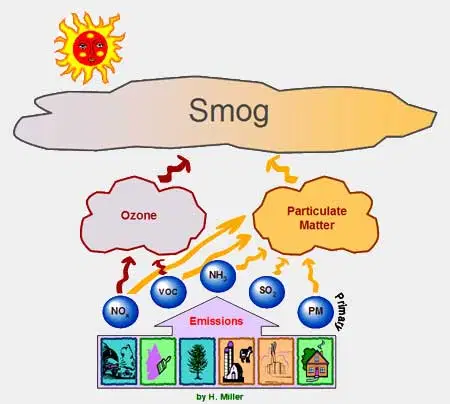
What are the ingredients for photochemical smog?

(Select 4 correct answers)

Heat
Rain
Sunlight
VOCs
Nitrogen oxides (NOx)
What is happening to the “good” ozone layer?
Gradually being destroyed by man-made chemcals
Rapidly being healed by man-made chemcals
Gradually being healed by natural chemcals
Rapidly being destroyed by natural chemicals
How much damage can 1 Chlorine atom do?
Can heal 100,000 "good" ozone molecules
Can destroy 1,000 "good" ozone molecules
Can destroy 100,000 "good "ozone molecules
Can heal 1,000,000 "good" ozone molecules
How does depletion of “good” ozone affect human health and the environment?
Causes increased amounts of UV radiation to reach Earth causing more lung cancer, also increasing crop yields and plant growth
Causes decreased amounts of UV radiation to reach Earth causing more skin cancer, also increasing crop yields and plant growth
Causes increased amounts of UV radiation to reach Earth causing more skin cancer, also reducing crop yields and plant growth
Causes decreased amounts of UV radiation to reach Earth causing more lung cancer, also reducing crop yields and plant growth
What causes “bad” ozone?
Released directly into the air by natural sources such as trees and volcanoes
Released directly into the air by vehicles and factories
Created by a chemical reaction between NOx and VOCs as well as sunlight
What are some sources of “bad” ozone?

(Select 4 correct answers)

Motor vehicle exhaust
Industrial facilities
Gasoline vapors
Electric vehicles
Electric utilities
How does “bad” ozone affect human health and environment?
Being exposed to "bad" ozone can cause skin cancer as well as rapid death to plants and animals that touch it
Humans are uneffected by "bad" ozone, but plants and other animals that are exposed develop black spots on their surfaces
Breathing "bad" ozone can cause respiratory problems as well as damage to agricultural crops and ecosystems
What can we do/actions we can take to reduce our risks?

(Select 6 correct answers)

Continue to do everything the way you are currently doing it
Use approved refrigerants in air conditioning and refrigeration equipment
Check the air quality forecast in your area
Help your local electric utilities reduce ozone air pollution by conserving energy at home and the office
Reduce air pollution from cars, trucks, gas-powered lawn and garden equipment, boats and other engines by keeping equipment properly tuned and maintained
Protect yourself against sunburn.
Use household and garden chemicals wisely