U2D2 Compounding e Jan24
star
star
star
star
star
Last updated about 1 year ago
16 Nsɛmmisa
Hyɛ no nsow a efi ɔkyerɛwfo no hɔ:


1
1
1
1
1
1
1
1
1
1
1
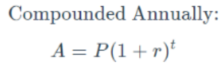
Suppose you invest $1000 in a savings account that earns 3% interest compounded per year. This amount that you invest is called your principal.
How much money will you have at the end of year 1?
After 2 years? After 6 years? Organize your work in the table.
Total Amount of Money $1000
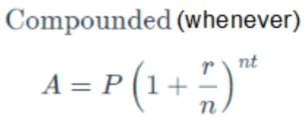
Suppose you invest $1000 at 3% per year but instead of earning the interest yearly, the account earns the interest compounded semi-annually. Thus, each quarter you earn 1/2 of 3% interest or 3/2% interest per quarter.
a. Do you see that 3/2% is equivalent to .03/2?
b. Complete the table to show the amount of money you have.
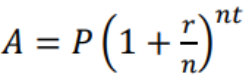
P = 1000, r = .03, n = 2, t = time in years
Total amount of money $1000
After 1 year, how does the amount of money in problem 2 compare to that of problem 1? What caused the difference in amounts?
To get a sense of what is happening, let’s simplify the situation to consider $1 invested at 100% per year for 1 year.
Identify the graph of (use desmos)
Identify the graph of (use desmos)
Tell whether the function represents exponential growth or exponential decay.
Try graphing this. What does the graph do?
Tell whether the function represents exponential growth or exponential decay.
You want to invest $2500 in an account to save for college. Account 1 pays 6% annual interest compounded quarterly. Account 2 pays 4% annual interest compounded continuously. Which account should you choose to obtain the greater amount in 10 years?
Compounded Quarterly (n = 4)
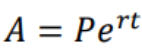
Compounded Continuously
The amount account 1 pays in 10 years is
The amount account 2 pays in 10 years is
Which account should you choose to obtain the greater amount in 10 years?
Identify the graph of (use desmos)
The number of Mycobacterium tuberculosis bacteria after t hours can be modeled by the function
where a is the number of bacteria at 12:00 P.M. and t is the time in hours.
At 12:00 P.M., there are 30 M. tuberculosis bacteria in a sample. Find the number of bacteria in the sample at 3:30 p.m. Round your answer to the nearest whole number.
The number of bacteria is about
represent
Identify the graph of the function.