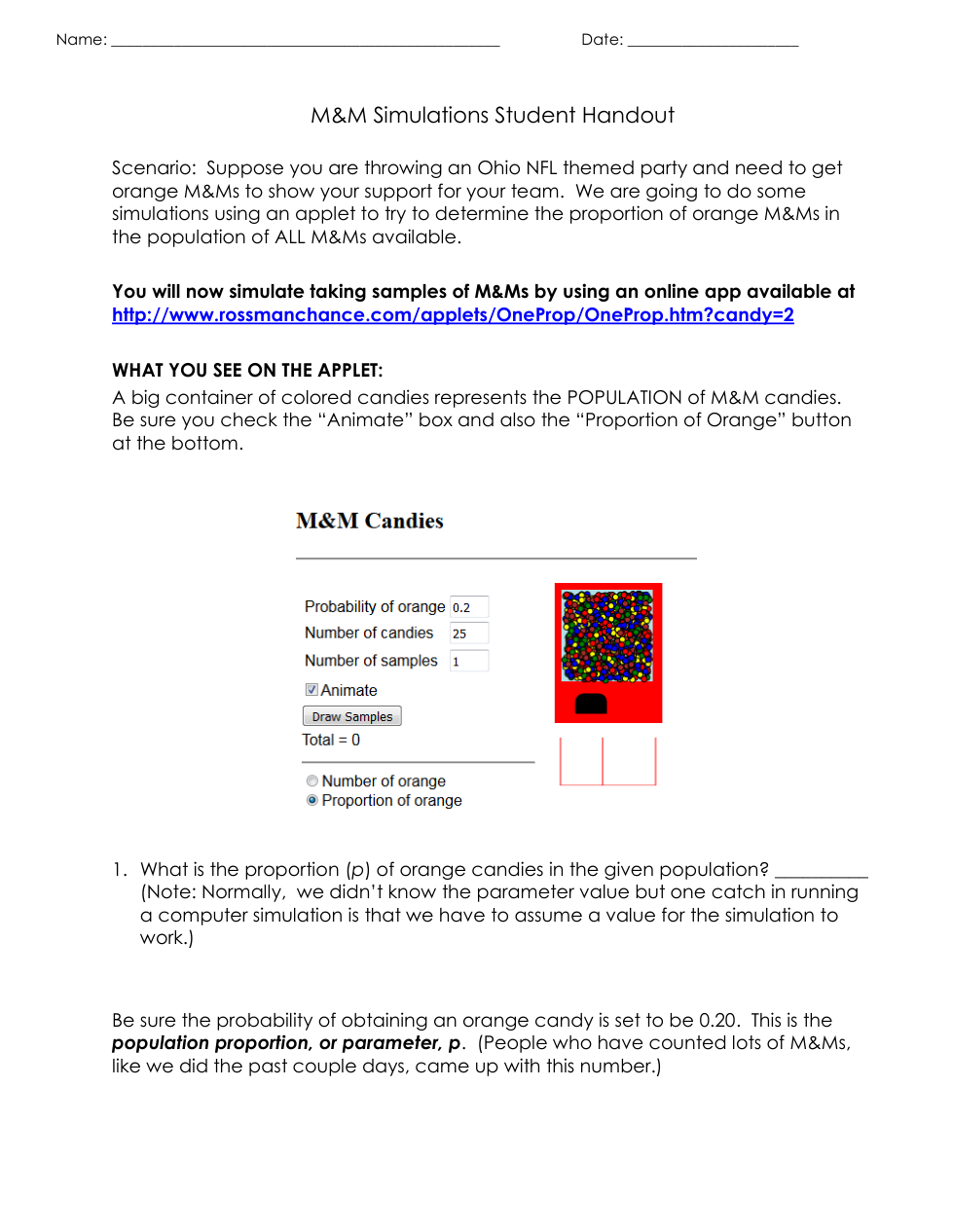
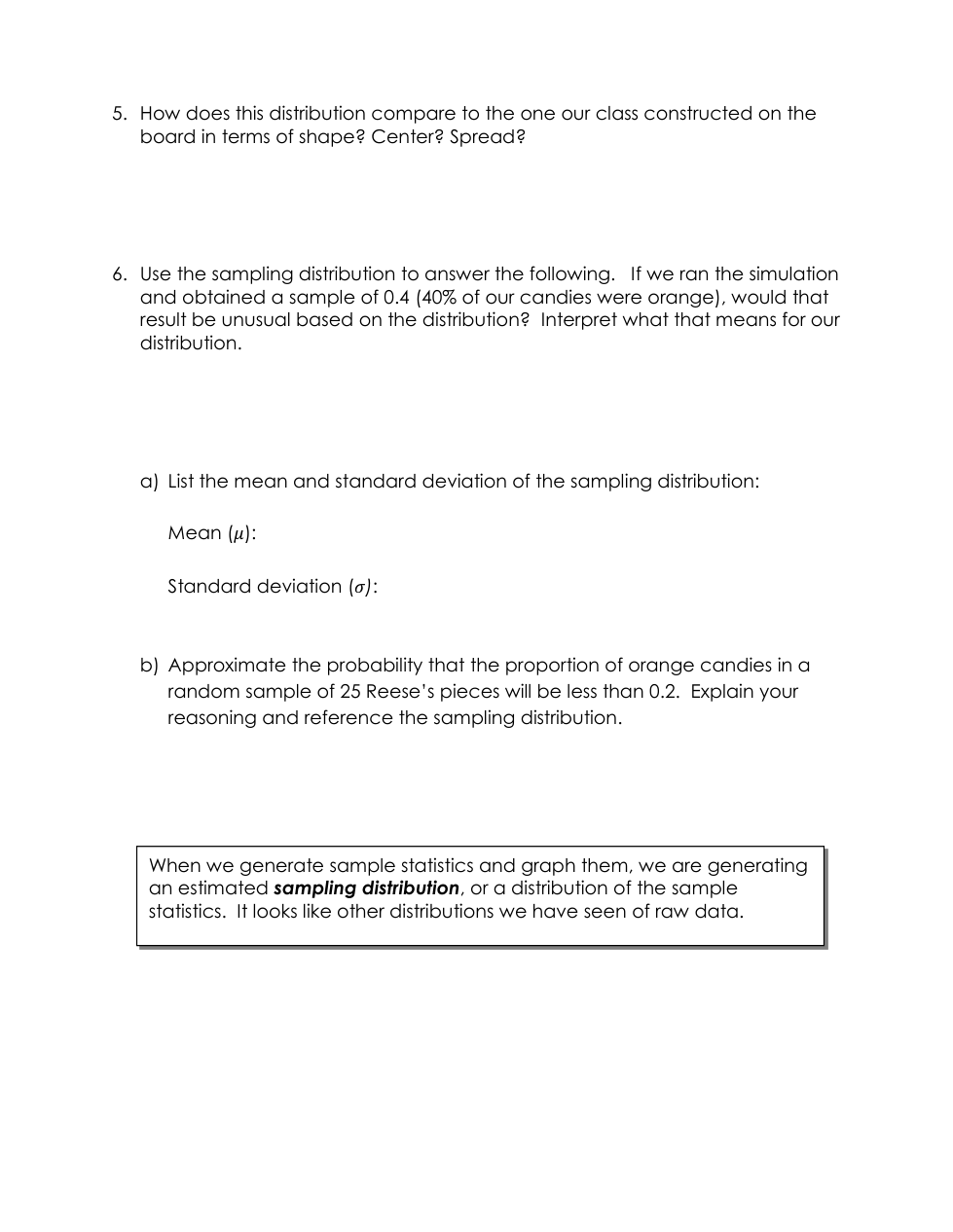
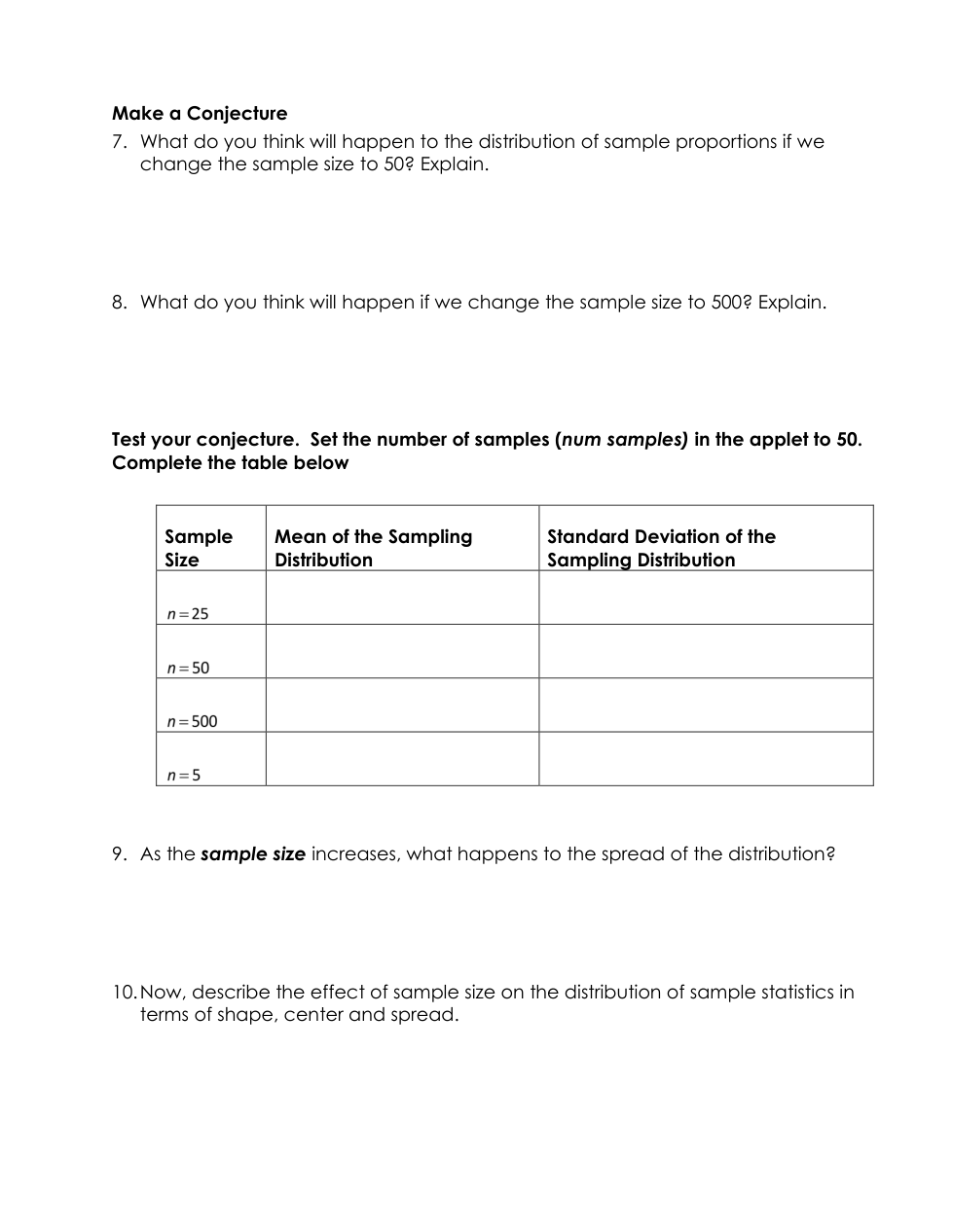
What is the proportion (p) of orange candies in the given population? In other words, what percentage of all m&ms are orange? (you can google this)
1
1
1
1
1
1
1
1
Question 9
9.
How does this distribution compare to the one our class constructed on the board from our previous lesson in terms of shape? Center? Spread?
1
Question 10
10.
Use the sampling distribution to answer the following. If we ran the simulation and obtained a sample of 0.4 (40% of our candies were orange), would that result be unusual based on the distribution? Interpret what that means for our distribution.
1
Question 11
11.
List the mean (you'll find it by the graph on the simulation website)
1
1
1
1
1
1
1
1
1
1
1
1
1
Question 2
2.
Click on the “Draw Samples” button in the applet.
One sample of 25 candies will be taken and the proportion of orange candies for this sample is plotted on the graph. What is the sample proportion (𝑝̂) of orange candies?
Question 3
3.
Repeat this again. (Draw a second sample.)
What is the sample proportion (𝑝̂) of orange candies in this sample?
Question 4
4.
Do you get the same or different values for each sample proportion (𝑝̂) on #2 and 3?
Why do you think that is?
Question 5
5.
How close is each sample statistic (𝑝̂) (answers on #2 and 3) to the population parameter (p) we gave on #1?
1) Uncheck the “Animate” box.
2) Check the “Summary Stats” box.
3) Change the “Number of samples” to 500.
4) Click on the “Draw Samples” button, and see the distribution of sample statistics (in this case proportions) build.
Question 6
6.
Describe the shape of the data.
Question 7
7.
Around where is the center of the data?
Question 8
8.
How far is the data spread out?
Question 12
12.
List the standard deviation (you'll find it by the graph on the simulation website)
Question 13
13.
What do you think will happen to the distribution of sample proportions if we change the sample size to 50? Explain.
Question 14
14.
What do you think will happen if we change the sample size to 500? Explain
Question 15
15.
If we run 50 samples with 25 candies, what is the mean?
Question 16
16.
If we run 50 samples with 25 candies, what is the Standard Deviation (SD)?
Question 17
17.
If we run 50 samples with 50 candies, what is the mean?
Question 18
18.
If we run 50 samples with 50 candies, what is the Standard Deviation?
Question 19
19.
If we run 50 samples with 500 candies, what is the Mean?
Question 20
20.
If we run 50 samples with 500 candies, what is the Standard Deviation?
Question 21
21.
If we run 50 samples with 5 candies, what is the Mean?
Question 22
22.
If we run 50 samples with 5 candies, what is the Standard Deviation?
Question 23
23.
As the sample size increases, what happens to the standard deviation (spread)?
Question 24
24.
As the sample size increases what effect does it have on the distribution of sample statistics in terms of shape, center and spread.