Log in
Sign up for FREE
arrow_back
Library

07 Rocks

star
star
star
star
star
Last updated about 2 hours ago
12 questions
Note from the author:
Required
0
Required
0.5
Required
1
Required
0.5
Required
1
Required
0.5
Learning Objective: Describe the 3 types of rocks.
Success Criteria: Compare the 3 types of rocks.

Gizmo Instructions
If you have not yet signed up for Gizmos, follow these instructions:
  1. Go to http://go-el.com/join
  2. Use code ELPFXXTR
  3. Click next
  4. If you've used Gizmos before and remember your login information, log into your account. Otherwise, create a new account
  5. Write down your username and password and put this information in a safe place

Click here to open the Rock Classification Gizmo

If you need help, please watch the class recording

Learning Objective: Describe the 3 types of rocks.
Success Criteria: Compare the 3 types of rocks.

Gizmo Instructions
If you have not yet signed up for Gizmos, follow these instructions:
  1. Go to http://go-el.com/join
  2. Use code ELPFXXTR
  3. Click next
  4. If you've used Gizmos before and remember your login information, log into your account. Otherwise, create a new account
  5. Write down your username and password and put this information in a safe place

Click here to open the Rock Classification Gizmo

If you need help, please watch the class recording

Question 1
1.

Draggable itemarrow_right_altCorresponding Item
arrow_right_alt
arrow_right_alt
arrow_right_alt
Question 2
2.

Draggable itemarrow_right_altCorresponding Item
arrow_right_alt
arrow_right_alt
arrow_right_alt
Question 3
3.

Question 4
4.
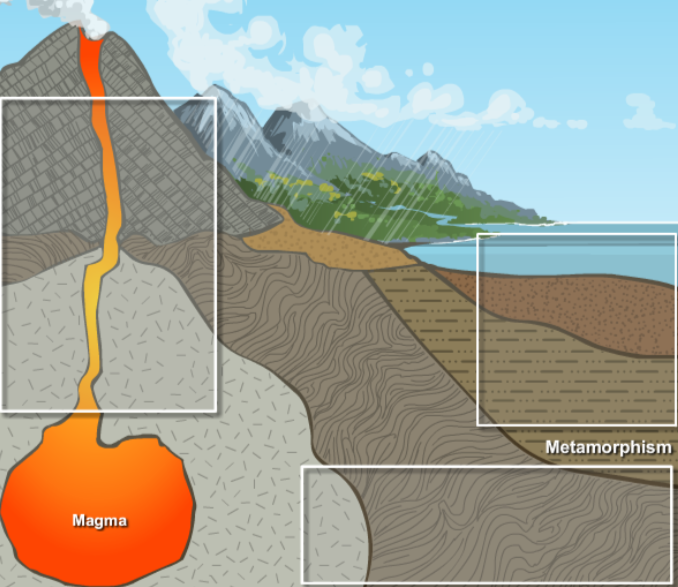
Part 2: Where do different kinds of rocks form?

Igneous rocks that form under Earth’s surface are called intrusive. Intrusive igneous rocks usually have large mineral grains because they form from magma that cools slowly. Igneous rocks that form above ground are extrusive.

Extrusive igneous rocks have small mineral grains or no grains at all because they form from lava that cools quickly.

Heat and/or pressure underground causes the minerals in metamorphic rock to form bands or become "cooked."

Sedimentary rocks form where sediments (pebbles, sand, silt, clay) form layers.
Other Answer Choices:
Intrusive igneous rocks
Extrusive igneous rocks
Metamorphic rocks
Sedimentary rocks
Question 5
5.

Question 8
00:57
keyboard_arrow_down
Required
0.3
Question 9
01:08
keyboard_arrow_down
Required
0.3
Question 10
01:44
keyboard_arrow_down
Required
0.3
Question 7
02:09
keyboard_arrow_down
Required
0.3
Questions 11 & 6
02:57
keyboard_arrow_down
Required
0.3
0
Question 12
12.

In your own words, compare igneous, sedimentary, and metamorphic rocks.

Warm Up: Rocks are classified by how they formed. The three types are:
  • Igneous rocks form from cooling magma or lava.
  • Sedimentary rocks form from the bonding of rock fragments such as sand, silt, or clay; from organic materials; and from chemicals dissolved in water.
  • Metamorphic rocks form when other rocks are changed by heat and pressure.
In which type of rock would you expect to find each of the following?
Sedimentary rocks
Air pockets, or vesicles, formed in rapidly cooling magma or lava
Metamorphic rocks
The remains of ancient plants and animals (fossils)
Igneous rocks
Foliation (layered or banded texture) from minerals flattened by heat and pressure
Part 1: Classify rocks as igneous, sedimentary, or metamorphic.

The three groups of rocks each have unique characteristics. For example, many igneous rocks have a texture of interlocking mineral crystals. Sedimentary rocks may have distinct layers of sediments, known as strata.

To learn other characteristics of igneous, metamorphic, and sedimentary rocks, turn on Show common characteristics in the CHARACTERISTICS pane.

Match each rock type to its common characteristics.
Metamorphic rocks
Formed from cooled magma. Texture of interlocking crystals with no layering or color banding. Some igneous rocks contain small holes or vesicles
Igneous rocks
Formed of particles such as pebbles, sand, silt, or clay cemented together. May contain fossils. Often form in layers.
Sedimentary rocks
Formed from rocks transformed by heat and/or pressure. Interlocking crstal texture often shows foliation (layewrs) or alternating light and dark bands.
Move your cursor over the rock pictures. Based on what you see, classify the rocks by dragging them into the correct box on the CHARACTERISTICS tab. Click on Status to check your answers.

Once you have successfully classified each rock, put each rock below into the appropriate category.
Rock L
Rock E
Rock B
Rock C
Rock G
Rock H
Rock A
Rock F
Rock D
Rock I
Rock J
Rock K
Igneous Rocks
Sedimentary Rocks
Metamorphic Rocks
Drag the rocks from the SIMULATION pane to the correct positions on the LOCATION tab. Click on the Status check box to check your placements as you go.

Each rock is labeled with a letter when you put your cursor on it. Record your findings by sorting the rock samples into the appropriate area.

Hint: there are 4 samples per type
Rock I
Rock G
Rock C
Rock K
Rock L
Rock A
Rock E
Rock H
Rock J
Rock D
Rock F
Rock B
Igneous Rocks
Sedimentary Rocks
Metamorphic Rocks
Question 8
8.
__________ are the building blocks of matter which combine to form __________. These typically arrange in crystal structures to form __________
Question 9
9.

Question 10
10.

Question 7
7.
Layers of small fragments known as sediments cement together over millions of years to form __________ rocks.
Question 11
11.
Due to heat and pressure, minerals in rocks realign and crystallize to form __________ rocks
Question 6
6.
Self Assessment:

Learning Objective: Describe the 3 types of rocks.
I would give myself a __________

Success Criteria: Compare the 3 types of rocks.
I would give myself a __________
What type of rock does cooled magma form?
Sedimentary
Metamorphic
Igneous
Categorize the characteristics of extrusive and intrusive igneous rock
Granite, cools slowly, makes up continental crust, large crystals
Basalt, cools quickly, makes up ocean crust, small crystals
Extrusive Igneous Rock
Intrusive Igneous Rock