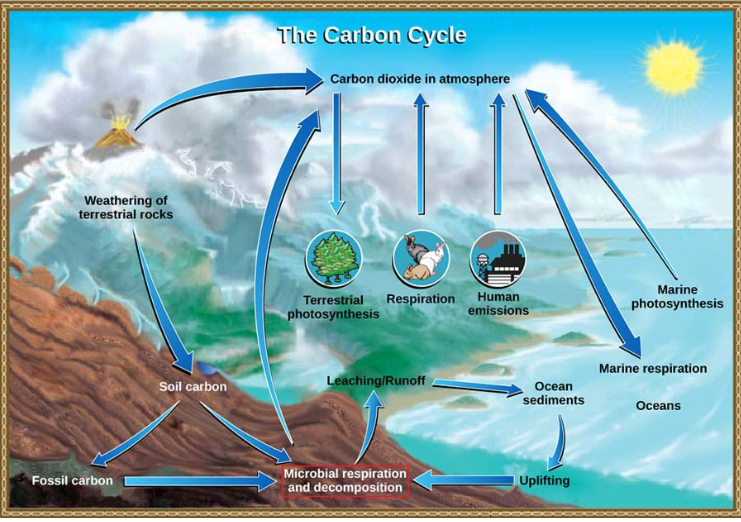
Use the image and the readings that follow it to demonstrate how well you and your group understand the carbon cycle. Work together to answer the questions!
Who is in your group? DO NOT include yourself?
While you are reading keep these question in mind to help you focus on what you should learn from the text.
What does "carbon cycle" mean?
How do all animals, from dinosaurs to humans relate to the carbon cycle?
Carbon is one of the most common elements found in living organisms. All living organisms, including plants and trees, fish in the ocean, and our own bodies are based on the carbon atom. Carbon atoms continually move through living organisms, the oceans, the atmosphere, and the Earth’s interior and crust. This movement is known as the carbon cycle.
Living organisms cannot make their own carbon, so how is carbon incorporated into living organisms? In the atmosphere, carbon is in the form of carbon dioxide gas (CO2 ). Recall that plants and other producers capture the carbon dioxide and convert it to glucose (C6H12O6) through the process of photosynthesis. Then as animals eat plants or other animals, they gain the carbon from those organisms.
How does this carbon in living things end up back in the atmosphere? Remember that we breathe out carbon dioxide. This carbon dioxide is generated through the process of cellular respiration, which has the reverse chemical reaction as photosynthesis. That means when our cells burn food (glucose) for energy, carbon dioxide is released. We, like all animals, exhale this carbon dioxide and return it back to the atmosphere. Also, carbon is released to the atmosphere as an organism dies and decomposes.
Chalk
There are trillions upon trillions of little ocean creatures that capture atmospheric carbon in the form of CO2 and use it to make calcium carbonate (CaCO3) shells. For example, the shells of clams and snails are made of calcium carbonate. Most of the carbonate shells are produced by microscopic creatures called plankton, which float in all oceans of the world. Although they do not live very long, plankton absorb vast quantities of carbon in their shell-building activities. By keeping carbon contained within their shells, marine organisms keep it from being re-evaporated into the atmosphere, where it would accumulate as CO2. When they die, their shells sink to the bottom of the ocean floor to form sediments of limestone and natural chalk.
These sediments are raised above sea level by tectonic activity and create large rock formations. For example, the white cliffs of Dover are gigantic chalk cliffs originally formed from these types of sediment. People mine large amounts of natural chalk from these rock formations. Through a simple chemical reaction with vinegar, we can release the carbon stored in this chalk into the atmosphere, where it will combine with oxygen to form CO2. It is possible that this is the same CO2 that was exhaled by dinosaurs during the Jurassic Period!
When we breathe air in (inhale), that air is made up of a lot of different things - nitrogen, oxygen, carbon dioxide, and a lot of other types of gases. Which one of those gases is most important to us?
How do we get a steady supply of oxygen on earth?
When we inhale our body absorbs the oxygen and when we exhale we breathe out all the other parts of the air - carbon dioxide, nitrogen, and all the other gases. Which of the gases that we breathe out is most important?
What happens to the carbon dioxide we exhale? (Choose all that apply)
What is a marine invertebrate?
Marine invertebrates have shells that are made of calcium carbonate. What happens to the carbon in those shells when the animal dies?
Open this simulation and use it to answer the following questions.
Click "Launch"
Select Carbon Storage on Earth
Click the Carbon Storage on Earth button at the bottom of the screen
Where is carbon stored on earth?
Use Google to find the definitions of organic and inorganic. How are they different?
Which organisms in the ocean use photosynthesis to convert CO2 into O2?
What are two things that happen to carbon in the deep ocean?
True or False? Wildfires take carbon out of the atmosphere
What does burning fossil fuels do to the amount of carbon in the air?
What happens to the amount of carbon in the atmosphere when a volcano erupts?
Which kind of ocean water can hold more carbon dioxide?
Subduction is when a piece of crust is pushed down into the mantle by another piece. At subduction zones carbon is _____