Log in
Sign up for FREE
arrow_back
Library
Early Republic Assessment
By Maria Labus
star
star
star
star
star
Share
share
Last updated about 2 years ago
12 questions
Add this activity
Note from the author:
Labus'
Required
1
Required
1
Required
1
Required
1
Required
1
Required
1
Required
1
Required
1
Required
1
Required
1
Required
1
Question 1
1.
Washington set many precedents as the first President. Which of the following was a precedent from Washington?
Developed and encouraged political parties
Issued an embargo act against foreign countries
Declared a policy of neutrality
The first Supreme Court case concerning judicial review
Question 2
2.
The Federalists and Democratic Republicans emerged as separate political parties partly as a result of the disagreement over --
How the nation should develop economically
Whether to enforce the Monroe Doctrine
How the nation should admit new states
Whether to approve the Declaration of Independence
Question 3
3.
Which of the following is the best example of an early U.S. struggle to define the domestic authority of the central government?
The XYZ Affair
The War of 1812
The Barbary Wars
The Whiskey Rebellion
Question 4
4.
What was Secretary of the Treasury, Alexander Hamilton's plan to repay financial debts from the American Revolution?
Build the Erie Canal, print lots of money, give money back to France & Spain
Taxes & protective tariffs, create a national bank, loan money to businesses
Tax the farmers and give the money to merchants, create a national bank in the South, trade with France
Increase the time to become a citizen from 5 to 14 years, outlaw criticism of the government, send diplomats to France
Question 5
5.
What two pieces of advice did President Washington give the nation in his Farewell Address?
Keep Calm and Carry On
Avoid permanent alliances and political parties
Be the first in war and the first in peace
Maintain alliances with all foreign nations
Question 6
6.
What was the significance of the Supreme Court case,
Marbury v. Madison
?
It outlawed slavery in the Northwest territory
It allowed Jefferson to buy the Louisiana Purchase which doubled the size of the United States
It created the free enterprise system
It established judicial review by declaring a law unconstitutional
Question 7
7.
Which of the following best summarizes the reason for the The Alien and Sedition
Acts being repealed?
It was a violation of the first amendment -- freedom of speech and press
Farmers refused to pay their taxes
The U.S. had the policy of isolationism.
It expelled poor merchants from the United States.
Question 8
8.
In 1814, the United States and Britain signed the Treaty of Ghent which ended the
War of 1812. Which statement best explains the results of the treaty?
The Treaty of Ghent caused the U.S. to lose land
The Treaty of Ghent established freedom of the seas for all nations
The Treaty of Ghent simply ended the war between two countries.
The Treaty of Ghent established the exact boundary between the U.S. and Canada.
Question 9
9.
James Monroe’s foreign policy can best be described as -
open trade and global exchange with all foreign nations
isolationist who refuses to extend help to a nation in need
believer in mercantilism and commerce for the good of the “mother country”
no European nation shall attempt to re-colonize the Western Hemisphere
Question 10
10.
Which of the following was the main point of disagreement between the first two
political parties in the U.S.?
The number of slave states allowed in the Union
The strength of the country’s central government
The system of checks and balances in government
The number of representatives a state sent to Congress
Question 11
11.
The Whiskey Rebellion challenged the idea that --
The federal government had the power to pass and enforce tax laws
A national military was needed for dealing with foreign threats
The federal government could raise tariffs to protect industries
A national court system was needed for resolving disputes between states
zoom_in
Required
1
Question 12
12.
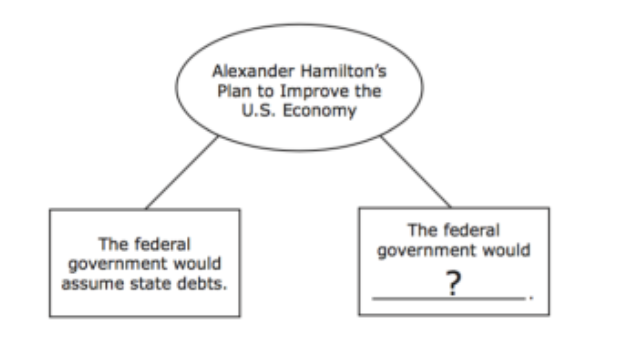
Which action completes this diagram?
Oversee state government agencies
Regulate the creation of new businesses
Establish a national bank
Eliminate protective tariffs