Log in
Sign up for FREE
arrow_back
Library

Earth's Rotation & Revolution - Concept Check

star
star
star
star
star
Last updated almost 2 years ago
10 questions
1
5.8.C
1
5.8.C
1
5.8.C
1
5.8.C
1
5.8.C
2
5.8.C
1
5.8.C
1
5.2.D
5.8.C
1
5.2.D
5.8.C
1
5.3.B
5.8.C
Question 1
1.

Question 2
2.

Question 3
3.

Question 4
4.

Question 5
5.

Question 6
6.
This question has two parts. First, answer Part A. Then answer Part B.

Part A
A student looks outside and observes the sun in the western sky. Which of the following times could it be? __________

Part B
Which statement provides evidence to support the answer to Part A? __________
Question 7
7.
Earth revolves around the sun, but it also makes a complete rotation. How long does it take Earth to make one complete rotation on its axis?

_______ hours
Question 8
8.

Question 9
9.

Question 10
10.

Students are asked to draw a diagram to show the process that causes day and night. Which of the following student diagrams correctly shows the process that causes the day/ night cycle?

Earth rotates on its axis once approximately every –
year
24 hours
12 hours
month
A person standing in Alabama notices the sun is rising. At the same moment, a person in Japan sees that the sun has just set. Which statement correctly describes how it can be sunrise and sunset at the same moment?
The sun has moved from one location to the other during the course of the day.
Earth has circled around the sun during the course of the day.
Earth's rotation on its axis enables part of Earth to have sunlight while the other part is in darkness.
The sun's rotation around the Earth enables part of Earth to have sunlight while the other part is in darkness.
Earth's rotation causes the day and night cycle. It also causes –
the sun to orbit Earth.
all of the above.
the sun to appear to move.
the sun to remain in orbit.
Which statement correctly describes the sun's apparent movement across the sky?
As Earth spins on its axis, it makes the sun appear to move across the sky.
The sun rotates around the Earth every 12 hours, making the sun appear to move across the sky.
Earth rotates around the sun every 24 hours, making the sun appear to move across the sky.
As the sun spins around the Earth, it moves across the sky.
A student notices the sun in the eastern part of the sky. What time of day could it be when the student makes this observation?

Select TWO correct answers.
4:00 A.M.
9:30 P.M.
10:00 A.M.
3:00 P.M.
8:00 A.M.
In an activity, students make a la human sundial. The sundial uses the sun to tell the approximate time of day.
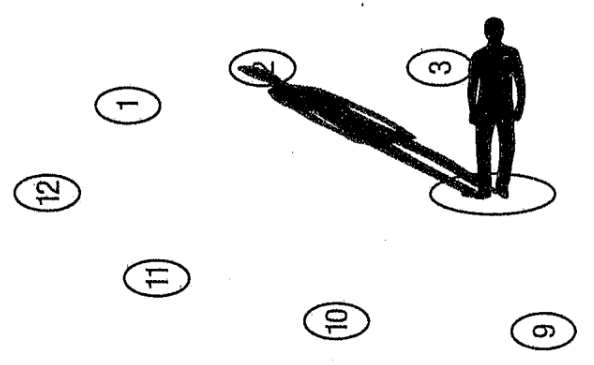

How is it possible?
Earth moves around the sun each day, causing the sun to appear to move across the sky.
The sundial measures the distance from Earth to the sun as it moves across the sky.
The sun moves across the sky each day because it spins around the Earth.
The position of the sun appears to change during the day because Earth rotates.
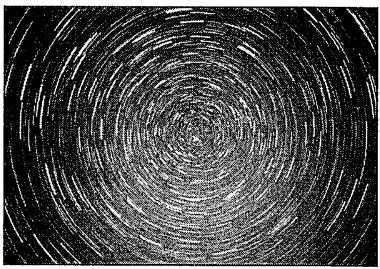
This photograph shows the night sky over a period of many hours.


Why does the night sky appear to move in a circular pattern?
The night sky rotates over Earth.
Earth rotates on its axis once a day.
Stars travel in a circular direction around Earth.
Earth rotates on its axis once every 12 hours.
