Log in
Sign up for FREE
arrow_back
Library

8th Grade Winter Benchmark

star
star
star
star
star
Last updated over 2 years ago
15 questions
1
1
1
1
1
1
1
Below is a picture of the rock strata of a mountain.
1
A group of students is developing a model that shows how geoscience processes gradually change Earth’s surface. The group comes up with the following drawing.
1
Examine the diagram below. At one time, these layers were found in the same area of land. Yet they have weathered very differently, with one location having more layers than the other location.
1
The first watermelons cultivated many years ago (3000 BCE) were very different from today’s watermelons grown by farmers in many places and climates all over the world.
The data table compares how watermelons today compare to the oldest known watermelons.
1
Question 11
11.

Mutations are structural changes to genes that may affect proteins. Some mutations are beneficial, meaning that they help the organism. Some mutations are harmful because they reduce the organism’s ability to survive or reproduce. Other mutations neither help nor harm the organism. These are called neutral mutations
1
Below is an image of a family tree (first generation) showing a group of mice. A dark gray mouse and a white mouse had four offspring, some had white fur, while others had dark gray fur. Use the image below to help you answer the following questions.
1
One of the white offspring (from the first generation in the introductory text) mated with an unrelated white mouse. Below is a family tree (second generation) showing these parents and their offspring. The parents’ genotypes are also shown in this image.
1
1
Question 1
1.

Question 2
2.

Question 3
3.

Question 4
4.

Question 5
5.

Question 6
6.

Question 7
7.

Question 8
8.

Question 9
9.

Explain what has happened to cause the layers in these locations to weather differently and how this provides evidence that Earth’s surface has changed over time.

Question 10
10.

Freckles are a dominant trait. Brianna has freckles, but her husband, Emilio, does not. They calculate the chances that their children will have freckles by completing a Punnett square.

What is the probability that each child will have freckles?
0%
25%
50%
75%
Question 12
12.

Question 13
13.

Question 14
14.

Question 15
15.

Explain your reasoning.

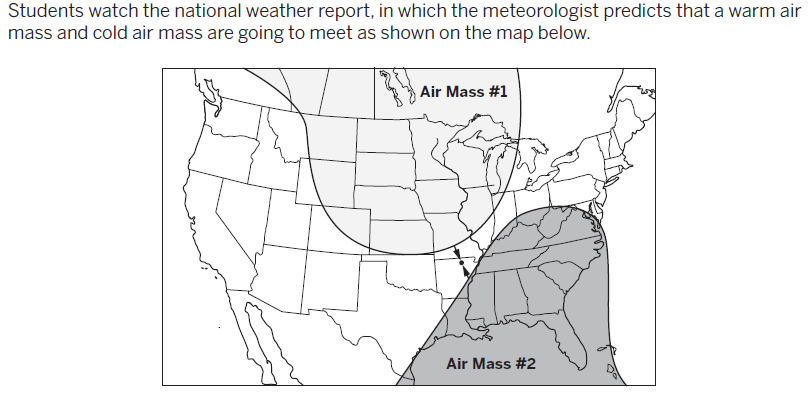
Which is the most likely weather condition that will occur at the location where the two air
masses meet?
A a very cold day
B a hot, windy day
C a nice, sunny day
D a cloudy, rainy day
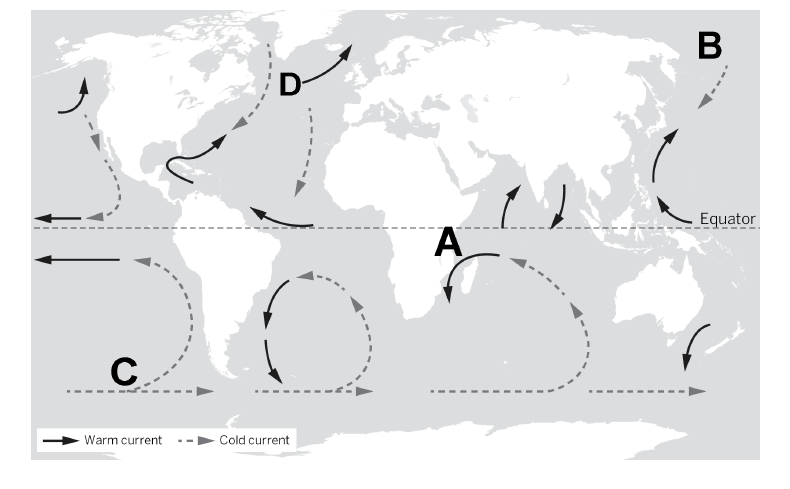
Raquel thinks that the current that carries the most energy is located at the area labeled A. Is
this an accurate statement? Explain.
A Yes - this current is closest to the equator and therefore receives more energy from the sun.
B Yes - this current is closest to the equator and therefore receives a lot of energy from the cold
current that comes from the poles.
C No - this current is closest to the equator, and therefore loses a lot of energy to the sun.
D No - this current is closest to the equator, and therefore loses a lot of energy to the water.
Which of the following is the correct relationship between energy, sun, and the air?
A. Energy is transferred from the sun directly to the air.
B. Energy is transferred from the sun to Earth’s surface.
C. Energy is transferred from the sun to the air, and then to Earth’s surface.
D. Energy is transferred from the sun to the Earth’s surface, and then to the air.
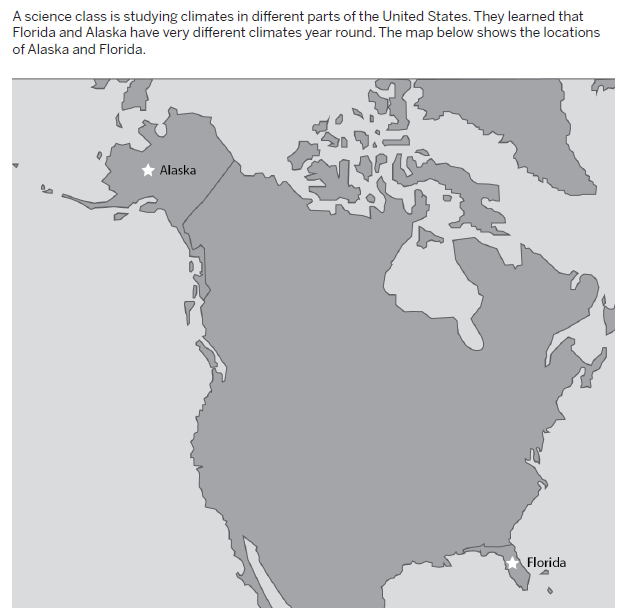
Which location, Florida or Alaska, gets more energy from the sun? Explain.
A. Florida - Areas closest to the equator get more energy from the sun.
B. Florida - Areas closest to the equator get more energy from the sun.
C. Alaska - Areas farthest from the equator get more energy from the sun.
D. Alaska - Areas closest to the poles get more energy from the sun.
You want to live in a city in Florida where the temperatures are relatively stable. Would you
choose a coastal city or one inland, one that is away from any water body? Explain.
A. Inland - land gains and loses energy more slowly than the ocean.
B. Coastal - the ocean gains and loses energy more slowly than the land.
C. Inland - land gains energy faster, but loses it more slowly than the ocean.
D. Coastal - the ocean gains and loses energy faster than land.
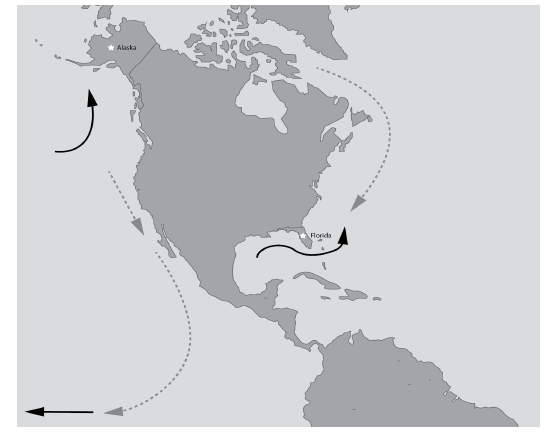
How do the currents off the coast of Florida and Alaska compare?
A. Although they are both warm currents, the one off of Florida’s coast has less energy.
B. Although they are both cold currents, the one off of Alaska’s coast has more energy.
C. Although they are both cold currents, the one off of Alaska’s coast has less energy.
D. Although they are both warm currents, the one off of Florida’s coast has more energy.
What can you infer about the layers in this picture?
The rock layers at the top of the mountain are the oldest.
The rock strata can provide an absolute time scale of Earth's history.
The rock strata can be used to understand relative dates in Earth's history.
The rock layers in the mountain are made out of materials that are the same age.
How can this model help the students explain how geoscience processes shape Earth's surface?
The model shows that an increase in precipitation leads to a decrease in the amount of movement of glaciers.
The model shows that when glaciers move, they can leave marks in different structures, such as land or mountains.
The model shows that melting glaciers do not have to move, since they are constantly being refreshed with more snow.
The model shows how global climate determines whether glaciers will move or melt, which affects the way landforms are shaped.
Which of the following statements explains why modern watermelons differ from those grown in ancient times?
Over time, farmers chose to plant the seeds of big, sweet, and soft watermelons.
People in the past preferred to grow smaller, harder watermelons with less sugar.
The watermelons that people grew in ancient times needed less water and soil nutrients.
Over time, animals chose to eat the biggest, sweetest, and softest watermelons and spread the seeds.
Which of these mutations would be considered neutral?
A
B
C
A and C
Which of the following descriptions about the parents is most likely true?
Their gene combinations for the fur color trait are the same.
Their gene combinations for the fur color trait are different.
Their gene combinations for the fur color trait depend solely on the environment.
Their gene combinations for the fur color trait do not affect their offspring.
Which best describes the light gray mouse’s genotype for the fur color trait?
A1A1A2
A2
A1A2
A1A1