Log in
Sign up for FREE
arrow_back
Library

Protein Synthesis Practice Worksheet

star
star
star
star
star
Last updated about 2 years ago
26 questions
Protein Synthesis and Codons Practice
Protein synthesis is the process where a sequence of DNA is used to build a protein from individual amino acids. The first step in this process is called TRANSCRIPTION, where a coding region of DNA is converted to messenger RNA (mRNA). During transcription, mRNA is made from the DNA sequence following the base pair rule, except RNA does not contain the base Thymine, but instead has Uracil. The mRNA then leaves the nucleus and goes to a ribosome in the cell's cytoplasm. The ribosome reads the message three bases at a time, called a CODON. Each codon will specify a single amino acid. The amino acids are joined together and folded into a protein, a process called TRANSLATION
Key Points:
  • DNA is used to make a copy of mRNA (transcription)
  • mRNA leaves the nucleus and goes to ribosomes
  • 3 bases = codon
  • 1 codon = a single amino acid
  • A chain of amino acids = a protein
  • Protein synthesis is also called translation
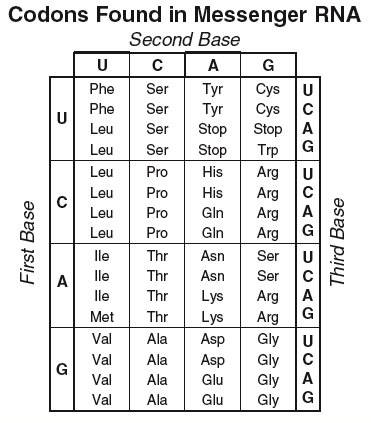
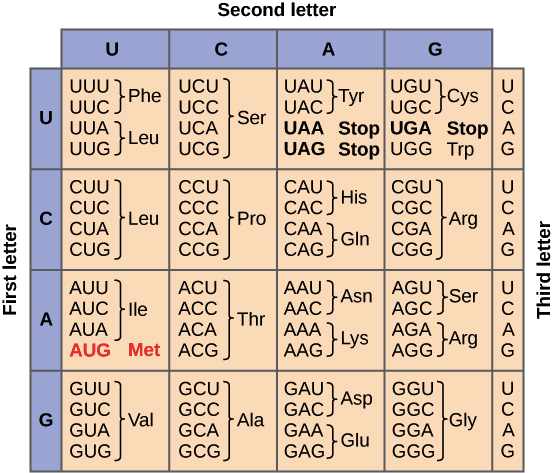
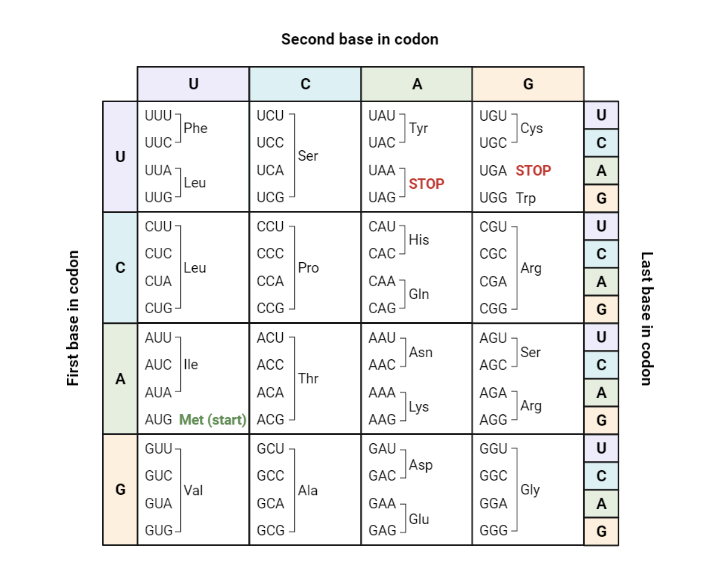
Biologists use a codon chart or a codon wheel to determine the amino acids. Amino acids are usually abbreviated on these charts as three letter words, like Cys and Ser.
4
4
4
0
4
0
4
4
Question 1
1.

What is a codon?

Question 2
2.

What is the role of a codon in protein synthesis?

Question 3
3.

Where does translation occur in the cell?

4
Question 4
4.

Use the codon chart to write the amino acid that corresponds to CCC.

4
Question 5
5.

Use the codon chart to write the amino acid that corresponds to CAG.

4
Question 6
6.

Use the codon chart to write the amino acid that corresponds to GAA.

4
Question 7
7.

Use the codon chart to write the amino acid that corresponds to UUU.
4
Question 8
8.

Use the codon chart to write the amino acid that corresponds to AGU.

4
Question 9
9.

Use the codon chart to write the amino acid that corresponds to UAC.

4
Question 10
10.

Use the codon chart to write the amino acid that corresponds to CGU.

4
Question 11
11.

Use the codon chart to write the amino acid that corresponds to CCA.

Write the CODON that corresponds with each amino acid. There may be more than one (any one code is all you need to type in. The full names are written, but the codon chart only shows the first three letters.
4
Question 12
12.

Proline

4
4
4
4
4
4
Question 18
18.

A single codon is used to signal the beginning of protein synthesis. It is commonly called the START CODON.
Locate the start codon on the chart. What are the three bases of this codon?

4
For each sequence of DNA is shown. Type the complementary RNA sequence , then use the codon chart to determine the amino acid sequence:
DNA → TAC CAT GGA ATT ACT
6
Question 20
20.

RNA SEQUENCE (put 1 space between each codon in all capital letters)

6
Question 21
21.

Amino Acid Sequence (type out with a space after each three letters).

Question 22
22.

Circle the mutation.

Question 23
23.

What type of frame shift mutation was shown in the picture on number 22?

Question 24
24.

Circle the mutation.

Question 25
25.

What type of mutation is shown in question 24?

Question 26
26.

Match the following mutation to its definition.

Draggable itemarrow_right_altCorresponding Item
Nonsense
arrow_right_alt
A mutation that causes the reading frame to shift, altering the sequence.
Missense
arrow_right_alt
Premature termination of protein synthesis due to a stop codon.
Frameshift
arrow_right_alt
A mutation that changes one amino acid to another.
Question 13
13.

Valine

Question 14
14.

Histidine

Question 15
15.

Glycine

Question 16
16.

Phenylalanine

Question 17
17.

Arginine

Question 19
19.

There are three codons that signal the end of synthesis, these are called STOP codons.
What are the three stop codons?