You are going to test three different elements and determine if they are metals, non-metals, or metalloids. You have the following things to use.
Your own eyes and hands
A small hammer you can use to try and break the element
A conductivity meter
What properties will you be able to test with these things?
Write the procedure we develop together in class here?
Describe how each sample #1 looks
Describe how each sample #2 looks
Describe how each sample #3 looks
What happened when you used the conductivity meter on sample #1?
What happened when you used the conductivity meter on sample #2?
What happened when you used the conductivity meter on sample #3?
What happened when you hit it sample # 1 with the hammer?
What happened when you hit it sample # 2 with the hammer?
What happened when you hit it sample # 3 with the hammer?
Use your answers to the questions above to fill in the blanks of your Evidence.
In this lab we tested three samples. Sample #1 looks . Sample #2 looks . Sample #3 looks . When we hit each sample with a wooden hammer, sample #1 , sample #2 , and sample #3 . We tested each sample with a conductivity meter. To use the conductivity meter you must turn the switch on and hold each copper electrode to the sample and make sure the two electrodes are not touching each other. When tested sample #1 lit . When tested sample #2 lit . When tested sample #3 lit .
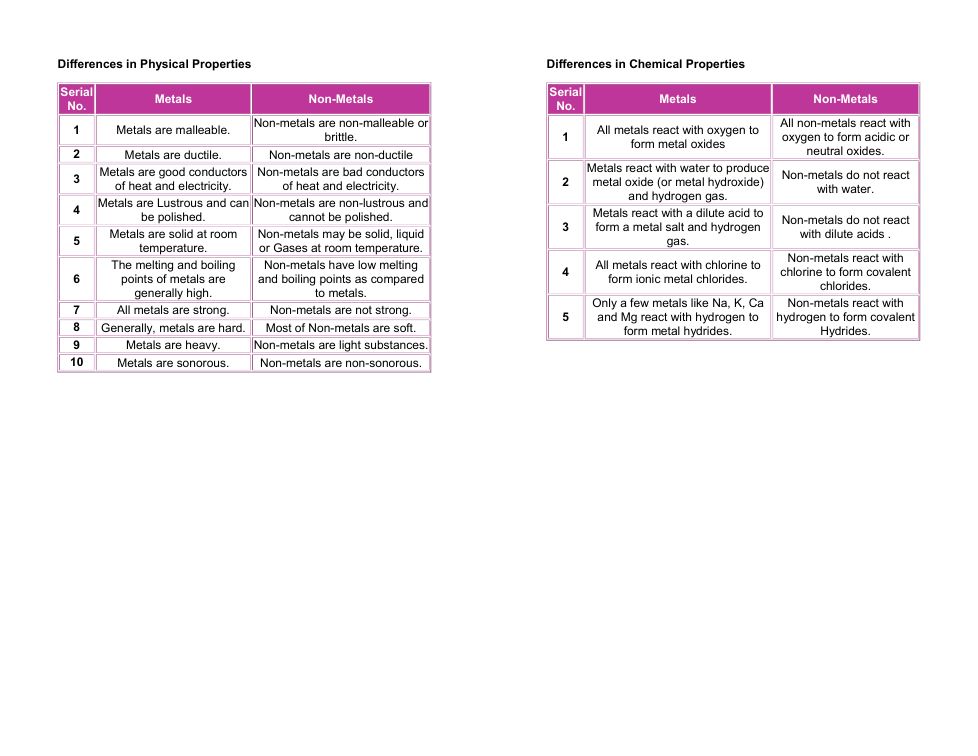
Use your Evidence and the information from the graphics at the bottom of the page to fill in the blanks for the first part of your Reasoning.
The appearance of metals is or shiny. The appearance of non-metals is or not shiny. Sample #1 appears . Sample #2 appears . Sample #3 appears .
When you hit a metal with a hammer you expect it to , because metals are . When you hit non-metal with a hammer you expect it to , because non-metals are . When we hit sample #1 with the hammer, it did , which makes it . When we hit sample #2 with the hammer, it did , which makes it . When we hit sample #3 with the hammer it did , which makes it .
Use your Evidence and the information from the graphics at the bottom of the page to fill in the blanks for the second part of your Reasoning.
When the the lights on the conductivity meter light up it indicates that the material being tested has conductivity. Metals have conductivity, so you would expect the conductivity meter to when testing a metal. Non-metals have conductivity, so you would expect the conductivity meter to when testing a non-metal. When sample #1 was tested with the conductivity meter lit up, which means it has conductivity. When sample #2 was tested with the conductivity meter lit up, which means it has conductivity. When sample #3 was tested with the conductivity meter lit up, which means it has conductivity.
Use your Evidence and the information from the graphics at the bottom of the page to fill in the blanks for the last part of your Reasoning.
Since Sample #1 appears, is when you hit it with a hammer, and has conductivity, it has the characteristics of a . Since Sample #2 appears , is when you hit it with a hammer, and has conductivity, it has the characteristics of a . Since Sample #3 appears , is when you hit it with a hammer, and has conductivity, it has the characteristics of .
Write your Claim:
Sample # 1 is a . Sample #2 is a Sample #3 is a