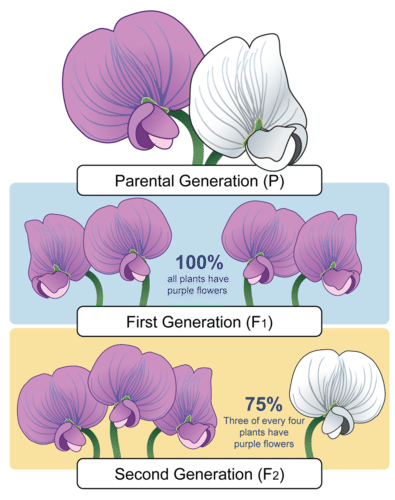
According to Mendel's experiment, what color were the flowers in the first generation?
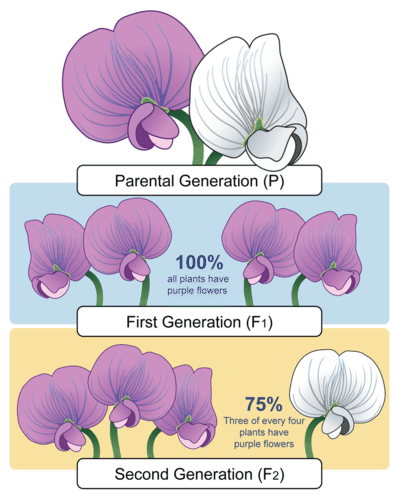
According to Mendel's experiment, what color were the flowers in the first generation?
What were the first pea plants traits studied by Mendel?
What does the 'P' in P generation stand for in Mendel's experiments?
What method did Mendel use to cross different pea plants?
What were the flower colors Mendel used in his experiments?
According to Mendel's experiment, what color were the flowers in the first generation?
After self-pollination of the F1 generation plants, what color were some of the F2 generation flowers?
What did Mendel assume produces white and purple flowers respectively?
What surprised Mendel when he allowed the F1 generation to self-pollinate?
Match the generational Mendelian names for his flowers with tradition family structures.
| Draggable item | arrow_right_alt | Corresponding Item |
|---|---|---|
F2 | arrow_right_alt | Parent |
F3 | arrow_right_alt | Children |
F1 | arrow_right_alt | Grandchildren |
P | arrow_right_alt | Great Grandchildren |
What is Mendel's Law of Segregation?
Which observation did Mendel make about the 'disappeared' characteristics in the F1 plants?
What percentage of traits did Mendel find in the F2 plants for each experiment?
According to Mendel's Law of Segregation, what happens to factors during reproduction?
Phenotype - literally means "the form that is shown"; it is the outward,
Dominant - the allele that
Recessive - an allele whose
Allele - one
Allelic pair - the combination of
Homozygote - an individual which contains only one allele at the allelic pair; for example DD is homozygous
Heterozygote - an individual which contains one of
Mendel discovered that the traits we inherit, like eye color or height, are determined by something he called genes. He found that each parent has a pair of genes for each trait in every cell. When two parents have a baby, the baby gets one gene for a trait from each parent. Each gene can be a dominant or a recessive type. When the parents' genes combine to make a baby, they mix together randomly, so it's like flipping a coin to see which gene the baby gets for each trait. How is this concept presented on the webpage: Sequence order below
The hereditary determinants are of a particulate nature. These determinants are called genes.
Gametes unite at random and irrespective of the other gene pairs involved
Each parent has a gene pair in each cell for each trait studied. The F1 from a cross of two pure lines contains one allele for the dominant phenotype and one for the recessive phenotype. These two alleles comprise the gene pair.
One member of the gene pair segregates into a gamete, thus each gamete only carries one member of the gene pair.
Phenotype | Genotype | Genetic description | |
|---|---|---|---|
Pure line homozygote recessive | |||
DD | |||
Tall Plant |