Log in
Sign up for FREE
arrow_back
Library
Copy of CK12 1.15- 1.18 (2/1/2024)
By Elizabeth Stevens
star
star
star
star
star
Share
share
Last updated about 2 years ago
52 questions
Add this activity
1.15
1
1
1
1
1
1
1
1
1
1.16
1
1
1
1
1
1
0
1.17
1
1
1
1
1
1
1.18
1
1
1
1
1
1
1
1
1
1
1
1
1
1
1
1
1
1
1
1.15- 1.18
1
1
1
1
1
1
1
1
1
1
1
Question 1
1.
What happens in an exothermic reaction?
Energy is released
Energy is stored
Reactants are cooled
Heat is absorbed
Question 2
2.
What is the general chemical equation for an exothermic reaction?
Reactants + Products → Heat
Heat → Reactants + Products
Reactants → Products + Heat
Reactants + Heat → Products
Question 3
3.
What is an example of an exothermic reaction?
Evaporation
Photosynthesis
Chlorine combining with sodium
Distillation
Question 4
4.
What is a chemical reaction that absorbs energy called?
Exothermic reaction
Endothermic reaction
Photosynthetic reaction
Kinetic reaction
Question 5
5.
What is the general chemical equation for an endothermic reaction?
Reactants + Products → Heat
Heat → Reactants + Products
Reactants → Products + Heat
Reactants + Heat → Products
Question 6
6.
Why does a chemical cold pack cool down?
Because of an exothermic reaction
Because of an endothermic reaction
Due to refrigeration
Due to the evaporation of water
Question 7
7.
What is activation energy in a chemical reaction?
Permanent energy of a reaction
Energy needed to start a reaction
Energy generated by a reaction
Energy released during a reaction
Question 8
8.
What is activation energy similar to?
The speed of a child on a slide
The push a child needs on a slide
The color of the slide
The height of a slide
Question 9
9.
Does a chemical reaction continue needing activation energy after it has started?
Only in endothermic reactions
Sometimes
Yes
No
Question 10
10.
What term describes the sum of all biochemical reactions in an organism?
Respiration
Catalysis
Digestion
Metabolism
Question 11
11.
Where do biochemical reactions occur in living organisms?
Inside cells
In the bloodstream
On the cellular surface
In the digestive tract
Question 12
12.
Which two fields of study are needed to fully understand biochemical reactions?
Physics and Chemistry
Biology and Physics
Biology and Chemistry
Chemistry and Geology
Question 13
13.
Which biochemical reaction breaks down molecules into smaller units?
Anabolic reactions
Endothermic reactions
Catabolic reactions
Exothermic reactions
Question 14
14.
What type of reaction is the joining of amino acids to form a protein?
Exothermic reactions
Anabolic reactions
Catabolic reactions
Endothermic reactions
Question 15
15.
Which type of reaction releases energy?
Endothermic reactions
Exothermic reactions
Anabolic reactions
Catabolic reactions
Question 16
16.
What type of reaction occurs when your body digests food? Hint: Glucose.
Catabolic reactions
Exothermic reactions
Endothermic reactions
Anabolic reactions
Question 17
17.
What are biological catalysts in organisms called?
Enzymes
Cells
Proteins
Mitochondria
Question 18
18.
Why must the rate of most biochemical reactions be increased by a catalyst?
Cell conditions make reactions too slow
To make cells grow faster
To produce more energy
To eliminate waste products faster
Question 19
19.
What is the main role of enzymes in biochemical reactions?
They slow down reactions.
They create reactions.
They stop reactions.
They speed up reactions.
Question 20
20.
Are enzymes used up in the reactions they control?
Sometimes they are used up.
No, they are not used up.
Only partially used up.
Yes, they are used up.
Question 21
21.
How are enzymes different from other catalysts?
Enzymes are not catalysts.
Enzymes are slower.
Enzymes can't be reused.
Enzymes are highly specific for certain reactions.
Question 22
22.
What is the efficiency of enzymes in catalyzing reactions?
They catalyze a single reaction per hour.
They catalyze hundreds of reactions per day.
They can catalyze millions of reactions per second.
They catalyze a few reactions per minute.
Question 23
23.
What role do enzymes play in biochemical reactions?
They speed up biochemical reactions
They slow down biochemical reactions
They stop biochemical reactions
They do not affect biochemical reactions
Question 24
24.
What is activation energy in the context of biochemical reactions?
Energy needed to start a chemical reaction
Energy released during a reaction
Energy absorbed during a reaction
The total energy in a reaction
Question 25
25.
Which phrase best describes a catalyst?
Substance that ends a chemical reaction
Substance that initiates a chemical reaction
Substance that speeds up a chemical reaction
Substance that slows a chemical reaction
Question 26
26.
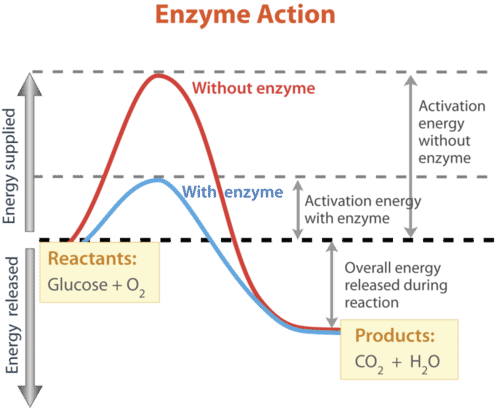
What are the products of a combustion reaction involving glucose and oxygen?
Glucose and oxygen
Carbon and hydrogen
Carbon dioxide and water
Water and oxygen
Question 27
27.
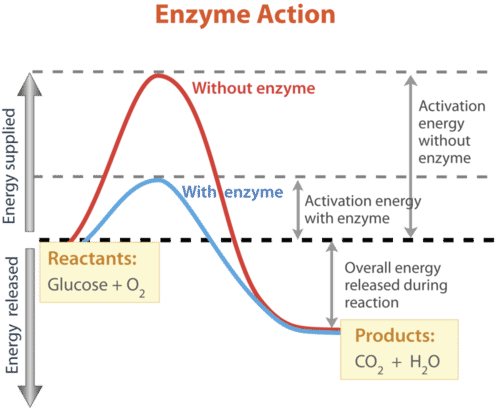
What happens to the activation energy in the presence of an enzyme?
It remains the same
It is eliminated
It decreases
It increases
Question 28
28.
What is the role of enzymes in a chemical reaction?
Does not affect the reaction
Slows down the reaction
Speeds up the reaction
Stops the reaction
Question 29
29.
What is released during a combustion reaction of glucose and oxygen?
Glucose
Energy
Carbon Dioxide
Oxygen
Question 30
30.
What is the role of enzymes in a biological reaction?
They lower activation energy
They stop the reaction
They have no role
They increase reaction energy
Question 31
31.
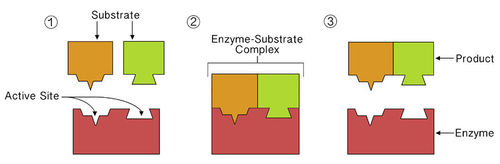
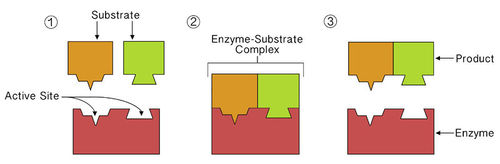
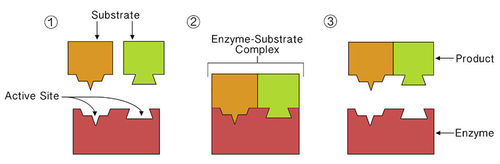
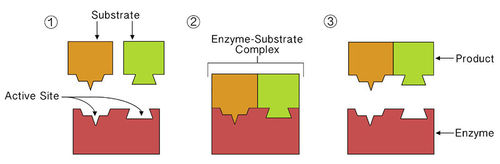
What is the name given to the reactant molecules enzymes bind?
Product
Mixture
Solution
Substrate
Question 32
32.
Where do enzymes bind reactant molecules?
In the substrate
Around the enzyme
On the passive site
On the active site
Question 33
33.
How do enzymes position reactants for a reaction?
Correctly to overcome intermolecular forces
Far apart to increase activation energy
Incorrectly to produce more energy
Close together for proper collision
Question 34
34.
What is the term for the molecule that binds an enzyme at its active site?
Solution
Reactant
Catalyst
Substrate
Question 35
35.
What occurs when an enzyme and substrate form a complex?
It stops the reaction
It slows down the reaction
It catalyzes a reaction
It freezes the reaction
Question 36
36.
What happens to the products after a biochemical reaction on the enzyme's active site?
They destroy the enzyme
They bind permanently
They are released
They become a new enzyme
Question 37
37.
What factors can influence the activities of enzymes?
Light intensity
Magnetic field
Gravity
Temperature, pH, ionic conditions
Question 38
38.
Which enzyme functions best in the acidic environment of the stomach?
Pepsin
Lipase
Trypsin
Amylase
Question 39
39.
What is the optimal pH for the activity of pepsin?
6.5
8
7
1.5
Question 40
40.
Trypsin operates optimally in which part of the digestive system?
Stomach
Mouth
Small Intestine
Large Intestine
Question 41
41.
What happens to most enzymes at temperatures higher than 98.6ËšF?
They multiply
They become more functional
Their shape deteriorates
Their size increases
Question 42
42.
Chemical reactions do not necessarily involve energy.
True
False
Question 43
43.
An endothermic reaction is one that absorbs energy.
True
False
Question 44
44.
The activation energy is the energy used to end a chemical reaction.
True
False
Question 45
45.
Exothermic reactions absorb energy from surroundings.
True
False
Question 46
46.
Biochemical reactions are chemical reactions that take place inside the cells of organisms.
True
False
Question 47
47.
All chemical reactions in an organism need enzymes to take place.
True
False
Question 48
48.
Biological catalysts that speed up biochemical reactions are known as enzymes.
True
False
Question 49
49.
Enzymes increase the activation energy required to start biochemical reactions.
True
False
Question 50
50.
Enzymes are unaffected by changes in temperature, ionic conditions or pH.
True
False
Question 51
51.
The function of an enzyme is not dependent on its surrounding environment.
True
False
Question 52
52.
Enzymes can help to accelerate biochemical reactions.
True
False