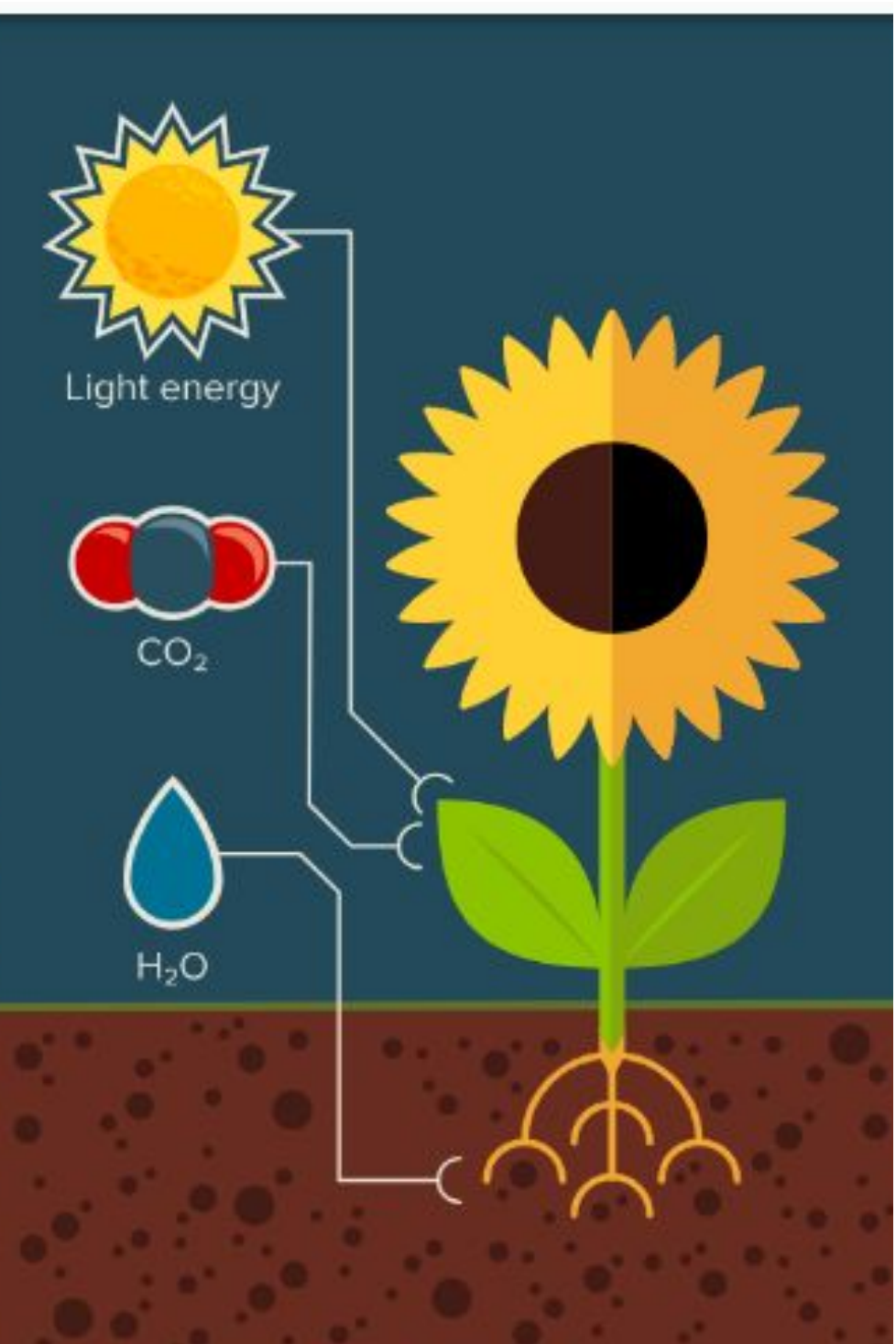
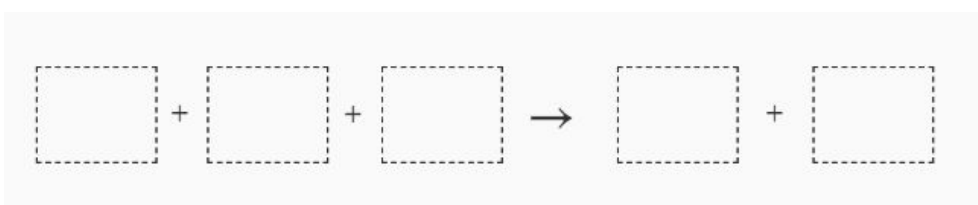
Drag the reactants and products to the correct side of the photosynthesis equation.
Mmuae Afoforo a Wobɛpaw:
light energy
Read the passages & the instructions as you go. We have discussed these topics in class and a lot of the information is covered in the included readings. Take you time.
Read the passages & the instructions as you go. We have discussed these topics in class and a lot of the information is covered in the included readings. Take you time.
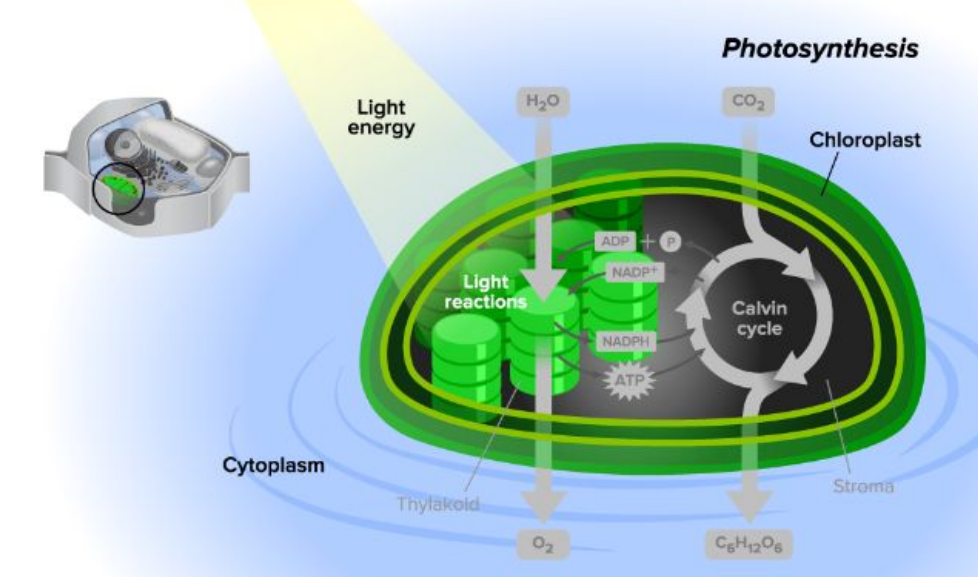
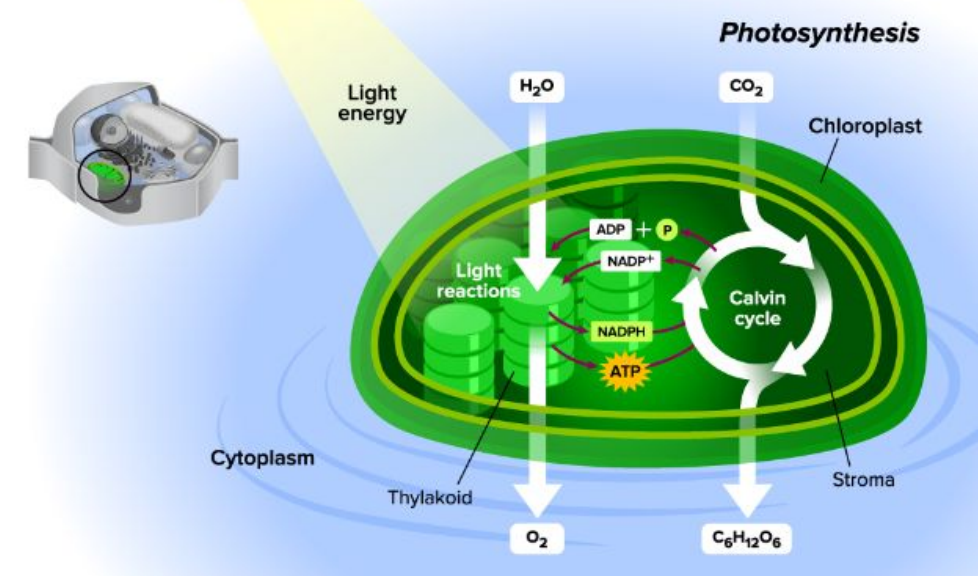
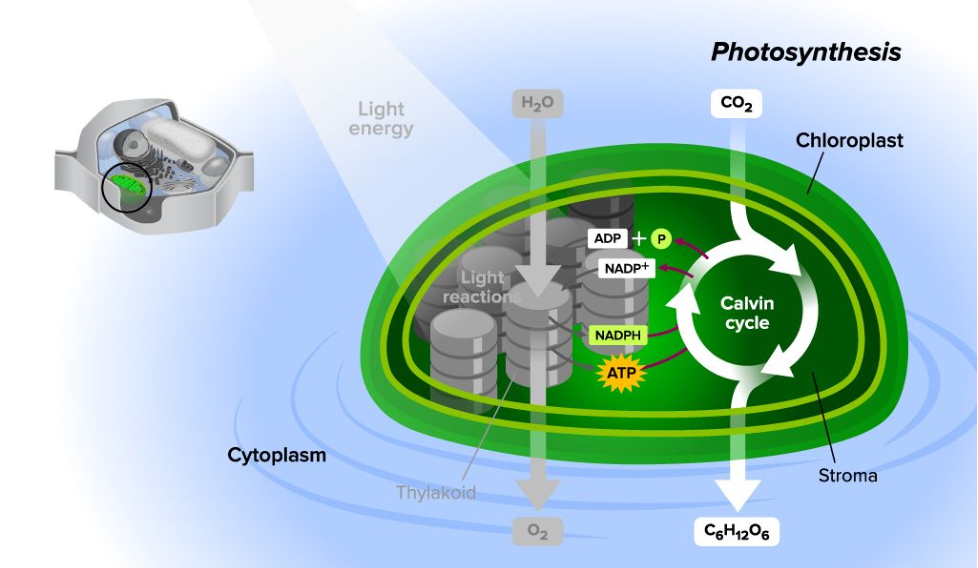
Photosynthesis is the process in which autotrophs convert light energy to chemical energy. It occurs in two phases. Phase one, the light-independent reactions, occurs in the thylakoids of the chloroplasts. Light energy is absorbed and then converted into ATP & NADPH. Carbon dioxide & water are used in this process & oxygen is a waste product. Phase two, the light-independent reactions, occurs in the stroma of the chloroplasts. ATP & NADPH are used to make glucose. Once glucose is produced it can be joined to other simple sugars to form larger molecules, like starch, proteins, lipids, or nucleic acids.
Drag the reactants and products to the correct side of the photosynthesis equation.
Located in the membrane of the thylakoids are a variety of pigments, the most important of which are called chlorophylls. There are several different types of chlorophylls. The two most common types are known as chlorophyll a and chlorophyll b.
A slight difference in the molecular structure between chlorophyll a and chlorophyll b causes the two molecules to absorb different colors of light. Chlorophyll a absorbs less blue light, but more red light than chlorophyll b absorbs. Neither chlorophyll a nor chlorophyll b absorbs much green light. Instead, they allow green light to be reflected or transmitted. That is why leaves and other plant structures that contain large amounts of chlorophyll look green.
Only chlorophyll a is directly involved in the light reactions of photosynthesis. Chlorophyll b assists chlorophyll a in capturing light energy; therefore, chlorophyll b is called an accessory pigment.
What is the main reason leaves look green?
What is the role of chlorophyll b in photosynthesis?
Which color of light is absorbed less by chlorophyll a?
Because chlorophyll b assists chlorophyll a in capturing light energy, chlorophyll b ...
Light-dependent Reactions
We know that plants use light energy, Carbon Dioxide (CO2) and water (H20) to grow. Light energy is absorbed in the chloroplasts and converted into chemical energy during photosynthesis.
The absorption of light is the first step in photosynthesis. Plants have special organelles called chloroplasts. Chloroplasts capture light energy. Once the energy is captured, two energy storage molecules, NADPH & ATP, are produced to be used in the light-independent reactions.
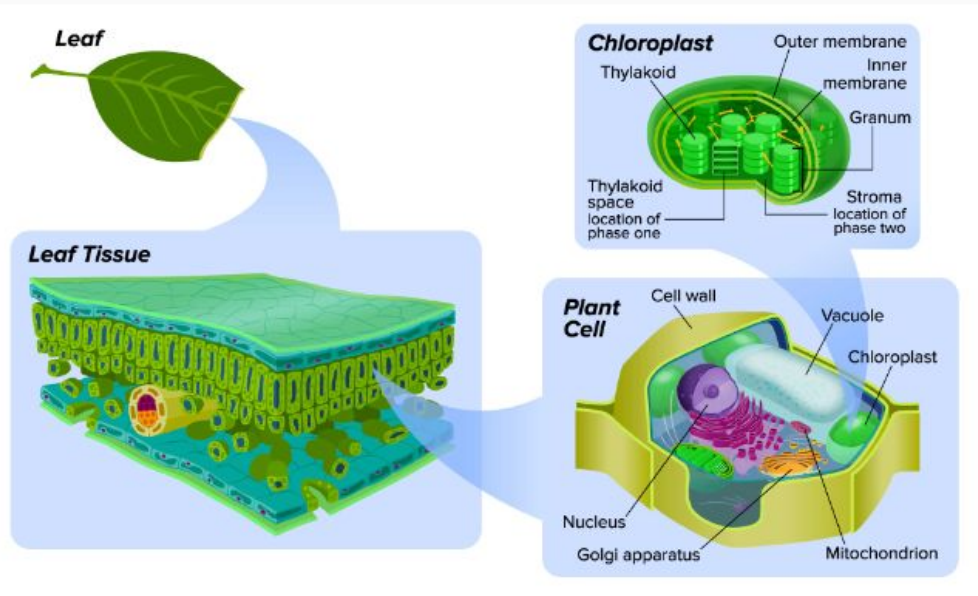
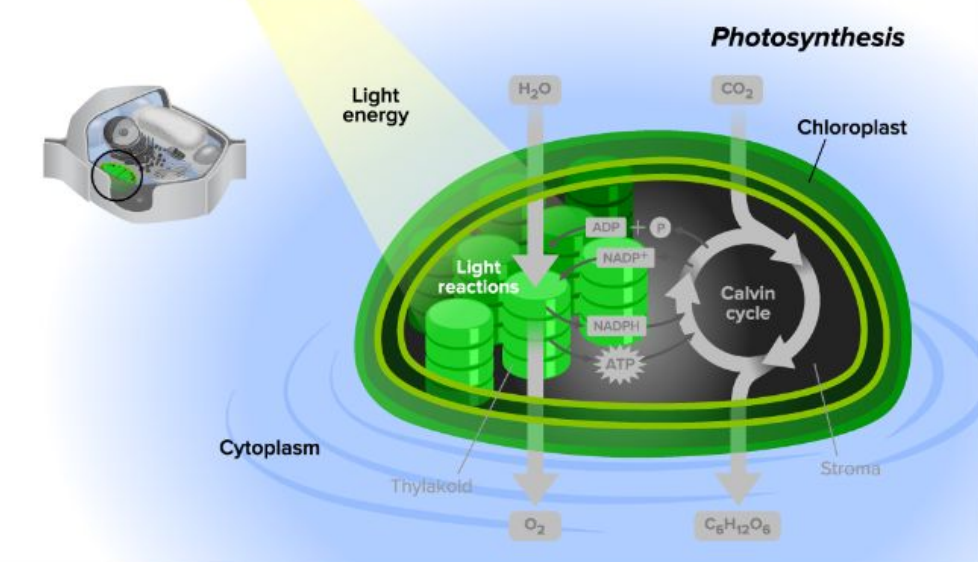
In phase one of photosynthesis, light energy breaks apart a water molecule and releases an electron into the electron transport system. This phase occurs in two parts of the thylakoids: the thylakoid membrane and the thylakoid space. The structure of the thylakoid membrane is the key to efficient energy transfer during electron transport.
Thylakoid membranes have a large surface area, which provides the space needed to hold large numbers of electron-transporting molecules and two types of protein complexes called photosystems. Photosystem I and Photosystem II contain light-absorbing pigments and proteins that play important roles in the light reactions. Thus, electron transport is known as the light-dependent reactions.
Photosystem II receives an electron from the breaking of a water molecule and transports it to photosystem I, which then transports the electron to the final electron acceptor, NADP+. This creates the energy-storage molecule NADPH.
Electron Transport Chain
1. First, the light energy excites electrons in photosystem II. The light energy also causes a water molecule to split, releasing an electron into the electron transport system, a hydrogen ion (H+) into the thylakoid space, and oxygen (O2) as a waste product. This breakdown of water is essential for photosynthesis to occur.
2. The excited electrons move from photosystem II to an electron-acceptor molecule in the thylakoid membrane.
3. Next, the electron-acceptor molecule transfers the electrons along a series of electron-carriers to photosystem I.
4. In the presence of light, photosystem I transfers the electrons to a protein called ferredoxin. The electrons lost by photosystem I are replaced by electrons shuttled from photosystem II.
5. Finally, ferredoxin transfers the electrons to the electron carrier NADP+, forming the energy-storage molecule NADPH.
* After the electron transport chain Chemiosmosis occurs.
Chemiosmosis
ATP is produced in conjunction with electron transport by the process of chemiosmosis-the mechanism by which ATP is produced as a result of the flow of electrons down a concentration gradient. The breakdown of water is essential not only for providing the electrons that initiate the electrons transport chain, but also for providing the protons (H+) necessary to drive ATP synthesis during chemiosmosis.
the H+ released during electron transport accumulate in the interior of the thylakoid. As a result of a high concentration of H+ in the stroma, H+ protons diffused down their concentration gradient, out of the thylakoid interior and into the stroma through ion channels spanning the membrane.
These channels are enzymes called ATP synthases. As H+ moves through ATP synthases, ADP is converted to ATP in the stroma.
When light strikes Photosystem II, it has enough energy to do which of the following?
What protein transfers electrons from the thylakoid membrane to NADP+?
What are the products of the electron transport? Select all that apply.
Place the steps of electron transport into the correct order.
Hydrogen ions in the stroma diffuse through ATP synthase.
Light energy excites electrons in photosystem I and transfers electrons to ferredoxin.
Ferredoxin transfers electrons to NADP+, forming NADPH.
ADP is converted to ATP in the stroma.
Excited electrons move from photosystem II through electron-acceptor molecules.
Light energy excites electrons in photosystem II.
Light energy causes a water molecule to split, creating hydrogen ions and oxygen.
The products from the electron transport chain and chemiosmosis are NADPH and ATP. Both molecules are produced in the stroma. These molecules will be reactants for the Calvin cycle, and form a "bridge" between the electron transport chain and the Calvin cycle. The Calvin cycle occurs in the stroma, and the energy stored in NADPH and ATP will be transferred to organic molecules such as glucose.
Light-independent Reactions (aka: The Calvin Cycle)
The second half of photosynthesis, the light-independent reactions, are known as the Calvin Cycle. The Calvin Cycle has four major steps that occur within the stroma of the chloroplasts.
Step 1: CO2 diffuses into the stroma from the surrounding cytosol. An enzyme combines each CO2 molecule with a 5-Carbon carbohydrate called RuBP. The product is a 6-Carbon molecule that splits immediately into a pair of 3-Carbon molecules known as 3-PGA.
Step 2: Each molecule of 3-PGA is converted into another 3-Carbon molecule, G3P, in a two-part process. First, each 3-PGA molecule receives a phosphate group from a molecule of ATP. The resulting compound then receives a proton from NADPH and releases a phosphate group, producing ADP, NADP+, and phosphate. These three products can be used again in the light reactions to synthesize additional molecules of ATP and NADPH.
Step 3: One molecule of G3P is used to make organic compounds.
Step 4: Most of the G3P is converted back into RuBP in a complicated series of reactions. These reactions require a phosphate group from another molecule of ATP, which is changed into ADP. By regenerating the RuBP that was consumed in Step 1, the reactions of Step 4 allow the Calvin Cycle to continue operating.
If the RuBP consumed in the first step of the Calvin Cycle was not regenerated in the last step, what would happen?
Put these events of the Calvin Cycle into the correct order.
The other molecule of G3P is converted back to RuBP so the cycle can start again
The 3-PGA molecules receive phosphate groups from molecules of ATP
CO2 combines with RuBP & makes two 3-PGA molecules
The two 3-PGA molecules are converted into two G3P molecules
One molecule of G3P is used to make organic compounds (glucose)
Carbon Dioxide (CO2) diffused into stroma
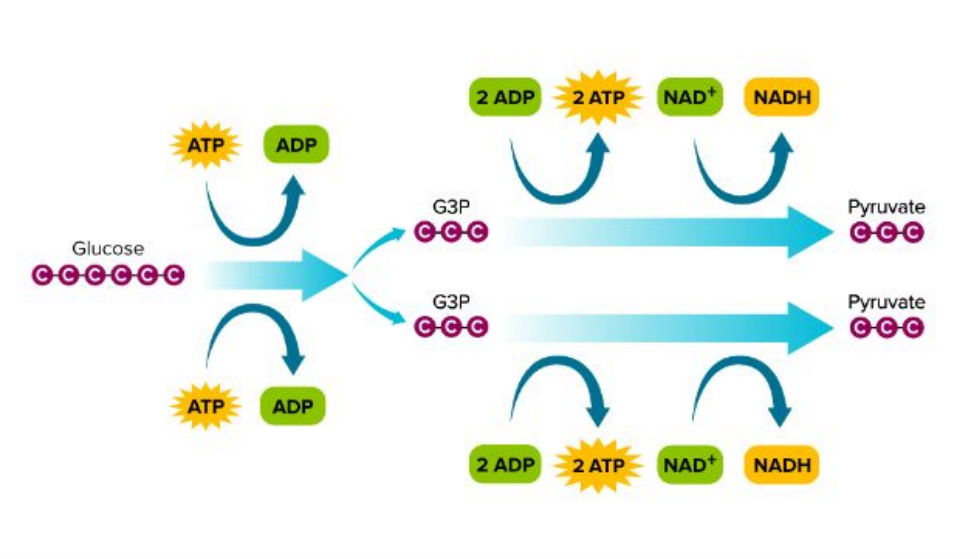
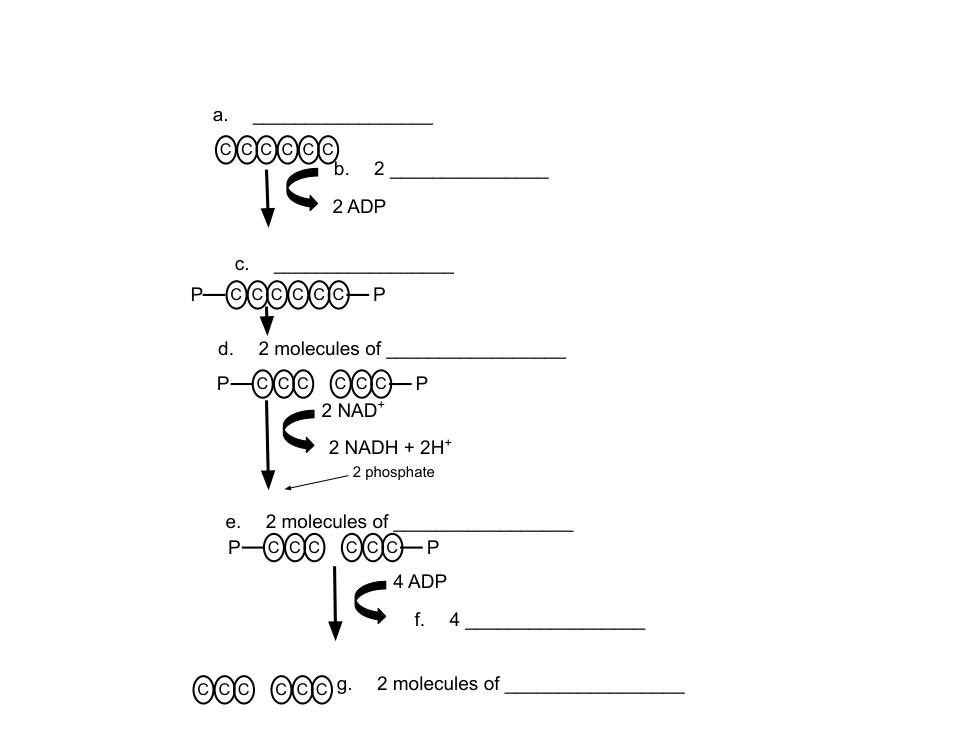
Glycolysis is a pathway in which one 6-carbon molecule of glucose is oxidized to produce two 3-carbon molecules of pyruvic acid. The pathway can be condensed into the following four main steps.
Step 1: Two phosphate groups are attached to one molecule of glucose, forming a new 6-carbon compound. The phosphate groups are supplied by two molecules of ATP, which are converted into two molecules of ADP in the process.
Step 2: The 6-carbon compound formed in step 1 is split into two 3-carbon molecules of G3P.
Step 3: The two G3P molecules are oxidized, and each receives a phosphate group. The product of this step is two molecules of a new 3-carbon compound. The oxidation of G3P is accompanied by the reduction of two molecules of NAD+ to NADH. Like NADP+, NAD+ is an organic molecule that accepts electrons during redox reactions.
Step 4: The phosphate groups added in step 1 and step 3 are removed from the 3-carbon compounds formed in step 3. This reaction produces two molecules of pyruvic acid. Each phosphate group is combined with a molecule of ADP to make a molecule of ATP. Because a total of four phosphate groups were added in step 1 and step 3, four molecules of ATP are produced.
What is the final product of glycolysis?
NADP+ and NAD+ are similar in that both...
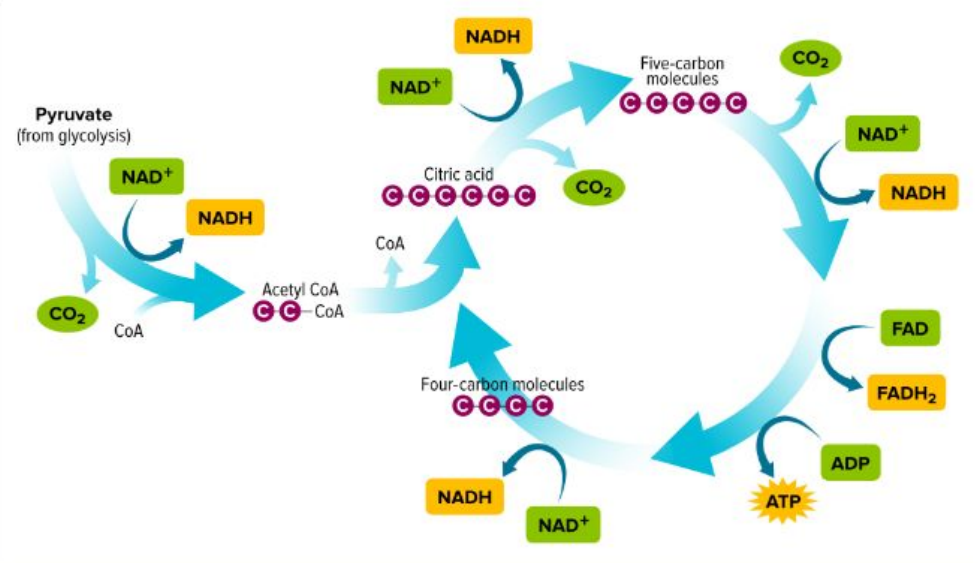
The Krebs cycle has five main steps. In eukaryotic cells, all five steps occur in the mitochondrial matrix.
Step 1: A 2-Carbon molecule of acetyl CoA combines with a 4-Carbon compound, oxaloacetic acid, to produce a 6-Carbon compound, citric acid.
Step 2: Citric acid releases a CO2 molecule and a hydrogen atom to form a 5-Carbon compound. The electron in the hydrogen atom is transferred to NAD+, reducing it to NADH.
Step 3: The 5-Carbon compound formed in step 2 also releases a CO2 molecule and a hydrogen atom, forming a 4-Carbon compound. Again, NAD+ is reduced to NADH. In this step, a molecule of ATP is also synthesized from ADP.
Step 4: The 4-Carbon compound formed in step 3 releases a hydrogen atom to form another 4-Carbon compound. This time, the hydrogen atom is used to reduce FAD to FADH2. FAD is a molecule very similar to NAD+. Like NAD+, FAD accepts electrons during redox reactions.
Step 5: The 4-Carbon compound formed in step 4 releases a hydrogen atom to regenerate oxaloacetic acid, which keeps the Krebs cycle operating. The electron in the hydrogen atom reduces NAD+ to NADH.
Recall that in glycolysis one glucose molecule produces two pyruvic acid molecules, which can form two molecules of acetyl CoA. Thus, one glucose molecule is completely broken down in two turns of the Krebs cycle. These two turns produce 8 NADH, 2 FADH2, 2 ATP, and 6 CO2 molecules.
Put these events into the correct order.
A molecule of acetyl CoA combines with oxaloacetic acid to produce citric acid.
Citric acid releases a CO2 molecule and a hydrogen atom to form a 5-Carbon compound.
A 5-Carbon compound releases a CO2 molecule to form a 4-Carbon compound.
A 4-Carbon compound releases a hydrogen atom to form another 4-Carbon compound.
A 4-Carbon compound is converted into oxaloacetic acid.
The Electron Transport Chain
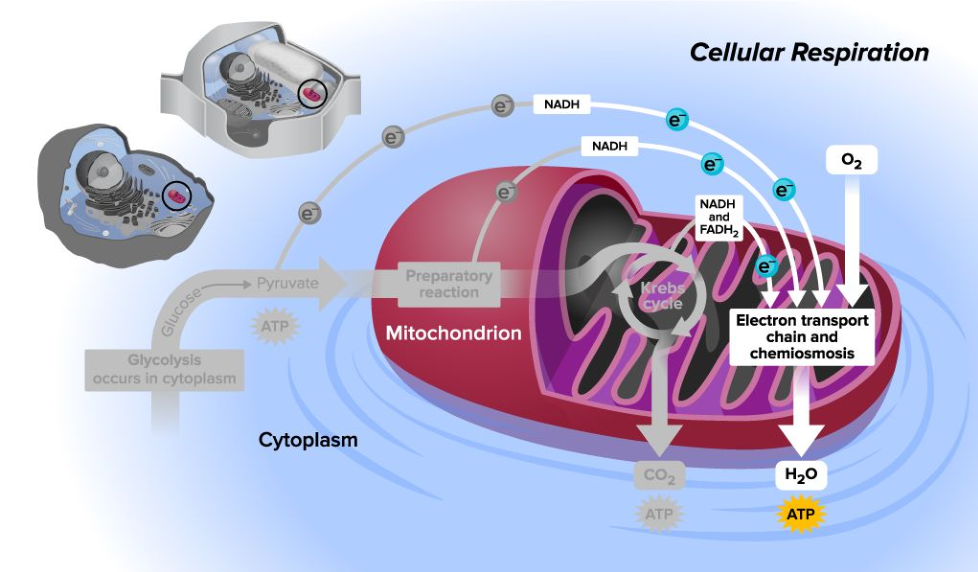
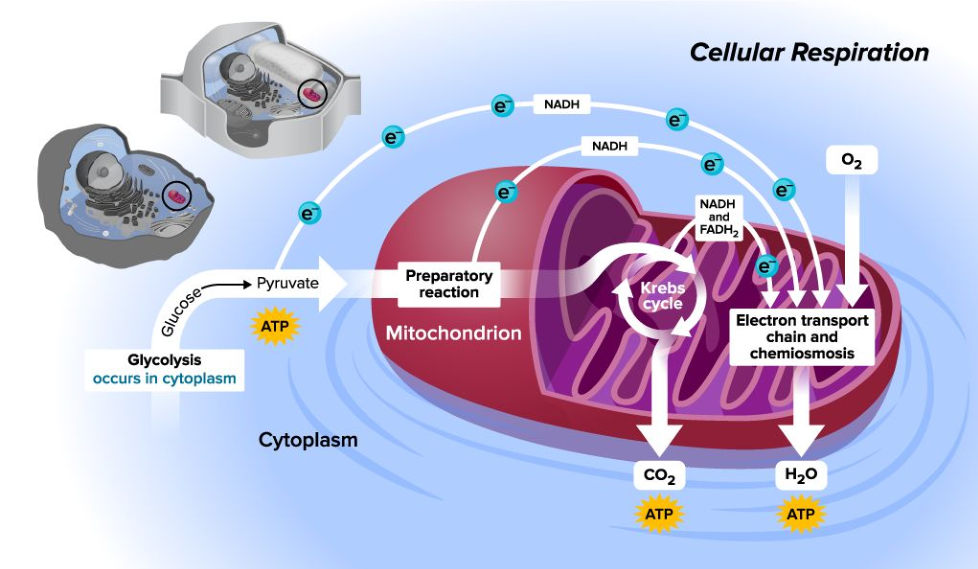
This is the final step in the breakdown of glucose. Most of the ATP is produced in this phase when high-energy electrons and hydrogen ions from NADH and FADH2 produced in the Krebs cycle are used to convert ADP to ATP.
The electron transport chain generates most of the ATP that is gained from cellular respiration. In the mitochondrial membrane, there are several transport proteins. These proteins shuttle electrons through the membrane and pump hydrogen ions into the intermembrane space. When NADH and FADH2 release electrons in the mitochondrial matrix, they are converted to NAD+ and FAD. Hydrogen ions are also released into the mitochondrial matrix. They are pumped into the intermembrane space by the transport proteins. Once hydrogen ions accumulate in the intermembrane space there is a concentration gradient. There are more hydrogen ions in the intermembrane space than there are in the mitochondrial matrix. The hydrogen ions move down the concentration gradient through ATP synthase another protein located in the mitochondrial membrane. When hydrogen ions come through ATP synthase, ADP is converted to ATP. When the electrons are shuttling through the carrier proteins and exit the membrane into the mitochondrial matrix, they join with oxygen, the final electron acceptor, and hydrogen ions to form H2O. Overall, the electron transport chain produces 32 ATP.
By the end of the electron transport and cellular respiration in eukaryotes, one glucose molecule yields about 36 ATP under ideal conditions.
In the first step of electron transport,
Hydrogen ions diffuse down the concentration gradient and cross the inner mitochondrial membrane through which protein?
How does the final step in the electron transport chain occur?
Generally, the electron transport chain creates 32 ATP molecules.
How many ATP molecules are typically created overall in eukaryotic cellular respiration?