Gizmo Instructions
If you have not yet signed up for Gizmos, follow these instructions:
Go to http://go-el.com/join
Use code ELPFXXTR
Click next
If you've used Gizmos before and remember your login information, log into your account. Otherwise, create a new account
Write down your username and password and put this information in a safe place
Gizmo Instructions
If you have not yet signed up for Gizmos, follow these instructions:
Go to http://go-el.com/join
Use code ELPFXXTR
Click next
If you've used Gizmos before and remember your login information, log into your account. Otherwise, create a new account
Write down your username and password and put this information in a safe place

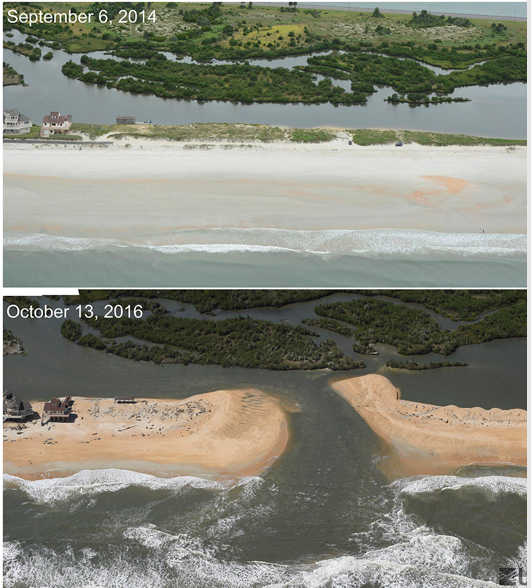
What could have caused these changes to the beach in the photos above?
Weathering is the slow breakdown of rocks due to the effects of rain, wind, frost, and other surface processes.
Weathering is classified as mechanical or chemical. Mechanical weathering occurs when rocks are broken into smaller pieces. Chemical weathering occurs when the minerals in rocks are changed by chemical reactions.
Click here to go to the Weathering Gizmo.
Start on the "Animation" tab and use the drop down to explore different types of weathering. Click on the play button to watch the animation of each type.
Categorize each weathering type as mechanical or chemical. Make sure to look at the "Other" category to see all weathering types.
Frost wedging
Pressure release
Rusting
Heat expansion
Dissolving
Clay formation
Lichen growth
Root wedging
Abrasion
Salt weathering
Mechanical
Chemical
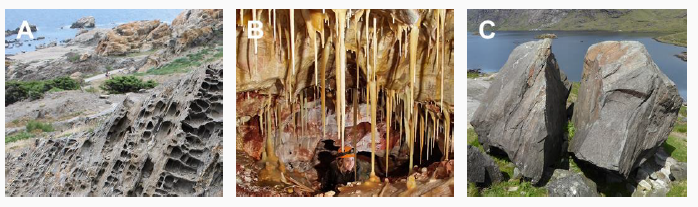
Match each image to its weathering type:
| Draggable item | arrow_right_alt | Corresponding Item |
|---|---|---|
Image B | arrow_right_alt | Salt weathering |
Image C | arrow_right_alt | Dissolving |
Image A | arrow_right_alt | Frost wedging |
Switch the Gizmo to the "Simulation" tab.
The Weathering Gizmo lets you explore weathering of four common rocks. Granite is a very hard rock formed from the crystallization of magma deep underground. Sandstone forms when sand grains become cemented together. Limestone is formed from ancient corals, shells and skeletons. Shale is formed from compacted mud.
Set the Average temperature to 25 °C and Precipitation to 250 cm/yr.
For each rock type, run a simulation of about 100,000 years and observe the amount of weathered rock. Click "Fastplay" to speed things up.
Rock type: Granite Weathered rock: About m3
Rock type: Sandstone Weathered rock: About m3
Rock type: Limestone Weathered rock: About m3
Rock type: Shale Weathered rock: About m3
Which rock weathers most quickly?
Which rock weathers most slowly?
Erosion is the removal and movement of soil, rocks, and other materials from one place to another on Earth’s surface. Erosion can be caused by high winds, moving water, and gravity, as well as human activities like farming and construction.'
Use the Gizmo to determine the effect vegetation cover (plants) has on erosion. Leave all settings to the default except Vegetation cover (%).
For each vegetation amount, run a simulation of about 100,000 years and observe the amount of eroded rock.
Vegetation cover (%): 100 Eroded rock: About km3
Vegetation cover (%): 50 Eroded rock: About km3
Vegetation cover (%): 0 Eroded rock: About km3
Predict: If the rock was changed from sandstone to a softer rock like shale, the rate of erosion would
(You can use the Gizmo to check your answer if you like)
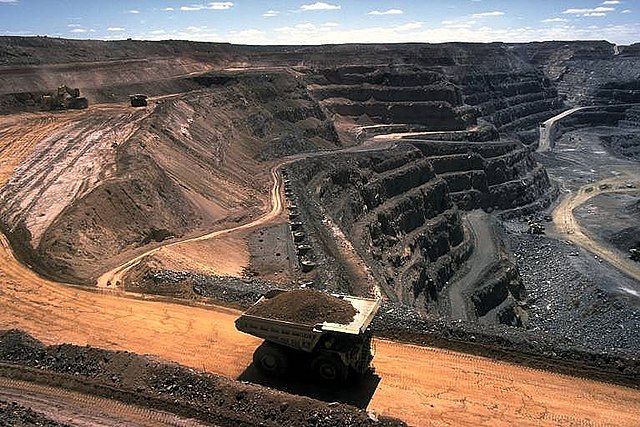
Mining companies are required to restore the land that they use, especially in open pit mining. Mining companies may also have to clean up the water and replace the solid material that they moved when the mine was dug.
Why is this restoration important for the environment?
What are some potential consequences if land restoration does not take place?