Reading: A Picture Is Worth a Thousand Words
star
star
star
star
star
Last updated 7 months ago
7 Nsɛmmisa
Read the passage below and answer the questions related to the reading.
Read the passage below and answer the questions related to the reading.
1 I began my professional career in the publishing industry working as a writer and an editor. As a young student, English was always my favorite class. I loved that all you need to do to enter an author’s world is open up the cover and start reading. It feels like time traveling, and you don’t even need electricity—unless the light is low, that is!
2 Therefore, it didn’t surprise anyone who knew me that I would go on to get bachelor’s and master’s degrees in literature and that subsequently I would go on to put these skills to use. My first job was as a publisher’s assistant, but eventually, I worked my way into the editorial department of a magazine as a writer. Because that went well, I became an editor, someone who looks over a writer’s work. Not long after, I was promoted to managing editor, wherein I helped a team of editors produce high-quality work and meet their deadlines.
3 Based on my youthful passions, experiencing this professional success should have fulfilled me. So I was surprised to learn that when I was honest with myself, this trajectory actually did not suit me. I still enjoyed words and writing, but I felt limited by them. The more I read, whether it was fiction or poetry or drama, the more I felt I was not cut out for the task. Perhaps something about me changed from when I was younger. In any event, I decided to take a somewhat anxious step away from the status quo and onto a whole new path.
4 The realization that I was not on my ideal professional path left me distraught. All that time effort and money I had invested in developing a career in writing suddenly seemed a waste. What’s more, I had no idea what professional career would be good for me. However, I was determined to find out. So, I put everything aside that would get in the way of me figuring it out: my resume, my previous education, any feelings of intimidation of starting over as a newbie, and more. After a long, hard look at who I was and what my proclivities were, I came up with photography.
5 Although I had always photographed my friends and family and felt those images were priceless memories, I had no idea how to operate a manual camera. But there was something about the medium that drew me to it after a career in writing. They say a picture is worth a thousand words, and I think that notion is partly what caused me to look into it. Words became frustrating to me, but pictures seemed to offer something more liberated and less picayune than assembling letters and punctuation character by character.
6 I decided to enroll in a beginner’s photography course at my local college, and slowly but surely I began learning about the magical medium of photography. I learned how to operate a manual camera. I learned what f-stops and shutter speeds were. I learned how to process film and how to develop a picture in the darkroom. I learned how to analyze light and use flash, in addition to other artificial lighting equipment. I learned about many of the great photographers and the impact of the pictures they made. Most elusive of all, I learned how to photograph people: how to make them comfortable in front of my lens and create an atmosphere they could enjoy.
7 After a few years of photography courses, I had indeed done what I set out to do. I had found my true passion, and I had started a new professional path for myself. Unlike my previous career, I felt completely fulfilled. Photography allowed me to engage with life, to really look at it and appreciate it.
8 But what’s interesting is that all the years I spent enamored with writing, only to find it didn’t suit me as a career, ended up being useful after all. Much to my surprise, I realized that a photograph is a kind of story. Viewers look at the subject of a photograph, as well as the details and context of that subject, and, as a result, a story ensues. Studying the structure of storytelling in all its myriad manifestations as a writer and editor made me a better photographer because it allowed me to understand what I value in life and how to articulate that.
9 Life is unpredictable. You can make plans for the future, but they very well might change in the end. Making this career change taught me to embrace change and to have confidence that being true to myself was my best guide.
The author’s primary purpose in “A Picture Is Worth a Thousand Words” is to convince readers that
The expression “newbie” in paragraph 4 of “A Picture Is Worth a Thousand Words” refers to a person who is
In paragraph 6, why does the author describe learning how to photograph people as being “elusive”?
The author relies most on which of the following persuasive techniques?
In paragraph 8 of “A Picture Is Worth a Thousand Words,” the author suggests that photography enabled him to
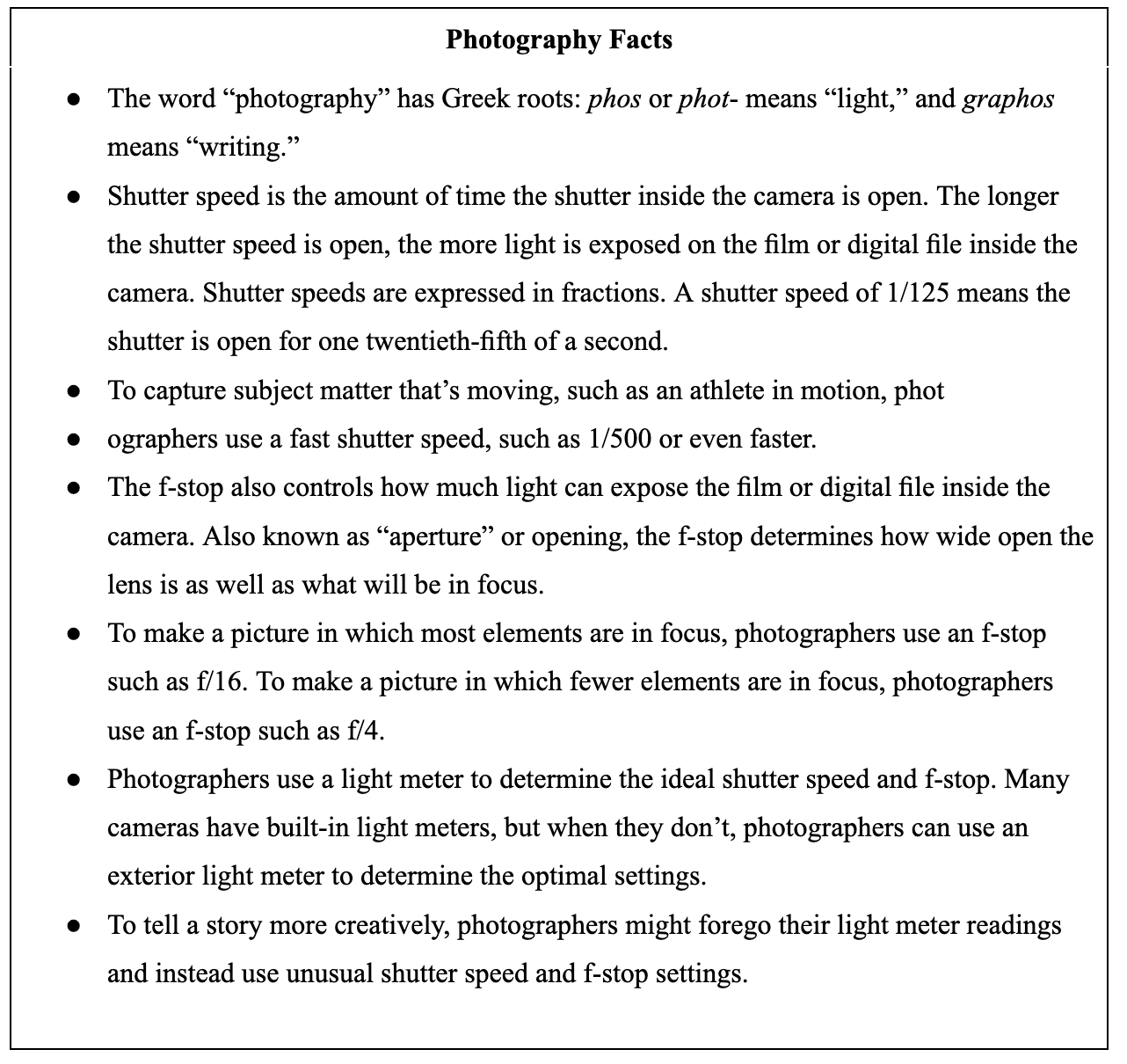
Which of the following from the text in the box titled “Photography Facts” supports one of the themes in the passage?
Read this sentence from paragraph 3.
In any event, I decided to take a somewhat anxious step away from the status quo and onto a whole new path.
What is the meaning of status quo as it is used in paragraph 3?