NUCLEAR ENERGY
star
star
star
star
star
Last updated almost 2 years ago
25 Nsɛmmisa
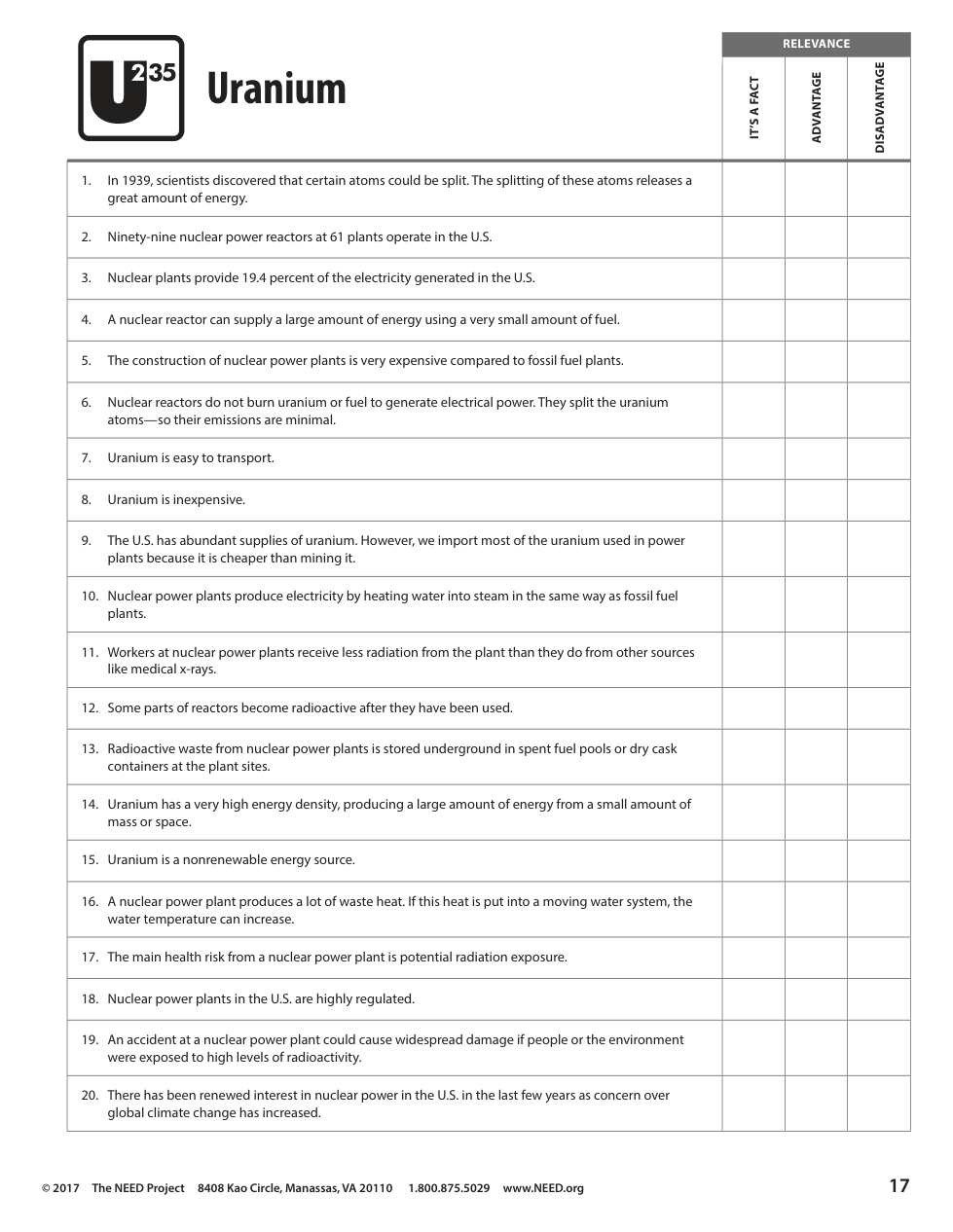
In 1939, scientists discovered that certain atoms could be split. The splitting of these atoms releases a great amount of energy.
Ninety-nine nuclear power reactors at 61 plants operate in the U.S. (As of 2017)
Nuclear plants provide 19.4 percent of the electricity generated in the U.S. (as of 2017)
A nuclear reactor can supply a large amount of energy using a very small amount of fuel.
The construction of nuclear power plants is very expensive compared to fossil fuel plants.
Nuclear reactors do not burn uranium or fuel to generate electrical power. They split the uranium atoms—so their emissions are minimal.
Uranium is easy to transport.
Uranium is inexpensive.
The U.S. has abundant supplies of uranium. However, we import most of the uranium used in power plants because it is cheaper than mining it.
Nuclear power plants produce electricity by heating water into steam in the same way as fossil fuel plants.
Workers at nuclear power plants receive less radiation from the plant than they do from other sources like medical x-rays.
Some parts of reactors become radioactive after they have been used.
Radioactive waste from nuclear power plants is stored underground in spent fuel pools or dry cask containers at the plant sites.
Uranium is a nonrenewable energy source.
A nuclear power plant produces a lot of waste heat. If this heat is put into a moving water system, the water temperature can increase and cause thermal pollution.
The main health risk from a nuclear power plant is potential radiation exposure.
Nuclear power plants in the U.S. are highly regulated.
An accident at a nuclear power plant could cause widespread damage if people or the environment were exposed to high levels of radioactivity.
There has been renewed interest in nuclear power in the U.S. in the last few years as concern over global climate change has increased.
What are 3 ADVANTAGES of nuclear energy?
What are 3 DISADVANTAGES of nuclear energy?
The radioactive element that we dig out of the ground to split its nucleus for nuclear energy is called _________.
Nuclear energy makes air pollution.
Nuclear energy makes water thermal pollution.
Nuclear energy requires the process nuclear ________.