Ch 6 Test Physics

Last updated almost 2 years ago
31 questions
3

A 12 kg mass is moving to the right with a velocity of 16.5 m/s. A 14 kg mass is moving to the left with a velocity of 15 m/s. Assuming that these two objects have a head-on collision and separate after, what will be the final velocity of the 12 kg mass if the final velocity of the 14kg mass is 6 m/s?

Round your answer to a whole number. Show your work for partial credit. 1 pt for the correct formula, 1 pt for substituting givens, 1 pt for the correct answer with units.

3

Suppose that you have a mass of 50 kg and are standing still on frictionless roller skates. Someone then throws you a ball with 6.2 kg mass with a velocity of +27 m/s and you catch it. What will be your resultant velocity?

Round your answer to the hundredth place (2 decimal). Show your work for partial credit. 1 pt for the correct formula, 1 pt for substituting givens, 1 pt for the correct answer with units.

3

A 0.5 kg ball has a change of momentum equaling 4 N•s when colliding with a wall for 0.10 s. What is the average force on the ball?

Round your answer to a whole number. Show your work for partial credit. 1 pt for the correct formula, 1 pt for substituting givens, 1 pt for the correct answer with units.

2


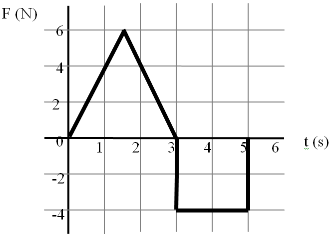
The object's mass is 7 kg. What is the change in velocity of the object at the end of its journey (5 seconds total)?

Round your answer to the hundredth place (2 decimals). Show your work for partial credit. 1 pt for the correct formula but the wrong answer. 2 pts for the correct answer.

1

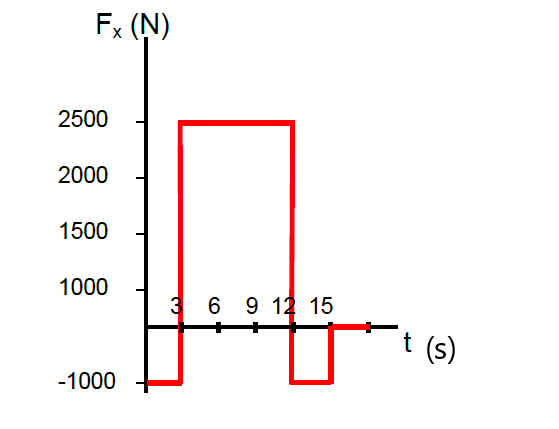
What is the net impulse on the object from 0-15 seconds according to the graph?

Note: There is no partial credit for this question. It is worth 1 point. Please take your time and double-check your work before submitting it.

1

What velocity must a 1340 kg car have in order to have the same momentum as a 2680 kg truck traveling at a velocity of 15 m/s to the west?

1

What is the change in momentum of the white sphere?

1

What is the total momentum before the collision?

1

Is it possible for two objects to have different speeds, yet have the same momentum?

1

How do airbags reduce your chance of getting hurt (decrease the force you experience) during an accident?

1

When comparing the momentum of two moving objects, which of the following is correct?

1

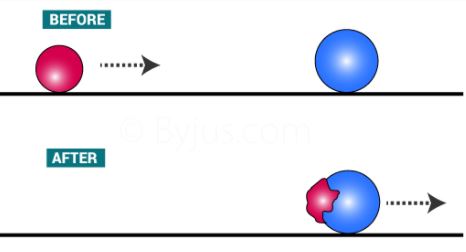
Two objects stick together and move with a common velocity after colliding. Identify the type of interaction.

1

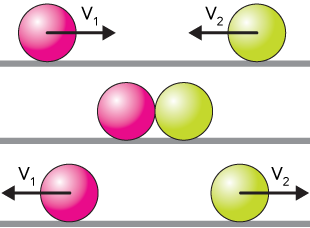
Two objects move separately after colliding, and the total momentum remains constant. Identify the type of interaction.

1

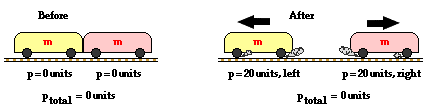
Two objects start together but then separate, and the total momentum remains constant. Identify the type of interaction.

1

A child with a mass of 23 kg rides a bike with a mass of 5.5 kg at a velocity of 4.5 m/s to the south. Compare the momentum of the child with the momentum of the bike.

1

A soccer ball collides with another soccer ball at rest. The total momentum of the soccer balls

1
A positive impulse is created by a(n) __________, which is created by a(n) __________
1

Which of the following objects have momentum? Select all that apply.

Required
1

Consider the interaction between a large cannon and the cannonball that it fires. During the explosion, which object experiences the greatest ...

Cannon
cannonball
both the same
force?
time duration (t) of the force?
impulse (F•t)?
momentum change?
change of velocity?
mass?
acceleration?
Required
1
An average Joe and Cat Woman are in the bumper cars at the amusement park. The man and woman collide face-to-face as shown below.

Before the collision, who has negative momentum? __________.
Who has more momentum before? __________
1

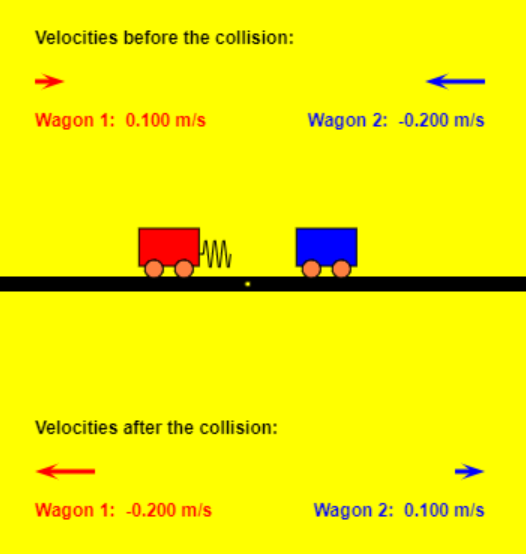
What is true for the velocity of the blue wagon in this collision?

Required
3

Sort the following Physics quantities based on being Scalars or Vectors.

  • speed
  • mass
  • momentum
  • displacement
  • time
  • impulse
  • force
  • velocity
  • acceleration
  • position
  • distance
  • Scalar
  • Vector
1
__________ would be more on Jupiter than on Earth, while __________ will stay the same on Jupiter.
1

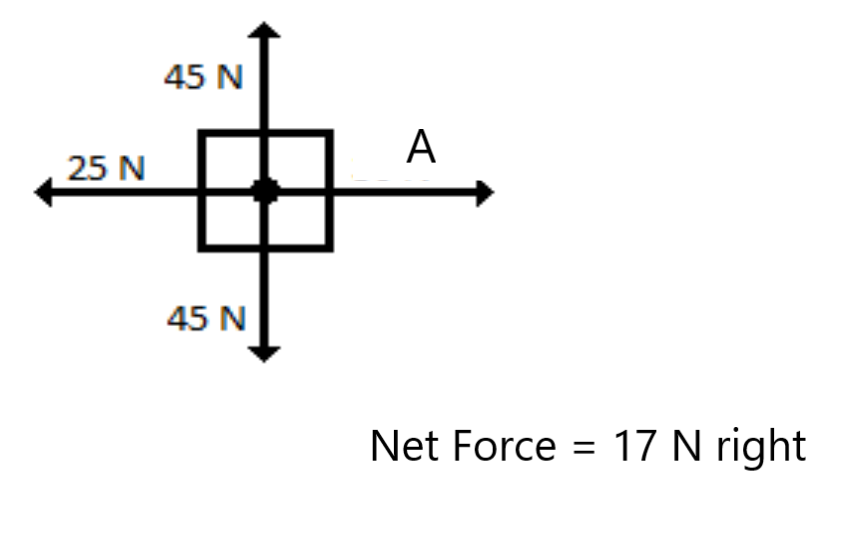
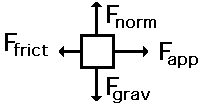
What magnitude must vector A have in order to have a Net Force of 17 N to the right?

1
Draggable itemCorresponding Item
A rightward force is applied to a book in order to move it across a desk with a rightward acceleration.
A rightward force is applied to a book in order to move it across a desk at constant velocity.
A car is coasting to the right and slowing down.
An egg is free-falling from a nest in a tree.
A flying squirrel is moving through the sky with terminal velocity.
1


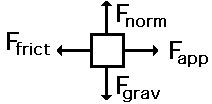
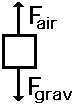
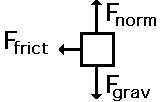
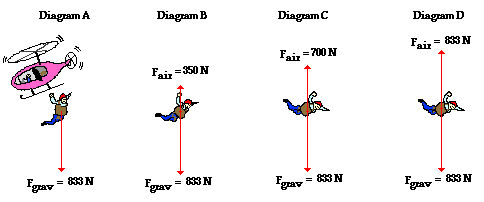
Sort each diagram based on the topics below.

  • A
  • B
  • C
  • D
  • Balanced forces acting on person
  • Person is accelerating
  • Diagram with terminal velocity
1

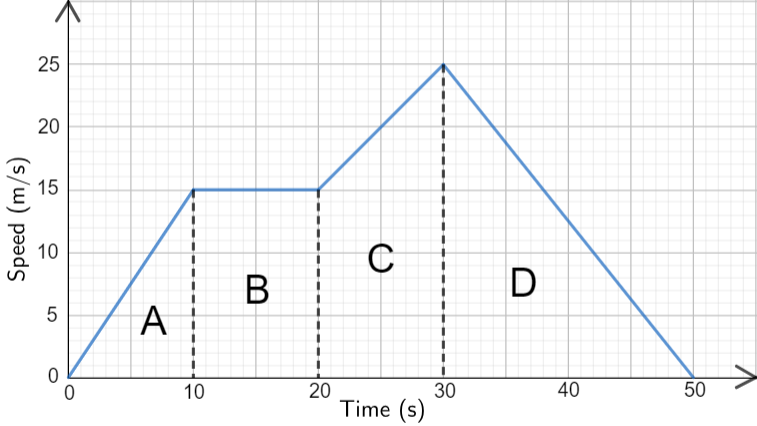
Which is true for the Speed Time Graph above?

1

What is the acceleration of the person from 0 to 10 seconds?

1


In which section(s) do you have a constant positive velocity?

1

Sort each characteristic based on the Newton's law that it corresponds to. Each characteristic will be used once.

  • law of inertia
  • law of acceleration
  • law of action-reaction
  • objects will continue doing what they are currently during until an unbalanced force acts on it
  • the acceleration of an object depends on the force applied and the mass of it
  • forces always act in equal and opposite directions
  • A passenger in a moving car who is not wearing a seat belt will be thrown forward when the car suddenly stops because he remains in motion.
  • It takes a smaller extra force to propel a small yacht at sea than to propel a supertanker because the latter has a greater mass than the former.
  • When you push on a wall, the wall pushes back on you.
  • Newton's First Law of Motion
  • Newton's 2nd Law of Motion
  • Newton's 3rd Law of Motion
1

Projectiles: Horizontal vs Vertical

  • velocity is constant
  • acceleration is 0 m/s/s
  • velocity is changing
  • acceleration is -9.8m/s/s
  • Horizontal
  • Vertical