Conservation of Matter Lab
star
star
star
star
star
Last updated over 1 year ago
12 Nsɛmmisa
Invisible ink may not be obvious to the naked eye, but pen scratches and
abnormalities on the paper can be telltale signs of its presence. Some inks are easier
to develop than others, which means anyone with knowledge of invisible inks may be able to decode your message.
Procedure:Part A
1. Add 1⁄2 cup of water to cup
2. Add 1 spoon full of baking soda
3. Stir until the baking soda is dissolved. This is your invisible ink.
4. Use a cotton swab to write a message or draw a picture on white paper.
5. Let the ink dry.
Observations: What does your paper look like? Describe using your senses (smell, sight, and sound), every sense except for touch and taste.
6. Write you name in a regular pencil or pen and put it to the side.
Procedure: Part B
7. Use a cotton swab to brush the grape juice over the paper and observe what happens.
Observations: What does your paper look like? Describe using your senses (smell, sight, and sound), every sense except for touch and taste.
Phenomena: What happens to the mass of an object when a chemical reaction occurs?
Materials: water bottle, balloon, vinegar, baking soda, spoon,
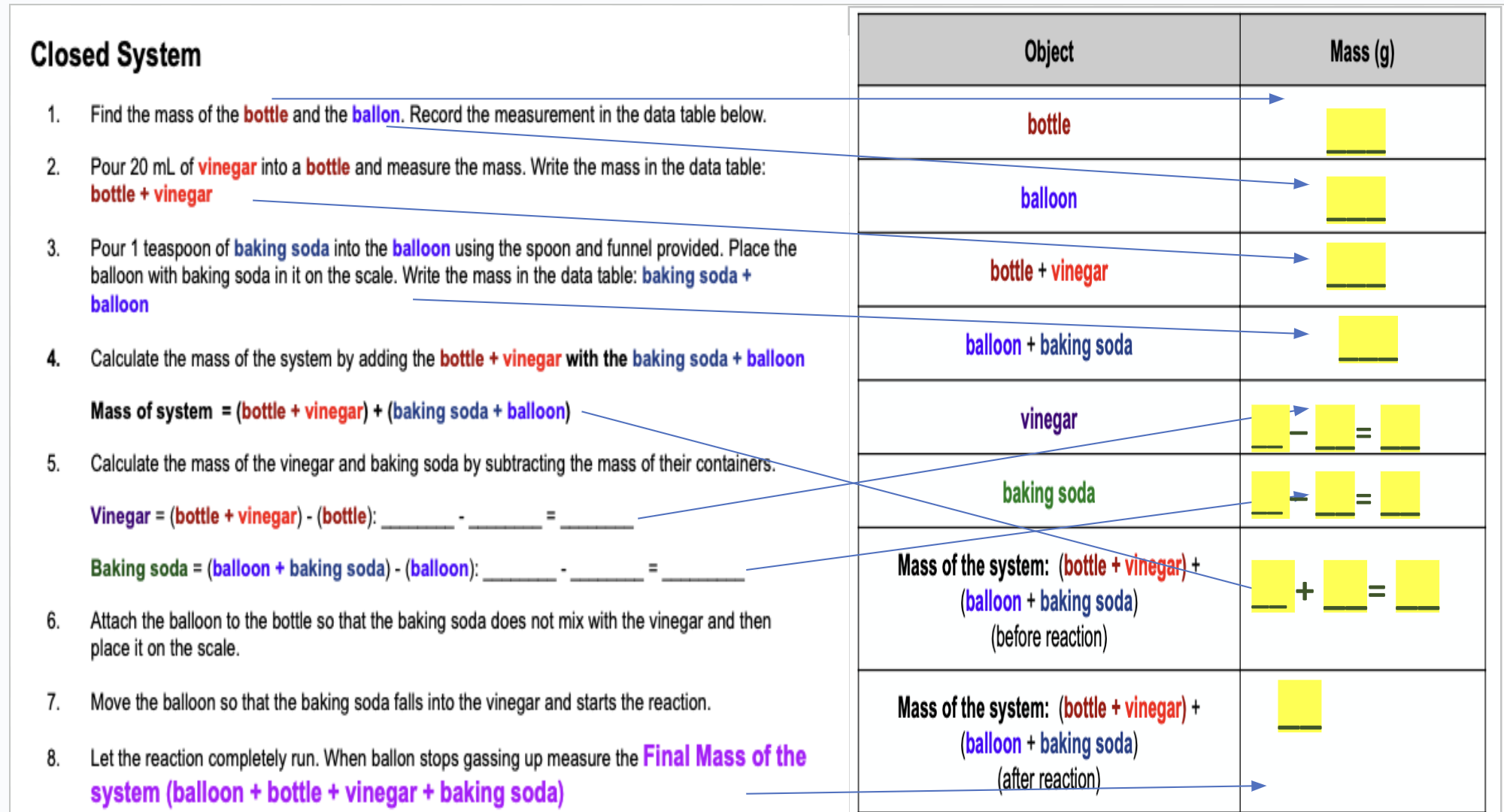
FOR THIS LAB..
YOU MUST WEAR SAFETY GOGGLES, GLOVES. IF YOU GET ANY LIQUIDS IN YOUR EYES. RINSE UNDER WATER FOR 15-20 minutes
COMPLETE THIS DATA TABLE AS YOU DO THE LAB
What was a sign that a chemical reaction took place. There may be more than one.
What was the mass of the system before and after the reaction?
* Gather from data table you filled out for question 2
Before Reaction:
After Reaction:
Where the masses the same, almost the same, very close, off by just a small amount, or very off?
Did your data support the law of conservation of mass? If so, how? If not, were there any possible explanations as to why? Did something go wrong with the experiment (did someone spill, etc.)
Create a model of the chemical reaction
Paste a picture of your artwork after revealing
Is what you are seeing a physical or chemical change?
One very simple form of invisible ink is heat activated. These inks can be made from many types of organic liquid. Once the message dries on the paper, it is invisible. When the ink is exposed to heat, such as under an iron or over a candle flame or
100-watt light bulb, the acids in the liquid turn a different color and the message becomes visible. You can find many heat-activated invisible inks right inside your kitchen, including clear soda, lemon juice, apple juice, onion juice, milk, soapy water, sugar water, and vinegar.
Today, many amusement parks use light-activated invisible inks. If you need to leave the park, they will stamp your hand, but you may be surprised when you look down to find nothing is there. When you return to the park, they will ask you to put your hand
under a special light, and just like magic, a glowing stamp imprint appears. Light-activated inks work because they contain substances that glow under different types of light, but remain invisible to the naked eye.
Another type of invisible ink is chemically activated. Chemically-activated inks can be made from any two chemical substances that are colorless until mixed with one another. When the message receiver adds the second chemical developer, the chemical reaction between both substances causes the color to change and the message to appear. Vinegar alone can be heat-activated, but if you add red cabbage water instead of heat, it becomes a chemically-activated invisible ink.
Let's imagine you use soapy water to write your message. If someone found your paper, they might use heat, chemicals and ultraviolet light. Since soapy water is reactive to each of these, it wouldn't take them long to reveal your top-secret message.
A) What are the three ways to decode invisible ink?