Preskoči na glavni sadržaj
Prijava
Sign up for FREE
arrow_back
Biblioteka

8.4 Homework Day 4 Graphing & Transforming Quadratic Functions (Vertex Form)

star
star
star
star
star
Posljednje aΕΎuriranje over 2 years ago
7
2
Pitanje 1
1.

a) According to the EOC reference sheet, what is the vertex form of a quadratic function?

b) What transformation is missing from this format?

1
1
5
10
6
Pitanje 6
6.
1
Pitanje 2
2.

Do horizontal transformations affect the x-values or the y-values?

Pitanje 3
3.

Do vertical transformations affect the x-values or the y-values?

Pitanje 4
4.

The quadratic function {𝒇(𝒙)=𝒙^πŸβˆ’πŸ‘} undergoes two different dilations, creating {π’ˆ(x)}and {𝒉(𝒙)}, as shown below.
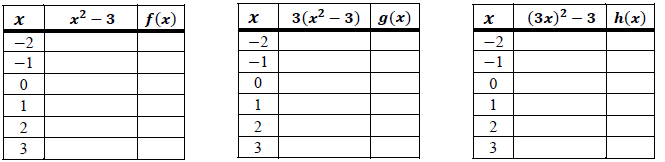
Complete the tables on paper. Upload your work below. (no work = no credit)

{\bold a)} Name the transformation for {g(x)}.

by a factor of

{\bold b)} Name the transformation for {h(x)}.

by a factor of

{\bold c)} Which has a more extreme effect on quadratic functions: vertical or horizontal dilations?

Pitanje 5
5.

Given a function {𝑓(π‘₯)}, decide what transformation is shown in each of the following, and what the result on the graph would be by circling the given options.

Vertical

Horizontal

Stretch

Compress

Reflection

Steeper

Flatter

𝑔(π‘₯)=𝑓(βˆ’8π‘₯)

𝑔(π‘₯)=2𝑓(π‘₯)

𝑔(π‘₯)=𝑓(2π‘₯)

𝑔(π‘₯)=𝑓(βˆ’π‘₯)

𝑔(π‘₯)=\frac{1}{2}𝑓(π‘₯)

𝑔(π‘₯)=𝑓(\frac12π‘₯)

𝑔(π‘₯)=βˆ’2𝑓(π‘₯)

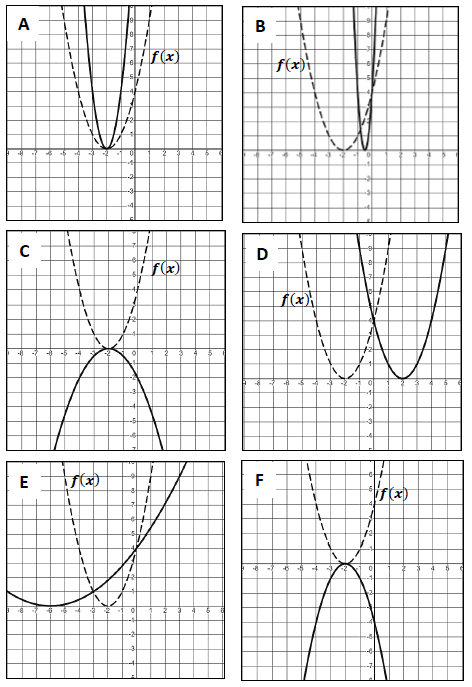
Suppose that the graph of the function 𝑓(π‘₯) (shown with a dashed line) is dilated in different ways.

Match each graph to its dilation.

{-f(x)}

{4f(x)}

{f(-x)}

{f(\frac 13x)}

{-\frac 14f(x)}

{f(4x)}

Pitanje 7
7.

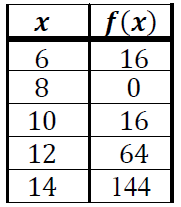
Several points on the graph of a quadratic function {𝒇(𝒙)} are shown in the table.

Identify the table for the transformed function defined by {𝒉(𝒙)= βˆ’\fracπŸπŸπ’‡(𝒙)}.