8.4 Homework Day 2 Graphing & Transforming Quadratic Functions (Vertex Form)

Last updated almost 2 years ago
9 questions
1
What is vertex form of a quadratic function?
{f(x)=}_______
1

Which part of vertex form represents the vertex of the parabola?

1

What transformation is indicated by the variable 𝒉?

1

What transformation is indicated by the variable 𝒌?

8
{\bold a)} {𝑦=(𝑥−8)^{2}−3} vertex: {\Large (}_______,_______{\Large )}

{\bold b)} {𝑦=-(𝑥+9)^{2}} vertex: {\Large (} _______,_______{\Large )}

{\bold c)} {𝑦=\frac{2}{3}(𝑥+6)^{2}+7} vertex: {\Large (}_______,_______{\Large )}

{\bold d)} {f(x)=3x^{2}−4} vertex: {\Large (}_______,_______{\Large )}
4
Describe the effect the transformation has on {𝑓(𝑥)}, and name the transformation.

{\bold a)}The equation {𝑓(𝑥)=2(𝑥+6)^2}
is transformed into {g(x) = f(x+5)}
Effect: _______ (give direction and magnitude, example left 3)
Name the transformation: _______

{\bold b)} The equation {𝑓(𝑥)=-3(𝑥-2)^2+11}
is transformed into {g(x) = f(x)+7}
Effect: _______ (give direction and magnitude, example left 3)
Name the transformation: _______
5
The equation {𝑓(𝑥)=(𝑥−2)^2−2} is transformed into {𝑔(𝑥)=𝑓(𝑥)−5}.
{\bold a)} vertex of {f(x)}:_______
{\bold b)} y-intercept: _______
{\bold c)} Evaluate {f(1)}. Use symmetry to graph {f(x)} on paper. (Use {f(1)}, the vertex, and y-intercept)

{\bold d)} Describe the effect of {g(x)} on {f(x)}: _______
(give direction and magnitude)
{\bold e)} Name the transformation: _______

{\bold f)} Sketch {𝑔(𝑥)} on the same graph by moving points from {𝑓(𝑥)}: _______ (leave this box empty)
Upload your graph below
3
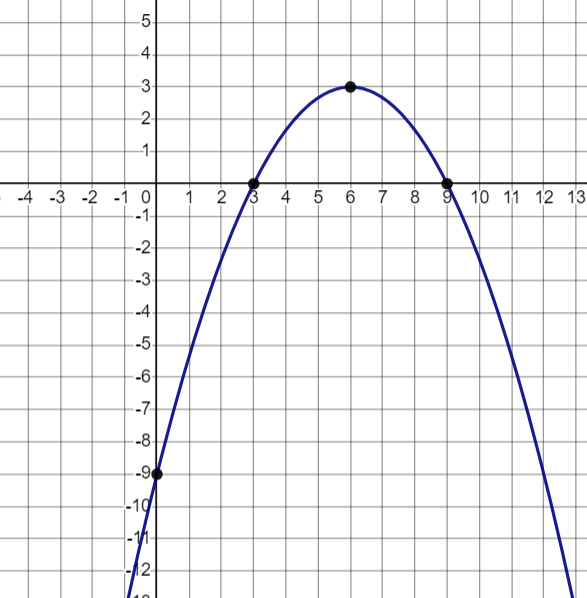
The graph of {f(x)} is shown. Copy this graph to your graph paper. Function {f(x)} is transformed into {𝑔(𝑥)=𝑓(𝑥+7)}.

{\bold a)}Describe the effect of {g(x)} on {f(x)}: _______
(give direction and magnitude)
{\bold b)}Name the transformation: _______

{\bold c)} Sketch g(x) on the same graph: _______ (leave this box empty)
Upload your graph below.
3
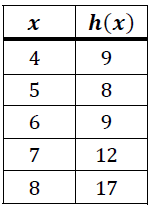
Several points on the graph of the quadratic function {ℎ(𝑥)} are shown in the table. Suppose this function is transformed into {ℎ(𝑥)+4}.

{\bold a)} Name the transformation: _______

{\bold b)} Describe the effect on the graph of {h(x)}: _______

{\bold c)} What is the vertex of the transformed function?
(find the vertex in the graph first)
_______