Log in
Sign up for FREE
arrow_back
Library
#3. The Periodic Table: Outcome A3
By Andrew Wilson
star
star
star
star
star
Share
share
Last updated over 1 year ago
12 questions
Add this activity
zoom_in
zoom_in
1
1.3d
1
1.3b
1
1.3b
1
1.3b
1
1.3b
1
1.3b
1
1.3b
zoom_in
1
1.3b
1
1.3a
1
1.3b
1
1.3b
1
1.3b
Question 1
1.
Question 2
2.
Question 3
3.
Question 4
4.
Question 5
5.
Question 6
6.
Question 7
7.
Question 8
8.
Question 9
9.
Question 10
10.
Question 11
11.
Question 12
12.
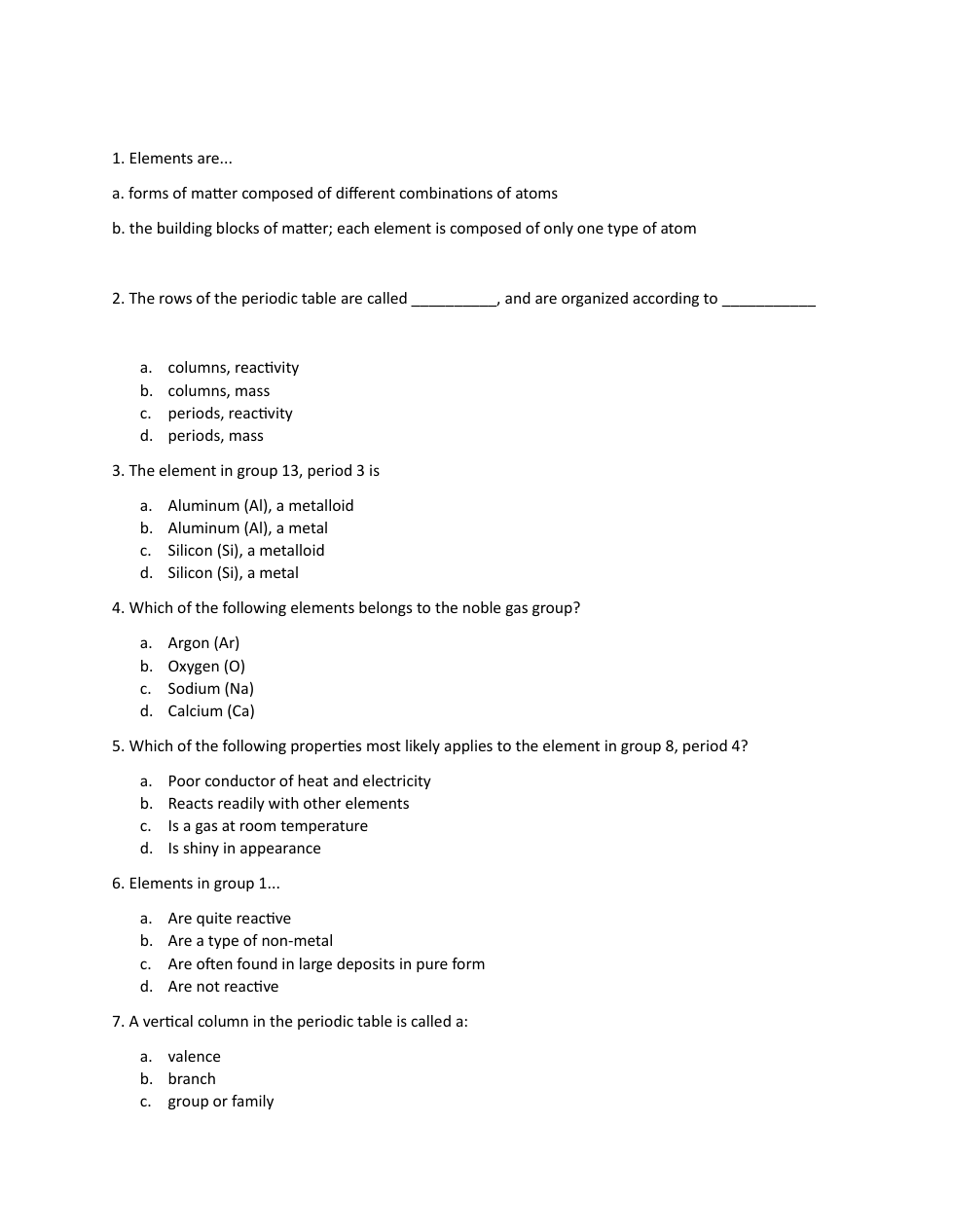
Elements are.....
forms of matter composed of different combinations of atoms
the building blocks of matter; each element is composed of only one type of atom
The rows of the periodic table are called __________, and are organized according to ___________
columns, reactivity
columns, mass
periods, reactivity
periods, mass
The element in group 13, period 3 is
Aluminum (Al), a metalloid
Aluminum (Al), a metal
Silicon (Si), a metalloid
Silicon (Si), a metal
Which of the following elements belongs to the noble gas group?
Argon (Ar)
Oxygen (O)
Sodium (Na)
Calcium (Ca)
Which of the following properties most likely applies to the element in group 8, period 4?
Poor conductor of heat and electricity
Very brittle
Is a gas at room temperature
Is shiny in appearance
Elements in group 1...
Are quite reactive
Are a type of non-metal
Are often found in large deposits in pure form
Are not reactive
A vertical column in the periodic table is called
valence
branch
group or family
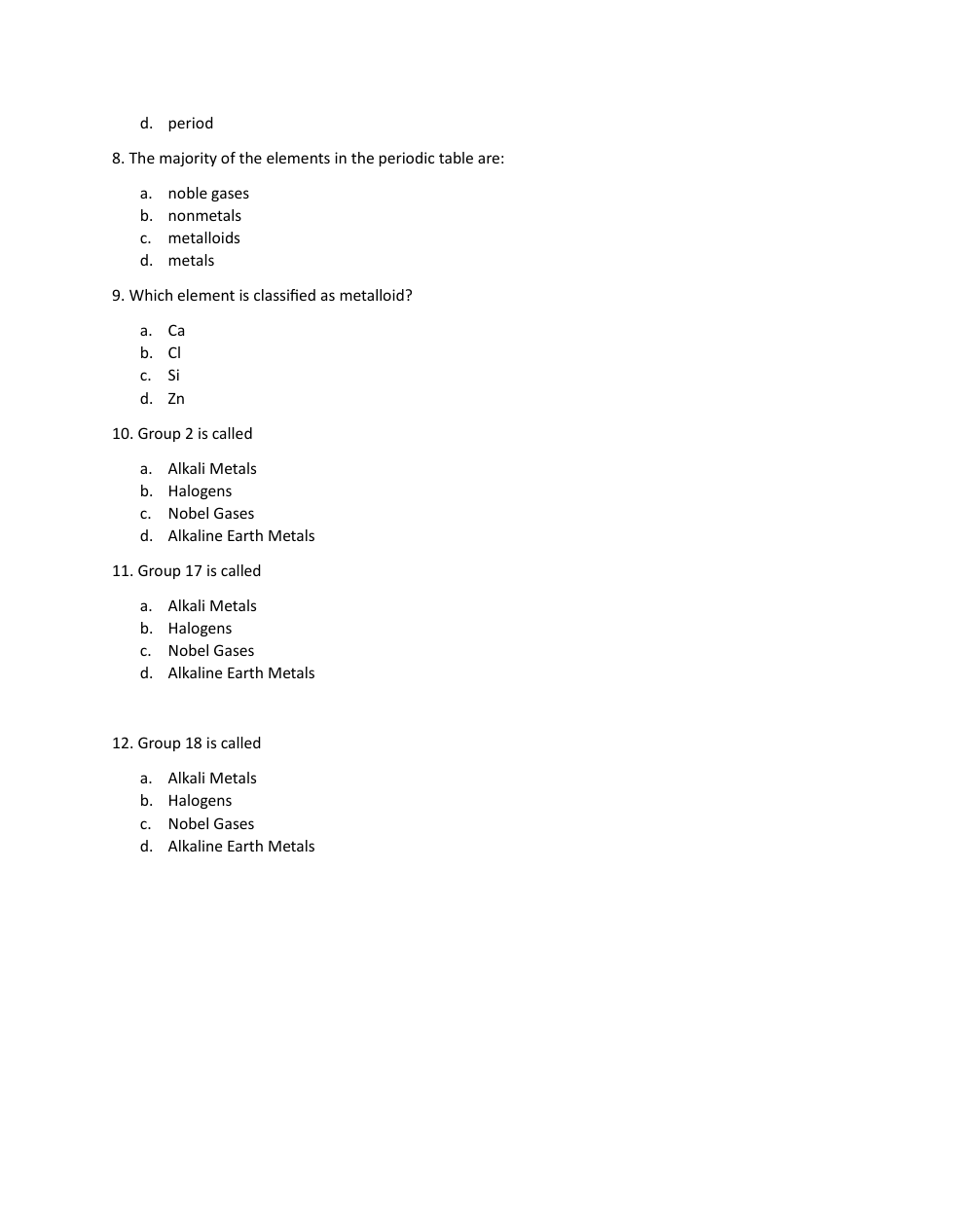
period
The majority of the elements in the periodic table are:
a. noble gases
b. nonmetals
c. metalloids
d. metals
Which element is classified as metalloid?
a. Ca
b. Cl
c. Si
d. Zn
Group 2 is called
a. Alkali Metals
b. Halogens
c. Nobel Gases
d. Alkaline Earth Metals
Group 17 is called
a. Alkali Metals
b. Halogens
c. Nobel Gases
d. Alkaline Earth Metals
Group 18 is called
a. Alkali Metals
b. Halogens
c. Nobel Gases
d. Alkaline Earth Metals