Log in
Sign up for FREE
arrow_back
Library

Quarter 3 Unit 4

star
star
star
star
star
Last updated over 1 year ago
20 questions
LT 4.1 Cell Cycle & Mitosis
1
5.1a
1
5.1a
1
5.1a
1
5.1a
1
5.1a
LT 4.2a Meiosis Stages
1
5.3a
1
5.3a
1
5.3a
1
5.3a
1
5.3a
LT 4.2b Meiosis Variation
1
5.3b
1
5.3b
1
5.3b
1
5.3b
1
5.3b
LT 4.3 Mitosis vs Meiosis
1
5.3c
1
5.3c
1
5.3c
1
5.3c
1
5.3c
Question 1
1.

Question 2
2.

Question 3
3.

Question 4
4.

Question 5
5.

Question 6
6.

Question 7
7.

Question 8
8.

Question 9
9.

Question 10
10.

Question 11
11.

Question 12
12.

Question 13
13.

Question 14
14.

Question 15
15.

Question 16
16.

Question 17
17.

Question 18
18.

Question 19
19.

Question 20
20.

A student using a compound light microscope is observing cells undergoing mitosis. If the cells are from a bean plant, which process could the student observe?
The pairing of homologous chromosomes.
The replication of centrioles
A pinching in of the cell membrane to form two cells.
The formation of a new plate between two new cells
The diagrams below show several events that occur during the process of mitosis. Which sequence represents the correct order of these events?
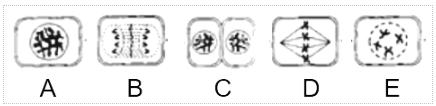
A→ E → B → C → D
B → D → E → A → C
C → A → B → D → E
A → E → D → B → C
The drug colchicine inhibits the formation of spindle fibers during mitosis. If you treat dividing plant cells with colchicine, what would you expect the result to be?
The chromosomes are halved during cell division and the result is a cell that has half the number of chromosomes than it would normally have.
The homologous chromosomes do not pull apart during cell division and the result is a cell that has double the number of chromosomes than it would normally have.
The chromosomes are separated during prophase and each of the four daughter cells receives a haploid number of chromosomes.
The chromosomes do not pull apart in an orderly fashion during cell division and the result is two cells with unequal numbers of chromosomes.
The diploid chromosome number in a certain species of fish is 20. How many chromosomes would normally be found in a bone cell of this fish?
20
10
40
23
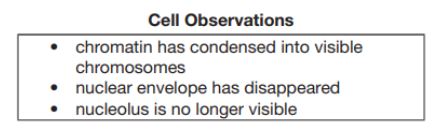
A student looking through a microscope records observations about a cell. Which stage of the cell cycle has the student described?

Prophase
Anaphase
Interphase
Telophase
If a normal diploid cell has 8 chromosomes, then...
there are 8 homologous pairs of chromosomes per diploid cell
there are 4 chromosomes per cell after meiosis
there are 8 chromatids per diploid cell between S phase and the first division of meiosis
sperm cells made from this diploid cell would have 8 chromosomes
Organisms that reproduce asexually have the advantage of being able to quickly colonize a new territory.  Organisms that reproduce sexually have the advantage of____.
exploiting more food sources
larger populations
shelter from the elements
greater genetic diversity
The products of meiosis are ­________ due to ___________:
genetically different; independent assortment of homologous chromosomes
genetically the same; the crossing over of homologous chromosomes
genetically different; the separation of sister chromatids
genetically the same; DNA replication in the S phase
Meiosis results in
4 haploid daughter cells
2 diploid daughter cells
4 diploid daughter cells
2 haploid daughter cells
Meiosis occurs only in germ cells to allow for the production of _______________ cells, also know as _________ in males and ______________ in females.
Gametic, sperm, eggs
Somatic, eggs, sperm
Gametic, eggs, sperm
Somatic, sperm, eggs
Which of the following best explains how meiosis is a contributing factor to genetic variation within a species?
Meiosis increases the number of chromosomes in daughter cells leading to new gene combinations
Meiosis allows for crossing over of chromosomes and independent assortment, resulting in new gene combinations
Meiosis reduces the number of mutations within an organism
Meiosis allows for crossing over of chromosomes and independent assortment, resulting in identical genes
The DNA content of a diploid cell is measured in the G1 phase. After meiosis, the DNA content of one of the two cells produced would be
Equal to that of the G1 cell
One fourth that of the G1 cell
Twice that of the G1 cell
One half that of the G1 cell
Which of the following statements is true about meiosis in humans?
The process begins in males and females at the same time
Females produce far more gametes than males do
Sperm and ova (egg) are not identical to the parent cells that produced them
Meiosis in males creates genetic diversity, but not in females
As a result of fertilization, which of the following normally occurs?
A single sperm and ovum (egg) combine their genetic material to create a haploid zygote
A single sperm and ovum (egg) combine their genetic material to create a diploid zygote
A gamete is created
The final phase of spermatogenesis is begun
What is one important result of chromosomal crossing-over during meiosis?
an increase in the amount of genetic variation within a population that can improve its ability to survive
a decrease in the frequency of genetic mutations and a limit to the diversity of traits within a species
a decrease in the number of chromosome pairs that can be passed from each parent to its offspring
an increase in the likelihood of having gametes in offspring that are genetically the same as their parents
Which of the following is a characteristic of BOTH mitosis and meiosis?
Divides twice
Produces body cell
Cell division
Makes 2n Cells
Mitosis and meiosis are processes involved in cellular reproduction. Which of the following describes an event that results from mitosis but NOT meiosis?
Two stages of cell division
our daughter cells that are produced from each parent cell
Daughter cells that are identical to the parent cell
Replication of cellular genetic material (DNA replication)
Unlike mitosis which produces _________________, meiosis results in the formation of _____.
two genetically identical cells; four genetically different cells
four genetically identical cells; two genetically different cells
two genetically different cells; four genetically different cells
Which process allows a mammal to continue to grow in size?
Mitosis of body cells
Meiosis of sex cells
Meiosis of body cells
Mitosis of sex cells
Which of the following statements about the difference between mitosis and meiosis is TRUE?
both processes produce two daughter cells
daughter cells in meiosis are identical to the parents cells
both processes undergo two cell divisions
homologous chromosome pairs line up only in meiosis