Ɛhia
1
In what years did the Three Governor's Controversy take place?
In what years did the Three Governor's Controversy take place?
Ɛhia
1
According to the video, how did Ellis Arnall defeat Eugene Talmadge?
Ellis Arnall's four years as governor of Georgia (1943-47) are considered to be among the most progressive and effective in the modern history of the state. Arnall undertook an ambitious ten-point reform program that was approved by the legislature within twenty-four days of his assuming the governorship—a record still unequalled in Georgia. He accomplished these and other democratic reforms and, in the process, paid off a state debt of $36 million.
Arnall's rise to political power is one of the most remarkable chapters in the state's political history. The thirty-five-year-old Arnall defeated Eugene Talmadge to become the youngest governor in the nation.
In 1942 Arnall ran against Governor Eugene Talmadge, who was seeking reelection. Talmadge's interference in the running of the state's university system, in what became known as the Cocking affair, had resulted in the loss of accreditation of most of the state's public colleges. On this issue, the thirty-five-year-old Arnall defeated Talmadge to become the youngest governor in the nation.
Gubernatorial Accomplishments
Arnall provided four years of progressive reform, replacing the state's "Tobacco Road" national image with that of a progressive and forward-looking state. As governor, Arnall successfully led efforts to restore accreditation to Georgia's institutions of higher learning. He reformed the state penal system, repealed the poll tax, lowered the voting age, revised the state constitution, established a teachers' retirement system, and paid off the long-existing state debt, and promised to end gubernatorial dictatorship in the state. Arnall led efforts to create eight constitutional boards in an effort to reduce the power of the governor. He also created a merit system for state employees and the State Ports Authority.
Arnall successfully led the South's fight against discriminatory railroad freight rates, which had hampered the region's industrial development. As a result of his reform program, members of the national press found themselves in the unusual position of praising rather than condemning a governor of Georgia.
Political Downfall
Just as remarkable as Arnall's political ascendancy was his political decline. Most damaging to Arnall's political career was his stance on allowing blacks to vote in the state's white primaries. A federal district court held that the state's white primaries were unconstitutional. Arnall refused to follow the examples of other southern states, which tried to evade the court's mandate. His inaction allowed the Eugene Talmadge faction to denounce him as a traitor to the white race. Many white Georgians believed Arnall was too liberal on the race issue, and a politically revived Talmadge won the 1946 primary by promising to restore the state's white primary. Many also resented Arnall's best-selling books, The Shore Dimly Seen (1946) and What the People Want (1948), and his nationwide lecture tour that, they believed, belittled the South.
The white primary was used by Southern whites to keep African-Americans from voting in the Democratic primary. Due to the fact that Georgia was a one-party state at the time, the Democratic primary was essentially the election, thus keeping African-Americans or Blacks from truly voting. In 1944, several African-Americans, led by Dr. Thomas Brewer and Primus E. King, a barber and minister, attempted to vote in the white primary in Columbus, Georgia. King was told that he could not vote and was forcefully removed from the court house. In 1945, Brewer, King, and several other African-Americans sued the state. In the court case King v. Chapman et al., the federal district court ruled in favor of King and said the white primary was unconstitutional. Governor Ellis Arnall, did not fight the ruling and the white primary ended in Georgia.
What was the white primary used for? How did it disenfranchise Black voters?
Which court case led to the end of the white primary? What was the ruling in the case?
How did Ellis Arnall respond to the ruling?
In what years did the Three Governor's Controversy take place?
Paragraph V. Succession to executive power.
(a) In case of the temporary disability of the Governor as determined in the manner provided in Section IV of this article, the Lieutenant Governor shall exercise the powers and duties of the Governor and receive the same compensation as the Governor until such time as the temporary disability of the Governor ends.
(b) In case of the death, resignation, or permanent disability of the Governor or the Governor-elect, the Lieutenant Governor of the Lieutenant Governor-elect, upon becoming the Lieutenant Governor, shall become the Governor until a successor shall be elected and qualified as hereinafter provided. A successor to serve for the unexpired term shall be elected at the next general election; but, if such death, resignation, or permanent disability shall occur within 30 days of the next general election or if the term will expire within 90 days after the next general election, the Lieutenant Governor shall become Governor for the unexpired term. No person shall be elected or appointed to the office of Lieutenant Governor for the unexpired term in the event the Lieutenant Governor shall become Governor as herein provided.
What is the main duty of the Lieutenant Governor?
If the Governor dies during his or her term, how do they pick a new governor?
Drag the tiles to the description it matches
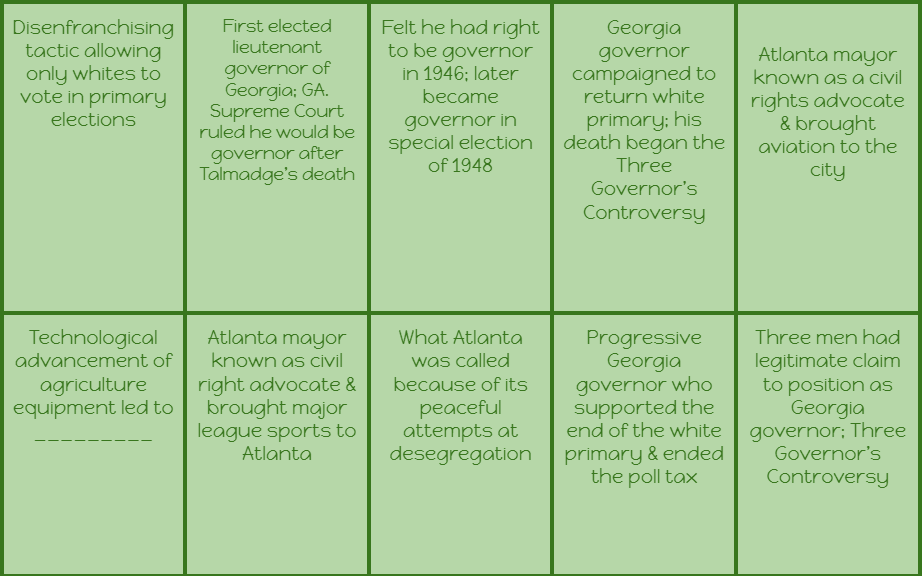
William B. Hartsfield
White Primary
Population shift from rural to urban
Eugene Talmadge
Ivan Allen, Jr.
1946 Governor’s Race
Ellis Arnall
Herman Talmadge
“The City Too Busy to Hate”
Melvin B. Thompson
How was Ellis Arnall different than Eugene Talmadge?
How many terms did Arnall serve as governor?
What type of governor was Ellis Arnall
What were Arnall's accomplishments? CHOOSE SIX
What led to Ellis Arnall's downfall? CHOOSE THREE
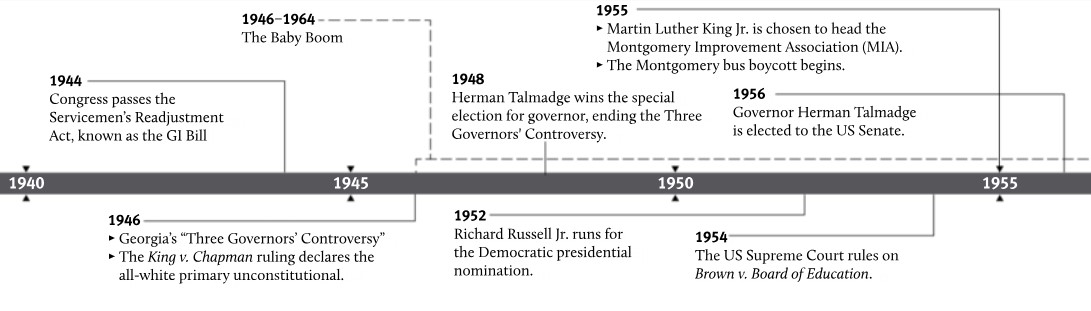
After the King v. Chapman case declared the white primary unconstitutional, how many years went by before MLK started the Montgomery Bus Boycott?
One of the more embarrassing episodes in Georgia’s history was the 1946 governor’s race, also known as the “Three Governors Controversy.” This episode made Georgia a nationwide laughing stock. More importantly, this election led to a series of segregationist governors who ended some of the progressive reforms made by Governor Ellis Arnall.
As the name implies, after the 1946 election three men claimed the governor’s office. Initially, Eugene Talmadge was elected for his fourth term. However, he died before taking office. Many of Eugene Talmadge’s supporters believed that, due to his poor health, he may die before he could be sworn in as governor.
They discovered that, based on past Georgia law, the General Assembly would have the power to select the second or third leading vote-getter if the governor-elect died before taking office. With this in mind, many secretly wrote in Herman Talmadge for governor.
However, the new Georgia Constitution stated that the lieutenant governor would take office if the governor died. In the 1946 election, Melvin Thompson, who was a member of the anti-Talmadge faction of the Democratic Party, was elected lieutenant governor and claimed the office for himself upon Talmadge’s death. Nonetheless, in January of 1947, the General Assembly selected Herman Talmadge as governor.
During the same time, the outgoing governor, Ellis Arnall, refused to relinquish the office until the issue was resolved as he believed that the General Assembly did not have the authority to elect a governor. Due to Arnall’s affiliation with the anti-Talmadge Democrats, physical altercations resulted with some of Talmadge’s followers. Talmadge eventually had state troopers escort Arnall out of the State Capitol and changed the locks of the governor’s office. Arnall, in turn, refused to give up the governor’s seal and set up a second “governor’s office” in a different location of the State Capitol.
Arnall finally gave up his claim to the governorship and supported Thompson. In the end, the Georgia Supreme Court ruled that Thompson was the rightful governor and Talmadge left the governor’s office within two hours of the ruling. A special election was called in 1948 and Herman Talmadge narrowly defeated Thompson.
Note: Eugene Talmadge ran on a platform to reinstate the white primary and was elected for a fourth term.
How did the Three Governor's controversy make Georgia look to the rest of the nation?
Who was elected for his fourth term in the 1946 governor’s race?
Why didn't Talmadge take office after his election?
What happened after the death of Eugene Talmadge?
Who refused to give up the governor’s office, leading to the Three Governors Controversy?
What was Melvin Thompson elected as?
Who was ruled the rightful governor by the Georgia Supreme Court?
How was the Three Governor's controversy finally resolved?