Log in
Sign up for FREE
arrow_back
Library

3.1.2 PAD and ABI

star
star
star
star
star
Last updated 4 months ago
14 questions
10
10
10
10
10
10
10
10
10
10
10
10
10
10
Question 9
9.

When the blood vessels that carry oxygen and nutrients from your heart to the rest of your body (arteries) become thick and stiff it is called

Question 10
10.

The buildup of fats, cholesterol and other substances in and on your artery walls (plaques), which can restrict blood flow is called

Question 11
11.

Question 12
12.

Question 13
13.

Question 14
14.

After an ABI test what additional test might the doctor complete to determine to confirm PAD?

Question 1
1.

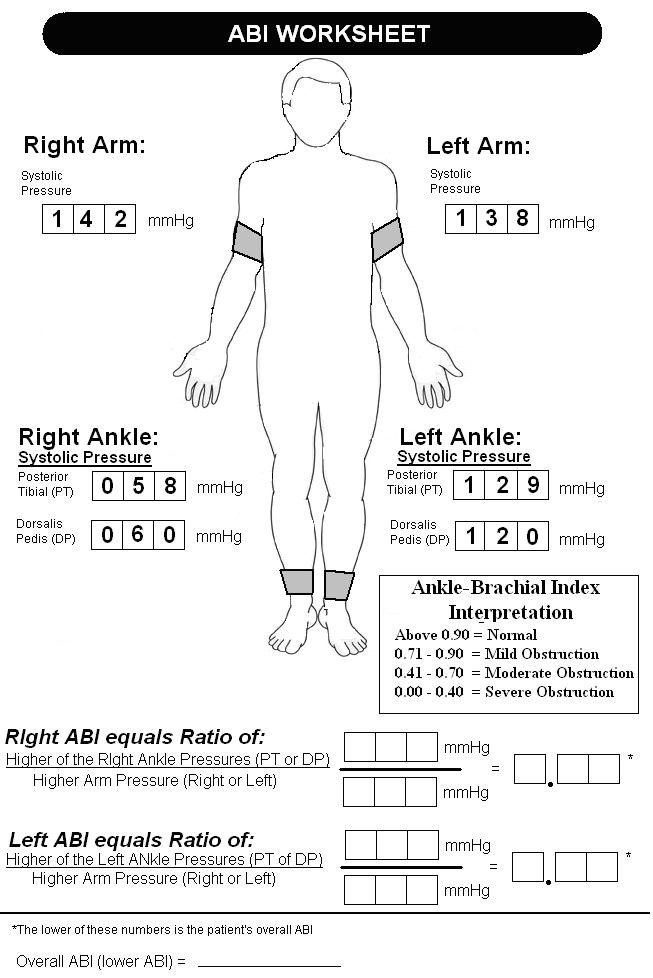
What should go here?

Question 2
2.

What should go here ?

Question 3
3.

What should go here?

Question 4
4.

What should go here?

Question 5
5.

What should go here?

Question 6
6.

What should go here? (remember to round correctly)

Question 7
7.

What is the overall ABI?

Question 8
8.

Atherosclerosis is a specific type of arteriosclerosis
True
False
What is most likely occurring inside your patient's leg to cause this increase in peripheral pressures?
there artery has been partially blocked due to a build up of plaque
the blood flow to the leg has been restricted
smoking has damaged the blood vessels
all of these
If the narrowing of the artery worsens which of the following is correctly matched to describe a medical intervention that could be used to treat the problem and prevent a possible future amputation of the leg
Angiogram - In this procedure, a small hollow tube (catheter) is threaded through a blood vessel to the affected artery. There, a small balloon on the tip of the catheter is inflated to reopen the artery and flatten the blockage into the artery wall, while at the same time stretching the artery open to increase blood flow.
Thrombolytic therapy - In this procedure, a small hollow tube (catheter) is threaded through a blood vessel to the affected artery. There, a small balloon on the tip of the catheter is inflated to reopen the artery and flatten the blockage into the artery wall, while at the same time stretching the artery open to increase blood flow.
Angioplasty- In this procedure, a small hollow tube (catheter) is threaded through a blood vessel to the affected artery. There, a small balloon on the tip of the catheter is inflated to reopen the artery and flatten the blockage into the artery wall, while at the same time stretching the artery open to increase blood flow.
Bypass surgery - In this procedure, a small hollow tube (catheter) is threaded through a blood vessel to the affected artery. There, a small balloon on the tip of the catheter is inflated to reopen the artery and flatten the blockage into the artery wall, while at the same time stretching the artery open to increase blood flow.
How would you interpret these results?
Normal
Mild Obstruction
Moderate Obstruction
Severe Obstruction