Cell membranes questions
star
star
star
star
star
Last updated almost 2 years ago
15 questions
Formative Generation Completed!
1
Which of the following is a function of the cell membrane?
1
The cell membrane is selectively permeable, allowing only certain substances to pass through.
1
Name one type of transport process that occurs across the cell membrane.
1
Which of the following components make up the cell membrane? (Select all that apply)
1
The cell membrane is a rigid structure that remains stable at all times.
3
Cells are surrounded by a plasma membrane that contains phospholipids. Explain how the structure of phospholipid molecules allows for the formation of plasma membranes.

1
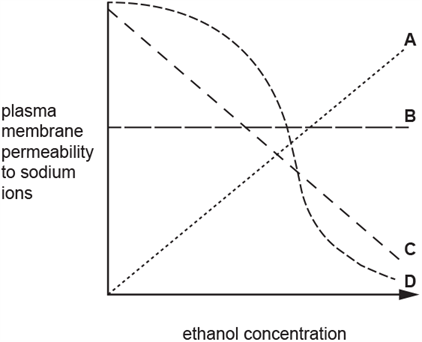
Which of the lines, A to D, in the graph represents the effect of increasing ethanol concentration on the permeability of the plasma membrane to sodium ions?

1
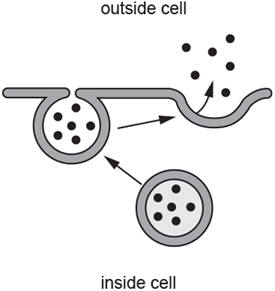
The diagram shows one method of transport across a cell membrane. Which method of transport is this?

1
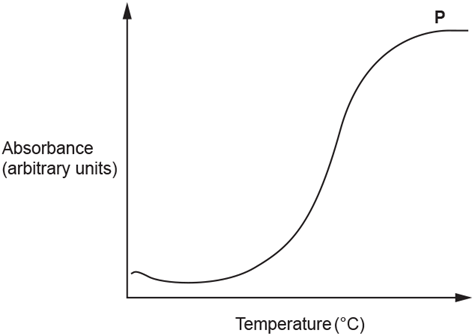
The graph shows reading from a colorimeter as pigment leaks out of beetroot membranes at different temperatures. Which statement explains why the absorbance stops increasing at point P?

4
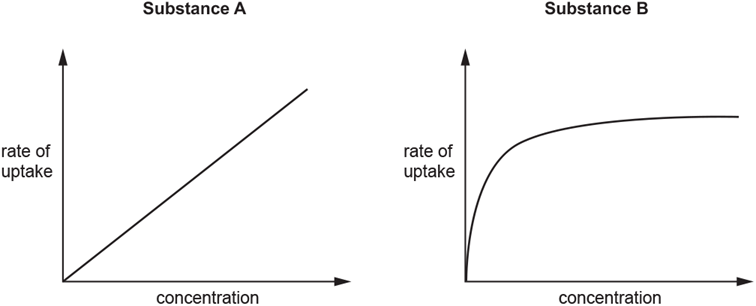
A student investigated the uptake of two different substances in cultured cells.
The rate of uptake was measured at different concentrations of each substance in the medium surrounding the cells. i. The student concluded that one substance entered the cells by simple diffusion and the other by active transport.
Evaluate the student’s conclusion.
A student investigated the uptake of two different substances in cultured cells.
The rate of uptake was measured at different concentrations of each substance in the medium surrounding the cells.
i. The student concluded that one substance entered the cells by simple diffusion and the other by active transport.
Evaluate the student’s conclusion.
4
i. The student then added 2,4-dinitrophenol (DNP) to the cells. DNP inhibits respiration.
Predict the effect of DNP on the uptake of each substance and explain your prediction.
i. The student then added 2,4-dinitrophenol (DNP) to the cells. DNP inhibits respiration.
Predict the effect of DNP on the uptake of each substance and explain your prediction.

1
Which label, A to D, indicates the component of the membrane that can affect its fluidity?
1
What determines the direction of osmosis?
1
How does osmosis affect cells?
1
What is the result of osmosis in a hypertonic solution?