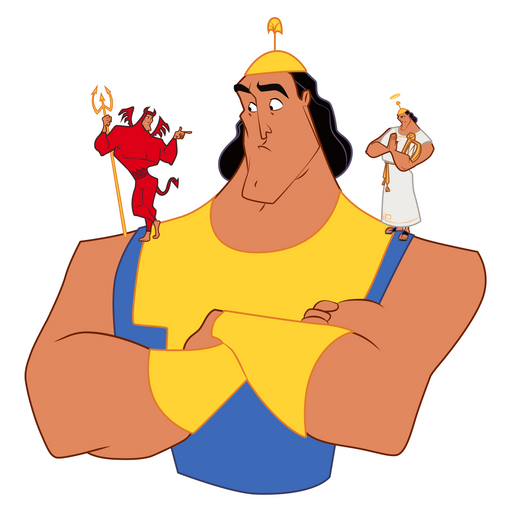
In the movie, The Emperor's New Groove Kronk has two warring angels on either shoulder guiding him towards right and wrong...
This is an example of...
1 point
1
Question 2
2.
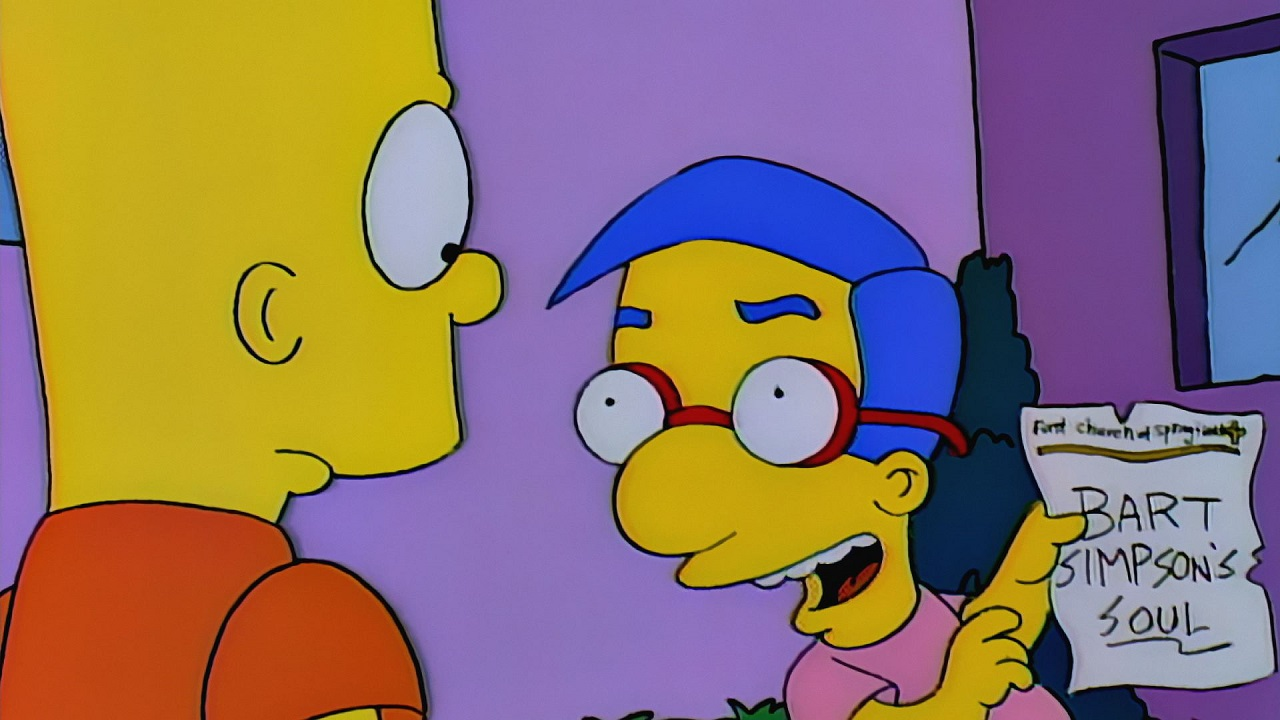
In the Simpsons episode, "Bart Sells His Soul", Bart scornfully dismisses the idea of "a soul" and makes a Faustian deal with his friend Milhouse, trading his soul for $5. He then spends the rest of the episode in agony debating his decision...
This is an example of...
1 point
1
Question 3
3.
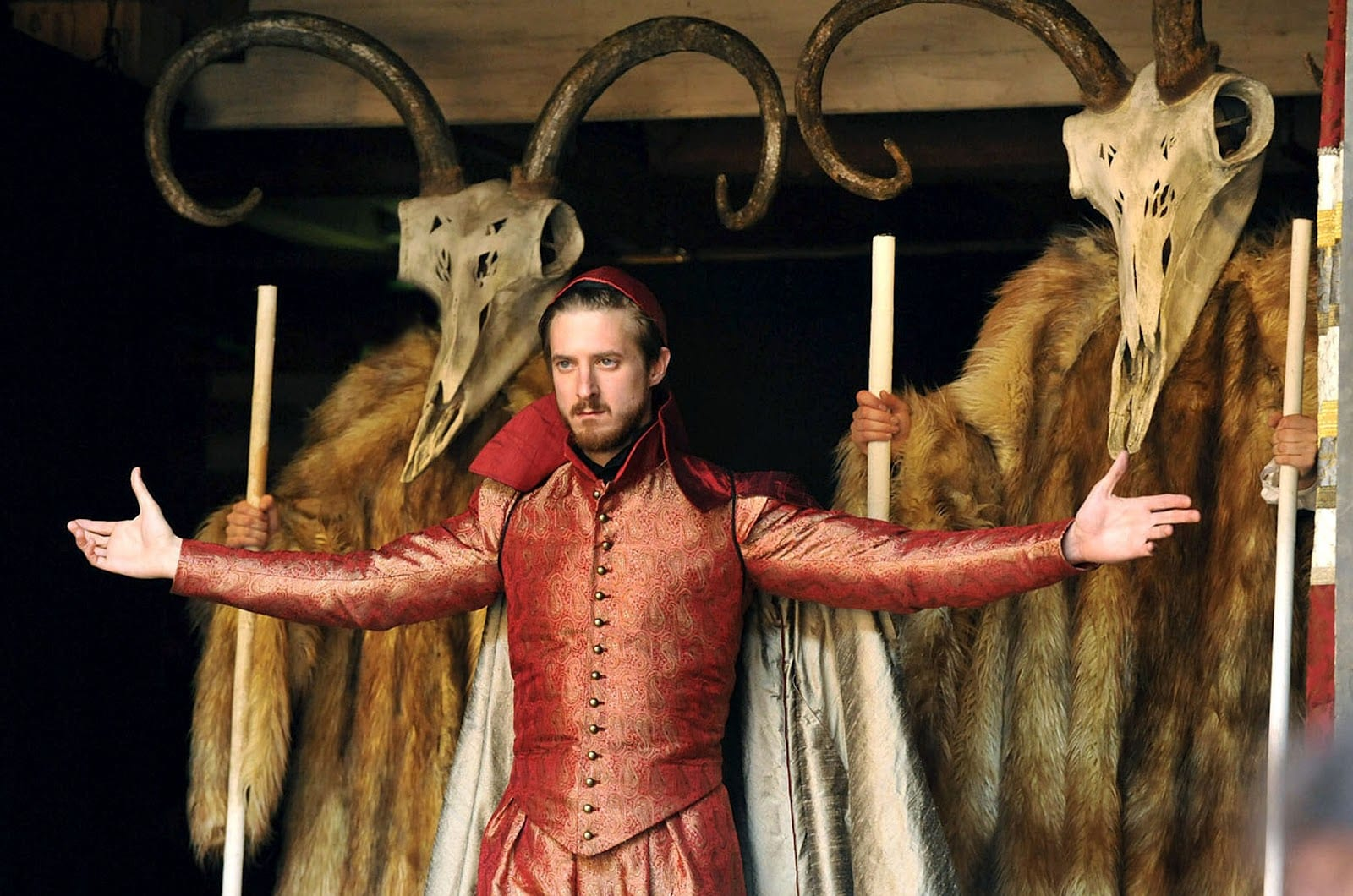
In the The Globe production of Doctor Faustus, when Mephistopheles first arrives, Faustus says he is "too ugly" to serve him and commands he return in a form that better suits his role on earth - returning dressed as in religious attire of the clergy.
Mephistopheles and Faustus' attire (as well as scenes throughout with members of the clergy) together form Marlowe's ______ of the Church and its corruption in the 16th century.
This is an example of...
1 point
1
Question 4
4.
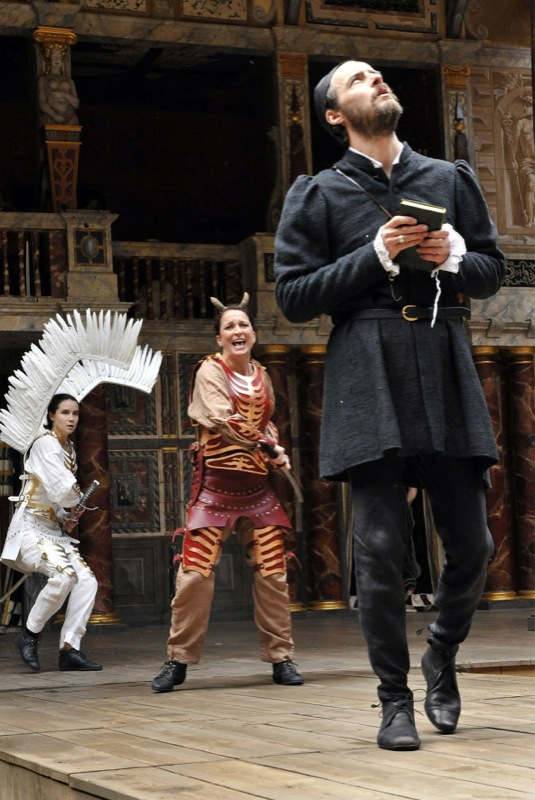
In the The Globe production of Doctor Faustus, the Good and Evil Angel are dressed in armor and fight with swords to illustrate the __________ of Spiritual Warfare over Faustus' soul.
This is an example of...
1 point
1
Question 5
5.
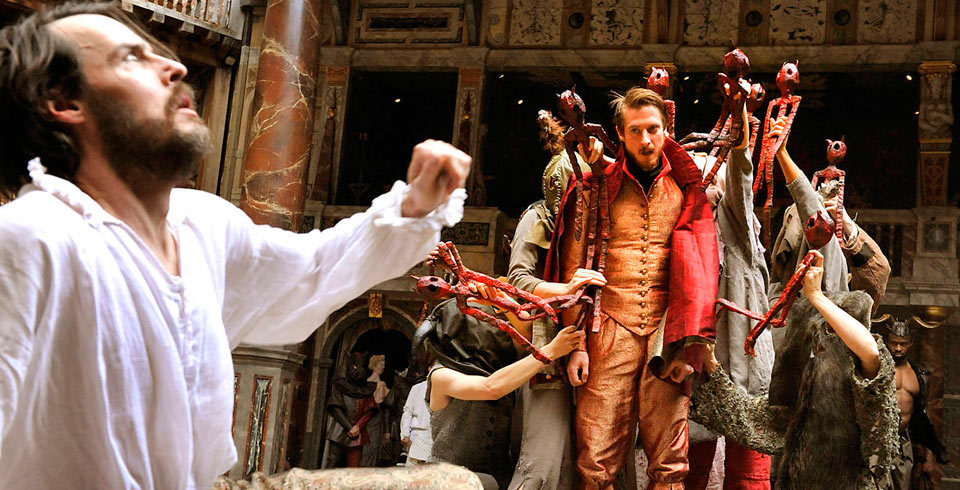
In the The Globe production of Doctor Faustus, Faustus refuses to acknowledge the physical presence of hell, despite having summoned a demon from hell and physical evidence of its existence...
The _____ of this situation creates suspense and tension throughout the play.
This is an example of...
1 point
1
Question 6
6.
Marlowe uses ______ to scripture in Faustus' monologues to make his blasphemy and heresy more obvious to the audience and more dramatic.
1 point
1
Question 7
7.
Marlowe uses ______ in between scenes to keep his audience entertained and invested in such a dark and serious tragedy.
1 point
1
Question 8
8.
In addition, Marlowe employs the above literary device because it is a key part of _________, the genre form that is being _____ in Doctor Faustus.
1 point
1
Question 9
9.
This genre of writing typically relied heavily on all of the following EXCEPT
1 point
1
Question 10
10.
Common tropes of this genre include all of the following EXCEPT
1 point
1
Question 11
11.
The purpose of this genre is...
1 point
1
Question 12
12.
Marlowe uses a mocking, cynical tone that is disdainfully or scornfully humorous to express an uncomfortable truth in a clever (or humorously malicious) way, often with a degree of skepticism.
This type of tone is called _______ .
1 point
1
Question 13
13.
Marlowe's play would best be described as ____________ .
1 point
1
Question 14
14.
Which of the following was NOT one of Marlowe's inspirations for writing Doctor Faustus.
1 point
1
Question 15
15.
The story of Doctor Faustus was partially based on a German legend and popular story of a real person named Faust.
1 point
1
Question 16
16.
Christopher Marlowe was arrested (and likely killed) for heresy and criticisms of the church.
1 point
1
Question 17
17.
The devil Mephistopheles was a character from Dante's Inferno and is a direct reference to that text.
1 point
1
Question 18
18.
In Doctor Faustus, Faustus trades his soul for immortality.
1 point
1
Question 19
19.
In Doctor Faustus, Faustus is compared to Icarus, who flies too close to the sun on wings of wax and falls from the sky.
1 point
1
Question 20
20.
In Doctor Faustus, Faustus is compared to Orpheus, who journeys to the underworld to save his lost wife (unsuccessfully).
1 point
1
Question 21
21.
In Doctor Faustus, Faustus is compared to Prometheus, who is punished for possessing knowledge/power that was forbidden by the gods.
1 point
1
Question 22
22.
Faustus writes and signs the contract without fully understanding the consequences or implications and banking on his ability to find a loophole in time.
1 point
1
Question 23
23.
Faustus attempts to break the contract by tricking Mephistopheles into saying "God" - something Meph. can't do - and thereby not upholding the contract.
1 point
1
Question 24
24.
This ploy works and Faustus is freed from the contract, but Faustus chooses of his own free will to continue collaborating with Mephistopheles in evil.
1 point
1
Question 25
25.
In Doctor Faustus, Faustus is known in his academic community for being a well renowned Doctor of Medicine.
2 points
2
Question 26
26.
Doctor Faustus claims his has mastered which of the following disciplines at the START of the play? Check all that apply (4)
1 point
1
Question 27
27.
Throughout the play, Faustus compares his desire for knowledge to what metaphorically?
1 point
1
Question 28
28.
How does Faustus wrestle with his choices (and ultimately convince himself not to repent)?
1 point
1
Question 29
29.
In a tragedy, the ________ has a ____________.
1 point
1
Question 30
30.
building on the previous question, Faustus' [_______] is...
1 point
1
Question 31
31.
How does Mephistopheles (and Lucifer) distract Faustus from repenting?
1 point
1
Question 32
32.
Considering the previous question, this detail allegorically implies what deeper meaning?
1 point
1
Question 33
33.
Faustus learns magic and these dark arts, as well as spells and incantations from...
1 point
1
Question 34
34.
Considering the previous question, this detail allegorically implies what deeper meaning?
10 points
10
Question 35
35.
Match the character from Faustus to its allegorical deeper meaning or purpose:
Draggable item
arrow_right_alt
Corresponding Item
Wagner and Clowns
arrow_right_alt
the scholar/individual tempted by forbidden or dangerous knowledge
Valdes and Cornelius
arrow_right_alt
temptations of this earth that keep us from spiritual redemption
The Pope / Friars
arrow_right_alt
salvation, the voice of God/mercy
The "horse-courser," knight, etc.
arrow_right_alt
damnation, the voice of Evil/temptation
Scholars
arrow_right_alt
comic relief and humor
Faustus
arrow_right_alt
those who study with or under us and are influenced by our example
Evil Angel / Mephistopheles
arrow_right_alt
the wrong friends, the ones that lead us astray and down dangerous roads
7 Deadly Sins
arrow_right_alt
those who are directly impacted by our actions, who are negatively affected
Good Angel / Old Man
arrow_right_alt
the Church as an organization
The Emperor / Duke
arrow_right_alt
power and authority as a construct
1 point
1
Question 36
36.
Based on the opening and closing scenes of the play, this play is a(n) ____ of Faustus.
1 point
1
Question 37
37.
Which quote below best captures the key allegorical deeper meaning of this play?
1 point
1
Question 38
38.
This dialogue is an example of Faustus convincing himself using which Logical Fallacy?
"Faustus: Tell me, where is the place that men call hell?
Mephistopheles: Under the heavens.
Faustus: Ay, but whereabout?
Mephistopheles: Within the bowels of these elements, where we are tortured and remain forever, hell hath no limits, nor is circumscribed in one self place; for where we are is hell, and where hell is there must we ever be...
Faustus: Come, I think hell's a fable.... Think'st thou that Faustus is so fond [of himself] to imagine that after this life there is any pain? Tush; these are trifles and mere old wives tales..
Mephistopheles: But Faustus, I am in instance to prove the contrary, for I am damned, and now in hell.
Faustus: How! Now in hell? Nay and this be hell, I'll willingly be damned here; what? walking, disputing, etc?"
1 point
1
Question 39
39.
This dialogue is an example of Faustus using which Logical Fallacy?
Mephistopheles: Thinkest thou that I who saw the face of God, And tasted the joys of heaven, am not tormented with ten thousand hells, in being deprived of everlasting bliss? O, Faustus, leave these frivolous demands, which strike terror to my fainting soul.
Faustus: What, is great Mephistopheles so passionate for being deprived of the joys of heaven? Learn thou of Faustus manly fortitude, and scorn those joys of heaven."
1 point
1
Question 40
40.
This excerpt is an example of Faustus using which TWOLogical Fallacies?
Faustus: A surfeit of deadly sin that hath damned both body and soul.... Faustus' offense can never be pardoned. The serpent that tempted Eve may be saved, but not Faustus.
1 point
1
Question 41
41.
This dialogue is an example of Wagner using which Logical Fallacy?
Wagner: Will thou serve me [Clown]? ...Sirrah, leave your jesting, and bind yourself presently unto me for seven years, or I'll turn all the lice about thee into [devils] and they shall tear thee into pieces
1 point
1
Question 42
42.
In the beginning of the play, Faustus convinces himself of the following syllogism:
The consequences of sin is death.
If we say we have no sin, we deceive ourselves (all men sin)
Therefore, all men must be damned to everlasting death.
Line one and two of this syllogism are direct quotes from scripture... but Faustus forgets (or intentionally omits) the second half of each verse. Here's how it should read:
"The wages of sin is death,
but the gift of God is eternal life through Jesus Christ, Our Lord" (Romans 6:23)
"If we say that we have no sin, we deceive ourselves;
If we confess our sins, He is faithful and just to forgive us our sins." (I John 1:8)
Therefore, any man who confesses his sins and accepts Christ as their savior is saved.
This logical fallacy is an example of...
1 point
1
Question 43
43.
As opposed to Faustus' logic, by contrast Mephistopheles and Lucifer rely on _________ to persuade Faustus against repenting.
EXCERPT 1
Enter Helen
Faustus: Was this the face
that launched a thousand ships?
And burnt the topless towers of [Troy]?
Sweet Helen, make me immortal with a kiss.
Her lips suck forth my soul; see where it flies.
Come, Helen, come give me my soul again.
Here will I dwell, for heaven be in these lips,
And all is dross that is not Helena.
I will be Paris, and for love of thee,
Instead of Troy shall Wertenberg be sacked,
And I will combat with weak Menelaus,
And wear thy colours on my plumed crest;
Yea, I will wound Achilles in the heel,
And then return to Helen for a kiss.
O, thou art fairer than the evening air,
Clad in the beauty of a thousand stars,
...More lovely than the monarch of the sky
...And none but thou shalt be my paramour."
1 point
1
Question 44
44.
Why does Faustus want Helen as his bride on his final day?
1 point
1
Question 45
45.
Faustus' summoning of Helen makes Marlowe's _____ of Helen real.
1 point
1
Question 46
46.
Which of the following is the STRONGEST analytical statement?
EXCERPT 2
[The clock strikes eleven.]
(1) O Faustus,
Now hast thou but one bare hour to live,
And then thou must be damn’d perpetually!
Stand still, you ever-moving spheres of heaven,
That time may cease, and midnight never come;
Fair Nature’s eye, rise, rise again, and make
Perpetual day; or let this hour be but
A year, a month, a week, a natural day,
That Faustus may repent and save his soul!
(2) O lente, lente currite, noctis equi!
[O slowly, slowly run, horses of the night]
The stars move still, time runs, the clock will strike,
The devil will come, and Faustus must be damn’d.
O, I’ll leap up to heaven!—Who pulls me down?—
See, where Christ’s blood streams in the firmament!
One drop of blood will save me: O my Christ!—
Ah, rend not my heart for naming of my Christ;
Yet will I call on him: O, spare me, Lucifer!—
Where is it now? ’tis gone:
And see where God stretcheth out his arm,
And bends his ireful brows.
Mountains and hills, come, come, and fall on me,
And hide me from the heavy wrath of heaven!
No no, then will I headlong run into the earth:
Gape, earth! O, no, it will not harbour me!
(3) You stars that reigned at my nativity,
Whose influence hath allotted death and hell,
Now draw up Faustus, like a foggy mist,
Into the entrails of yon labouring cloud[s],
That, when you vomit forth into the air,
My limbs may issue from your smokey mouths;
But let my soul mount and ascend to heaven!
[The clock strikes the half-hour.]
(4) O, half the hour is past! ‘twill all be past anon.
O, if my soul must suffer for my sin,
Impose some end to my incessant pain;
Let Faustus live in hell a thousand years,
A hundred thousand, and at last be sav’d!
No end is limited to damned souls.
Why wert thou not a creature wanting soul?
Or why is this immortal that thou hast?
O, Pythagoras’ metempsychosis, were that true,
This soul should fly from me, and I be changed
Into some brutish beast!
All beasts are happy, for, when they die,
Their souls are soon dissolved in elements;
But mine must live still to be plagued in hell.
Cursed be the parents that engendered me!
No, Faustus, curse thyself, curse Lucifer
That hath deprived thee of the joys of heaven.
[The clock strikes twelve.]
(5) It strikes, it strikes! Now, body, turn to air,
Or Lucifer will bear thee quick to hell!
O soul, be chang’d into small water-drops,
And fall into the ocean, ne’er be found!
[ Thunder. Enter DEVILS. ]
My God, my God, look not so fierce on me!
Adders and serpents, let me breathe a while!
Ugly hell, gape not! come not, Lucifer;
I’ll burn my books!—Ah, Mephistophilis!
1 point
1
Question 47
47.
In paragraph 1, what is Faustus's tone?
1 point
1
Question 48
48.
In paragraph 2, what does Faustus mean by "O lente, lente currite, noctis equi!" [O slowly, slowly run, horses of the night]
1 point
1
Question 49
49.
In paragraph 2 and 3, Faustus cries out to ________ to hide him from damnation.
1 point
1
Question 50
50.
In paragraph 4, Faustus...
1 point
1
Question 51
51.
In this monologue, what is keeping Faustus from repenting and asking for forgiveness?
1 point
1
Question 52
52.
Throughout this whole monologue, Faustus is begging for...
1 point
1
Question 53
53.
Faustus repents and accepts Christ as his savior, but is damned to hell anyway.
EXCERPT 3
“Faustus is gone; regard his hellish fall,
Whose fiendful fortune may exhort the wise,
Only to wonder at unlawful things,
Whose deepness doth entice such forward wits,
To practice more than heavenly power permits.”
1 point
1
Question 54
54.
Which of the following BEST paraphrases the first two lines?
1 point
1
Question 55
55.
Which of the following BEST paraphrases lines 3-5?
1 point
1
Question 56
56.
According to these last lines of the play, why is knowledge dangerous?
1 point
1
Question 57
57.
According to these last lines of the play, what should the audience BEWARE of allegorically?
EXCERPT from The Screwtape Letters, by C.S. Lewis
Background: In The Screwtape Letters, a devil uncle, Screwtape, writes encouraging letters to his devil nephew, Wormwood, giving advice on how to better corrupt the souls of mankind.
_______________________________________________
Chapter 1
My dear Wormwood,
(1) I note what you say about guiding your patient’s reading and taking care that he sees a good deal of his materialist friend. But are you not being a trifle naïve? It sounds as if you supposed that argument was the way to keep him out of the Enemy’s clutches. That might have been so if he had lived a few centuries earlier. At that time the humans still knew pretty well when a thing was proved and when it was not; and if it was proved they really believed it. They still connected thinking with doing and were prepared to alter their way of life as the result of a chain of reasoning. But what with the weekly press and other such weapons we have largely altered that. Your man has been accustomed, ever since he was a boy, to have a dozen incompatible philosophies dancing about together inside his head. He doesn’t think of doctrines as primarily “true” or “false”, but as “academic” or “practical”, “outworn” or “contemporary”, “conventional” or “ruthless”. Jargon, not argument, is your best ally in keeping him from the Church. Don’t waste time trying to make him think that materialism is true! Make him think it is strong, or stark, or courageous — that it is the philosophy of the future. That’s the sort of thing he cares about.
(2) The trouble about argument is that it moves the whole struggle onto the Enemy’s own ground. He can argue too; whereas in really practical propaganda of the kind I am suggesting He has been shown for centuries to be greatly the inferior of Our Father Below. By the very act of arguing, you awake the patient’s reason; and once it is awake, who can foresee the result? Even if a particular train of thought can be twisted so as to end in our favour, you will find that you have been strengthening in your patient the fatal habit of attending to universal issues and withdrawing his attention from the stream of immediate sense experiences. Your business is to fix his attention on the stream. Teach him to call it “real life” and don’t let him ask what he means by “real”.
(3) Remember, he is not, like you, a pure spirit. Never having been a human (Oh that abominable advantage of the Enemy’s!) you don’t realise how enslaved they are to the pressure of the ordinary. I once had a patient, a sound atheist, who used to read in the British Museum. One day, as he sat reading, I saw a train of thought in his mind beginning to go the wrong way. The Enemy, of course, was at his elbow in a moment. Before I knew where I was I saw my twenty years’ work beginning to totter. If I had lost my head and begun to attempt a defence by argument I should have been undone. But I was not such a fool. I struck instantly at the part of the man which I had best under my control and suggested that it was just about time he had some lunch. The Enemy presumably made the counter-suggestion (you know how one can never quite overhear what He says to them?) that this was more important than lunch. At least I think that must have been His line for when I said “Quite. In fact much too important to tackle at the end of a morning”, the patient brightened up considerably; and by the time I had added “Much better come back after lunch and go into it with a fresh mind”, he was already halfway to the door. Once he was in the street the battle was won. I showed him a newsboy shouting the midday paper, and a No. 73 bus going past, and before he reached the bottom of the steps I had got into him an unalterable conviction that, whatever odd ideas might come into a man’s head when he was shut up alone with his books, a healthy dose of “real life” (by which he meant the bus and the newsboy) was enough to show him that all “that sort of thing” just couldn’t be true. He knew he’d had a narrow escape and in later years was fond of talking about “that inarticulate sense for actuality which is our ultimate safeguard against the aberrations of mere logic”.He is now safe in Our Father’s house.
(4) You begin to see the point? Thanks to processes which we set at work in them centuries ago, they find it all but impossible to believe in the unfamiliar while the familiar is before their eyes. Keep pressing home on him the ordinariness of things. Above all, do not attempt to use science (I mean, the real sciences) as a defence against Christianity. They will positively encourage him to think about realities he can’t touch and see. There have been sad cases among the modern physicists. If he must dabble in science, keep him on economics and sociology; don’t let him get away from that invaluable “real life”. But the best of all is to let him read no science but to give him a grand general idea that he knows it all and that everything he happens to have picked up in casual talk and reading is “the results of modern investigation”. Do remember you are there to fuddle him. From the way some of you young fiends talk, anyone would suppose it was our job to teach!
Your affectionate uncle,
Screwtape
1 point
1
Question 58
58.
In Paragraphs 1 and 2, Screwtape coaches his nephew to...
1 point
1
Question 59
59.
In paragraph 3, Screwtape...
1 point
1
Question 60
60.
Who is "The Enemy" in paragraph 3?
1 point
1
Question 61
61.
The bolded line at the end of paragraph 3 is an example of
1 point
1
Question 62
62.
In paragraph 4, Screwtape ...
1 point
1
Question 63
63.
What is C.S. Lewis' purposein writing The Screwtape Letters?
1 point
1
Question 64
64.
The Screwtape Letters are an example of...
1 point
1
Question 65
65.
Similar to this person being described in this text, Faustus is also distracted from salvation by...