Log in
Sign up for FREE
arrow_back
Library

Partner Test Ch. 5

star
star
star
star
star
Last updated over 1 year ago
25 questions
Required
2
Required
2
Required
2
Required
2
Required
2
Required
3
Required
2
Required
2
Required
2
Required
2
Required
2
Required
2
Required
4
Required
2
Required
2
Required
2
Required
2
Required
2
Required
2
Required
2
Required
4
Required
3
Required
3
Required
3
Required
0
Question 1
1.

Which of the following are discrete random variables?

Question 2
2.

The probability distribution below is for the random variable X = the number of questions correct on a randomly chosen 3 question quiz.


Is X a discrete or a continuous random variable? Explain.

Question 3
3.

The probability distribution below is for the random variable X = the number of questions correct on a randomly chosen 3 question quiz.

Show that the probability distribution of X is valid.

Question 4
4.

The probability distribution below is for the random variable X = the number of correct questions on a randomly chosen three question quiz.

Compute the expected value of X. Show work on the recording document.
What does this mean? (Interpret the expected value)

Question 5
5.

The probability distribution below is for the random variable X = the number of correct questions on a randomly chosen three question quiz.

Give the notation for “ the probability of getting at least 2 questions correct" in terms of X and find its probability.

Question 6
6.

Which of the following are conditions for the binomial setting?

Question 7
7.

Binomial Probability:
It is known that 15% of the seniors in a large high school enter military service upon graduation.
If a group of 20 seniors are randomly selected, what is the probability of observing eighteen who will be entering military service?
Which is the correct set up?

Question 8
8.
In a certain large lake 40% of the fish are thrown back because they are too small. Consider catching 20 fish from the lake. Assume that the fish you caught can be considered a random sample from the very large number of fish in the lake.
Let Y = the number of fish that you throw back because they are too small. Explain how Y can be considered a binomial random variable.
B _______
I _______
N _______
S _______
Question 9
9.

In a certain large lake 40% of the fish are thrown back because they are too small. Consider catching 20 fish from the lake. Assume that the fish you caught can be considered a random sample from the very large number of fish in the lake.
Let Y = the number of fish that you throw back because they are too small.
Find the probability that exactly 5 fish are thrown back.
Show your work on your half sheet.
Round to three places.

Question 10
10.

In a certain large lake 40% of the fish are thrown back because they are too small. Consider catching 20 fish from the lake. Assume that the fish you caught can be considered a random sample from the very large number of fish in the lake.
Let Y = the number of fish that you throw back because they are too small.
Calculate (5.4) and interpret the mean of Y.

Question 11
11.

In a certain large lake 40% of the fish are thrown back because they are too small. Consider catching 20 fish from the lake. Assume that the fish you caught can be considered a random sample from the very large number of fish in the lake.
Let Y = the number of fish that you throw back because they are too small.
Calculate (5.4) and interpret the standard deviation of Y. Round to three places past the decimal.

Question 12
12.

Thirty percent of all trucks undergoing a certain inspection will fail the inspection. Assume that 40 trucks are independently undergoing this inspection, one at a time.
The expected number of trucks who fail the inspection is:
Hint: expected value = mean

Question 13
13.
The probability a person is infected by a certain cold virus is 0.3. If a random sample of 12 people is taken, what is the probability that none of the people will be infected by the cold virus? _______ Round to four places past the decimal.
What is the probability that at least one person will be infected by the cold virus? _______
Round to four places past the decimal.
Question 14
14.
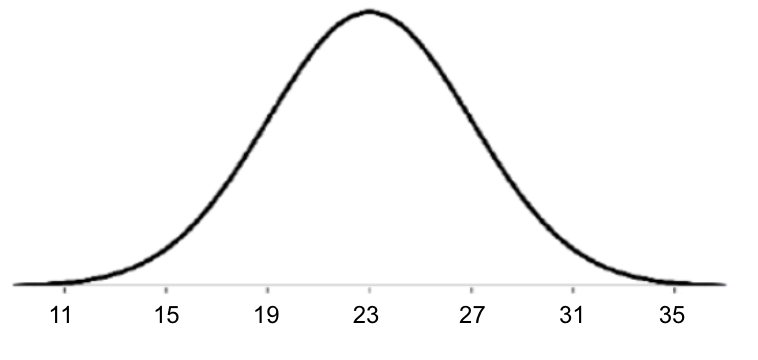
Normal Distribution: Lessons 5.5-5.7 from here on.
Estimate the mean and standard deviation of the normal density curve in the figure.


Mean = _______
Standard Deviation = _______
Question 15
15.

If the foot length of women follows a normal distribution with a mean of 23 cm, and 95% have a foot length between 15 cm and 31 cm, what is your estimate of the standard deviation of the foot lengths in this population?

Question 16
16.

Use the 68-95-99.7 Rule:
A normal distribution has a mean of 0.40 and standard deviation of 0.028. What percentage of observations will lie between 0.344 and 0.456?

Question 17
17.

The heights of a population of women follow a normal distribution, and the middle 95% have heights between 58 inches and 70 inches.
What is your estimate of the mean height in this population?
Hint: sketch a normal curve or look at your flipbook.

Question 18
18.

Which of the following is the closest z-score to the 9th percentile of the standard normal distribution?

Question 19
19.

Which of the following is the closest percentile to a z-score of 1.02 in the standard normal distribution?

Question 20
20.

The proportion of pepperoni pizza orders on a randomly selected day at a local pizza shop is approximately normal with mean 0.26 and standard deviation 0.03.
Let X = the proportion of pepperoni pizza orders on a randomly selected day.

Give the notation for the normal model:

Question 21
21.
The proportion of pepperoni pizza orders on a randomly selected day at a local pizza shop is approximately normal with mean 0.26 and standard deviation 0.03.
Let X = the proportion of pepperoni pizza orders on a randomly selected day. Use the 68–95–99.7 rule to approximate:    
(a) P(X > 0.29) = _______
(b) The probability that the data values of pepperoni pizza orders is
between 0.20 and 0.35= _______
(c) The range for the middle 95% of the data values of pepperoni pizza
orders for a randomly selected day= _______ to _______
Question 22
22.

Professional tennis player Novak Djokovic hits the ball extremely hard. His first-serve speeds follow a normal distribution with mean 112 miles per hour (mph) and standard deviation 6 mph. If you randomly choose one of Djokovic’s first serves at random, let X = its speed, measured in miles per hour.

A first serve with a speed less than 99 miles per hour is considered “slow.”
What percent of Djokovic’s first serves are slow?
Enter your answer as a decimal rounded to three places.

Question 23
23.

Professional tennis player Novak Djokovic hits the ball extremely hard. His first-serve speeds follow a normal distribution with mean 112 miles per hour (mph) and standard deviation 6 mph. If you randomly choose one of Djokovic’s first serves at random, let X = its speed, measured in miles per hour.

A first serve with a speed more than 115.5 miles per hour is considered “fast.”
Round the z score to two places.
What percent of Djokovic’s first serves are fast?
Enter your answer as a decimal rounded to three places.

Question 24
24.

Professional tennis player Novak Djokovic hits the ball extremely hard. His first-serve speeds follow a normal distribution with mean 112 miles per hour (mph) and standard deviation 6 mph.

Find the speed for the slowest 10.5% of Novak Djokovic’s first-serve speeds.
Keep all decimal places.

Question 25
25.

BONUS:
Professional tennis player Novak Djokovic hits the ball extremely hard. His first-serve speeds follow a normal distribution with mean 112 miles per hour (mph) and standard deviation 6 mph. Choose one of Djokovic’s first serves at random.
Let X = its speed, measured in miles per hour.

Find the speed for the fastest 4% of Novak Djokovic’s first-serve speeds.
Keep all decimal places.